Die Neue Sammlung Brand Guidelines
An exhibition title that became a museum’s name.
Aa
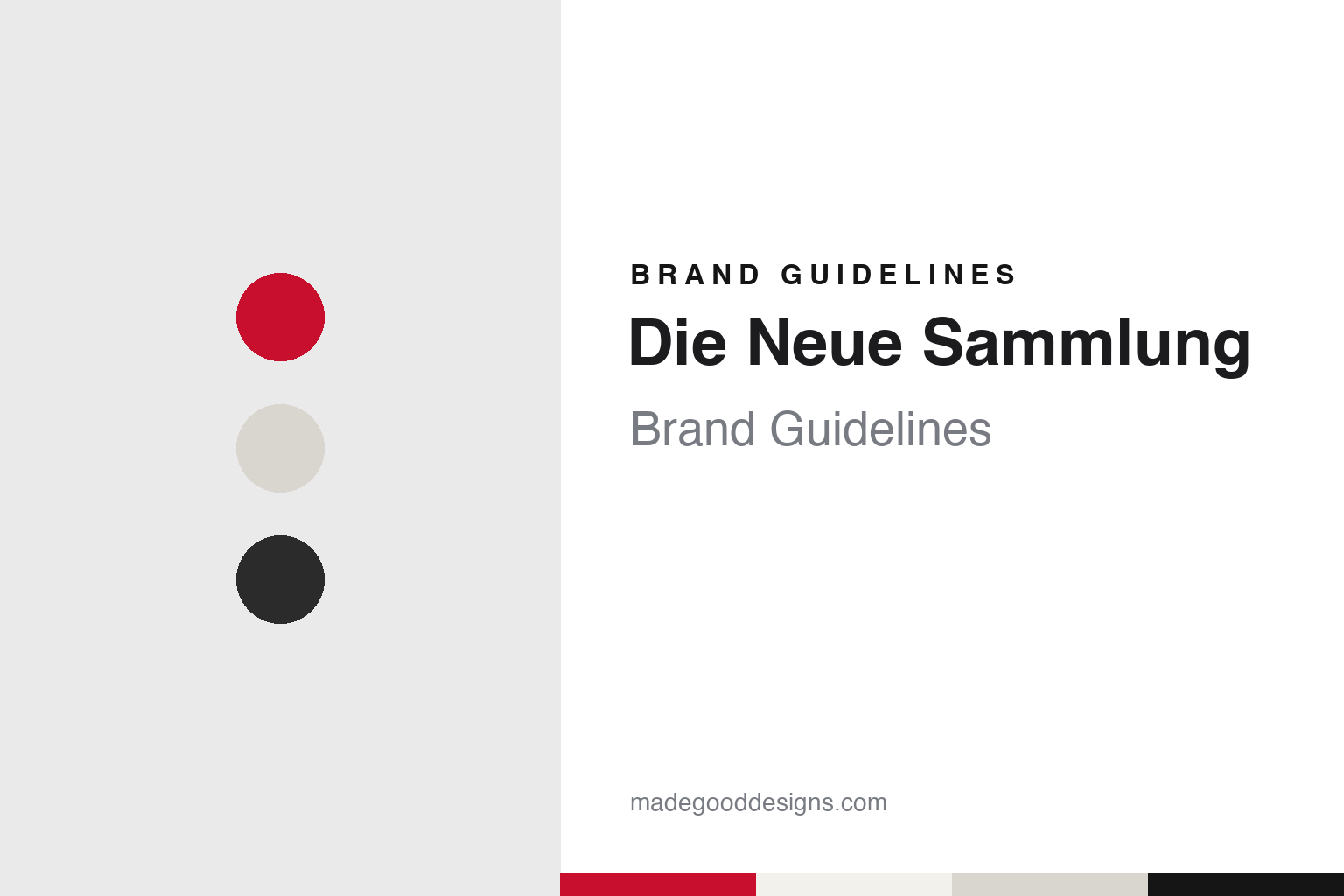
Two constants: a black, concrete grey, poster red and plaster white palette and a Grotesque sans register. Abstract homage — not a Die Neue Sammlung asset or mark; no logo or wordmark is reproduced.
A collection called new
From a Werkbund model collection to a state museum.
Die Neue Sammlung grew out of design reform in Munich. German Wikipedia says its origins are closely bound up with the founding of the Deutscher Werkbund in Munich in 1907, when a modern model collection, a Vorbildersammlung, was begun; those objects formed the core of the later museum. In a February 2025 interview with Design Perspectives, the magazine of the German Design Council, the museum’s director Angelika Nollert said the Munich branch of the Werkbund had begun collecting objects for a museum that did not yet exist, and that the designer Richard Riemerschmid had insisted the group look beyond Germany and collect internationally.
The museum itself dates from 1925. German Wikipedia says it was officially founded that year as a state museum of the Free State of Bavaria. Administratively it belonged to the Bavarian National Museum, and for decades it was housed in that museum’s western garden wing, which is why the label Abteilung Gewerbekunst, or department of applied art, appears in some records. German Wikipedia adds that it nevertheless always had its own directors, with authority over its exhibitions and its collecting.
The name came from an exhibition. Nollert told Design Perspectives that the opening exhibition, in 1926, was called Die Neue Sammlung, “The New Collection”, and that the title later became the name of the institution. German Wikipedia dates its use as the museum’s proper name to 1929. Nollert linked the word “new” to the period: new architecture, new film and new ways of living were all being discussed, and the museum, she said, was set up to engage with contemporaries rather than to look back. The magazine reproduced the design for the 1926 exhibition, credited to Ludwig Valentin.
German Wikipedia lists the museum’s directors. Günther von Pechmann led it from 1925 to 1929 and again from 1946 to 1952, and Wolfgang von Wersin from 1929 to 1934. Later directors were Hans Eckstein (1958–1964), Wend Fischer (1965–1979), Hans Wichmann (1980–1990) and Florian Hufnagl, who served from 1990 until January 2014. Angelika Nollert has been director since May 2014. German Wikipedia says photography was taken up as a collecting area of its own as early as the 1960s.
Colour
A rotunda in Munich, a glass façade in Nuremberg.
For most of the twentieth century the museum had no permanent display. German Wikipedia says that the opening of the Pinakothek der Moderne in September 2002 was a turning point: after roughly 75 years in a building meant only as a temporary home, one that allowed nothing but changing exhibitions, the museum could put its holdings on permanent show, inside a building where architecture, art and design share one roof.
The Pinakothek der Moderne stands on Barer Straße in Munich’s Kunstareal. German Wikipedia says it was designed by the architect Stephan Braunfels and opened on 16 September 2002. It houses four independent museums: the Sammlung Moderne Kunst, the Staatliche Graphische Sammlung, the Architekturmuseum of the Technical University of Munich and Die Neue Sammlung. Inside a white body of exposed concrete, two large staircases lead out from a double-shelled rotunda, some 30 metres across, at the centre of the building. The design collection occupies the lower floor.
German Wikipedia describes the layout of the design galleries as following the structure of the building: a monumental entrance under the heading Design Vision, a sequence of rooms forming a historical route, and tall double-height spaces that open towards the outside and to other levels, used for the theme of mobility and for changing displays. Speaking to Design Perspectives in 2025, Nollert described other spaces: a Paternoster Hall given over to key figures in design, which at the time showed the American graphic designer Paula Scher in Type is Image (2023–2025); an open-storage gallery, the X-D-E-P-O-T, in use since 2021, with a tactile station added in 2024; and a Social Seating project of 2024 in the rotunda, with furniture designed to encourage people to sit and talk.
Jewellery has its own room. German Wikipedia says the Danner Foundation placed its international collection of modern artists’ jewellery with the museum on permanent loan in 1999, and that it has been shown since 2004 in a separate, treasury-like room in the Pinakothek der Moderne.
The museum also shows design outside Munich. German Wikipedia says it has exhibition space at the Neues Museum in Nuremberg, the state museum for art and design, and at the International Ceramics Museum in Weiden in the Upper Palatinate. The Neues Museum building is by the Berlin architect Volker Staab, who won the competition in 1991 with a design for Klarissenplatz behind a 100-metre glass façade; it opened on 15 April 2000, and its design galleries draw on Die Neue Sammlung’s holdings from 1945 onwards.
Typography
Rotundas, concrete and changing walls.
A design museum carries its identity across more surfaces than most institutions. The first is usually a wordmark or monogram: a short name, an abbreviation or a pair of initials that has to work at the size of a ticket stub and at the scale of a banner hung down a façade. Because these marks are so compact, the choice of letterforms, the spacing between them and any joining device such as an ampersand or a plus sign tend to carry most of the character.
The second surface is the building. Architecture gives a museum a silhouette that photographs, posters and souvenirs repeat, so the building often works as an informal second logo alongside the official one. Entrances, signage and wayfinding then translate the graphic identity into the physical space.
Third come exhibition graphics: titles, wall texts, posters and campaigns that change with every show while sitting inside a fixed system of type, grid and colour. Finally, the shop and the catalogue act as brand surfaces in their own right. Bags, book jackets, postcards and printed guides travel far beyond the galleries, and for many people they are the most frequent contact with a museum’s visual language.
Aa
A plain grotesque sans — after the restrained lettering of a modernist museum. (Specimen set in Archivo, a sans STAND-IN; NOT the Die Neue Sammlung logo or any typeface used by the museum.)
Die Neue Sammlung
A name in three words, and a subtitle in English.
The museum’s identity begins with its name, and the name has stayed fixed. It is a plain German phrase, “the new collection”, taken from a 1926 exhibition title and kept for nearly a century. In recent years the museum has paired it with an English descriptor, Die Neue Sammlung – The Design Museum, the form used on its own website and in the 2025 Design Perspectives interview, so that the German title stays intact while the subtitle tells visitors from abroad what the institution does.
That pairing suits the way the museum works. Its own galleries sit inside a shared building, the Pinakothek der Moderne, where four institutions have to be told apart on the same signs, tickets and floor plans. Its design holdings also appear under other roofs, in Nuremberg and Weiden, where the name has to sit beside another museum’s. A short, typographic name that can be set in one line is practical in that situation.
Programming adds a changing layer. Speaking to Design Perspectives, Nollert said the museum prefers to make its own exhibitions with its own curators rather than take travelling shows, and that when a space is redesigned it works with designers, ideally on an installation made for the room. She described Sound of Design, a project that records the sounds of designed objects, such as a car door closing or an electric shaver, and makes them available on the museum’s website and through QR codes in the galleries. She also said the museum has never collected fashion, because the Munich City Museum already holds a historic fashion collection, and that it no longer collects cars, while still showing how car design has developed.
The centenary gave the museum a new set of public images. Design Perspectives reported in February 2025 that the museum was marking 100 years since its opening over two years, and listed a permanent presentation, 100 Jahre, 100 Objekte (“100 years, 100 objects”), at the Pinakothek der Moderne from 21 May 2025. Nollert said the museum wanted to move away from chronology and hierarchy, showing anonymous industrial design beside well-known pieces, and textile pattern designs by Anni Albers and Gunta Stölzl beside one-off works.
For a design guide, Die Neue Sammlung shows how an exhibition title can harden into a lasting name, and how a museum without a building of its own for decades came to be identified with a concrete rotunda shared with three neighbours. Compare Vitra Design Museum, a privately founded German design museum, and London’s Design Museum. For this guide we use black, concrete grey, poster red and plaster white with a sans, an unofficial interpretation; no product or logo is reproduced.
Explore & save
Keep Die Neue Sammlung’s identity on hand — save it to a board in the Made Good inspiration library.
Die Neue Sammlung identity set
Pin the Die Neue Sammlung black, concrete grey, poster red and plaster white palette and the Grotesque sans register to your own board.