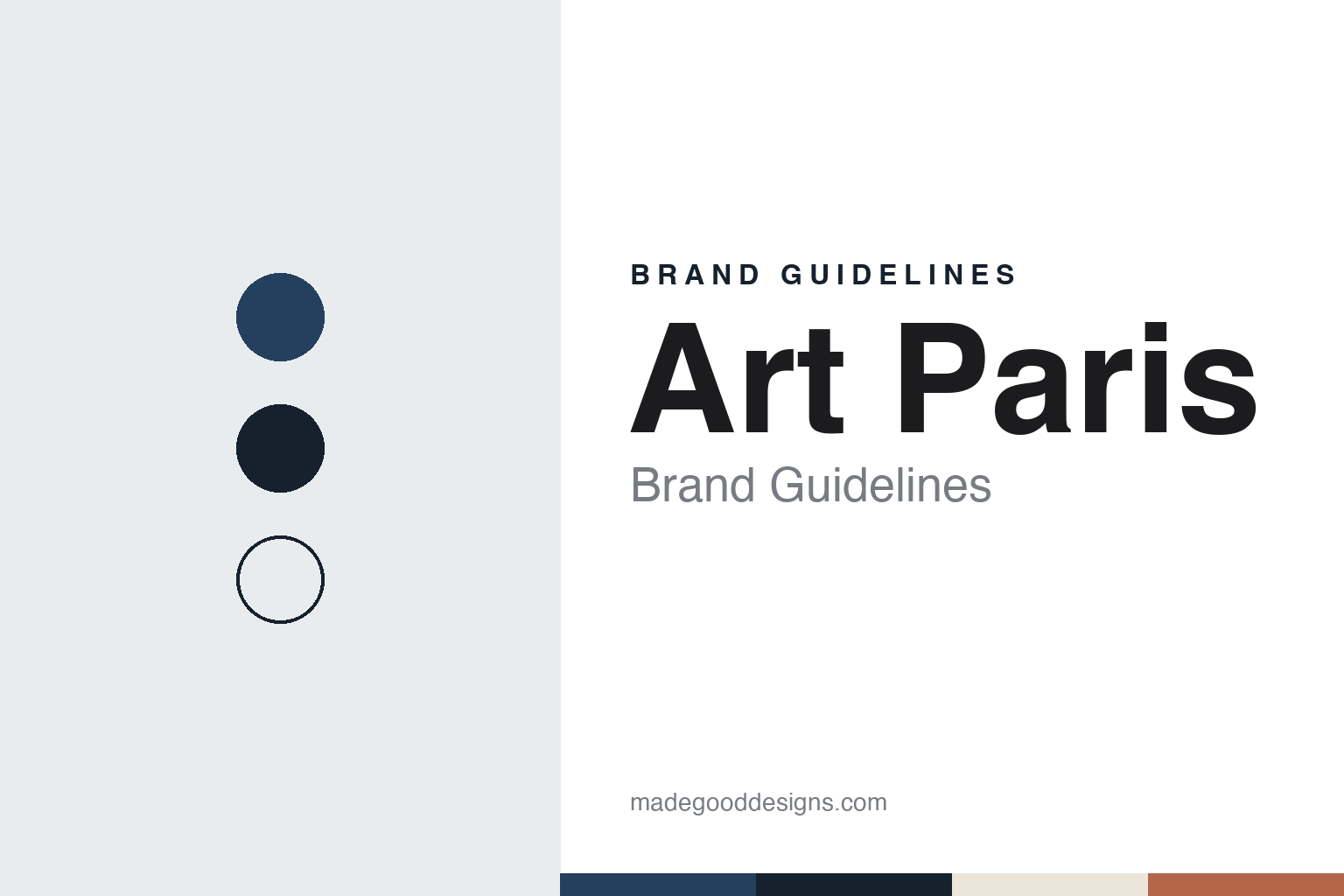
Art Paris Brand Guidelines
The spring fair for modern and contemporary art at the Grand Palais.
Aa
Two constants: a slate blue, night ink and limestone palette and a soft display serif register. Abstract homage — not an Art Paris asset; no logo, poster or artwork is reproduced.
Carrousel du Louvre
A spring fair in Paris since 1999.
Art Paris is a fair for modern and contemporary art held each spring in Paris. French Wikipedia dates it to 1999 and names its founders as Alain Lamaignère and Caroline Clough Lacoste. Before the fair, Lamaignère had co-run the Paris gallery Lamaignère-Saint-Germain from 1987 to 1993 and had been artistic director of ST-Art, the Strasbourg fair, from 1995 to 2000, according to the same article.
The first editions were held at the Carrousel du Louvre, the exhibition space beneath the Louvre, and the fair took a place in the spring calendar from the start. In 2006, when the Grand Palais reopened after renovation, Art Paris moved under its historic glass roof, French Wikipedia says, and the nave of the Grand Palais became the setting most associated with the fair.
Ownership and management changed over the following years. French Wikipedia says that in 2007 the investment group Luxrule owned Art Paris, and that in 2011 two co-directors general took over the running of the fair, which is operated by the company France Conventions; the article describes them as co-owners of that organising company. In the same year, it says, Guillaume Piens became artistic director and the fair was renamed “Art Paris Art Fair.” The Art Newspaper, writing in April 2018, described Piens as director of Art Paris since 2012, so the two sources give different years for the start of his tenure. Today the fair’s own website presents him as its general curator.
Colour
From the nave to the Champ-de-Mars and back.
By its twentieth anniversary the fair had settled into a recognisable form. The Art Newspaper reported in April 2018 that the edition of 5–8 April brought together 142 modern and contemporary exhibitors from 22 countries in the nave of the Grand Palais, with a programme built around “discoveries and rediscoveries,” a focus on European regions — Switzerland that year — and a project marking twenty years of the French scene, presented across twenty stands. Galleries named in that report include Templon, whose stand was pictured from the 2017 edition, and Loevenbruck.
In 2020 the edition planned for April moved to September, according to French Wikipedia, and was held at the Grand Palais des Champs-Élysées. When the Grand Palais then closed for a second, longer renovation, the fair moved to the Grand Palais Éphémère, a temporary building on the Champ-de-Mars, for the editions of 2021 to 2024. French Wikipedia gives the 25th edition, from 29 March to 2 April 2023, as 134 galleries from 25 countries, and the 26th, from 4 to 7 April 2024, as 136 galleries from 25 countries.
The 27th edition, from 3 to 6 April 2025, brought the fair back to the renovated nave. Euronews, reporting on 4 April 2025, counted 170 galleries from 25 countries and nearly 1,000 artists, and said that design pieces were shown at the fair for the first time: to mark the centenary of the 1925 International Exhibition of Modern Decorative and Industrial Arts in Paris, around twenty interior architects and designers were invited. The same report described a particular focus on French figurative painting from the 1970s onwards, and the “Promises” space for emerging artists, with 17 galleries showing at the Grand Palais for the first time. It quoted Piens describing Art Paris as “a regional and cosmopolitan fair,” and put the split of exhibitors at about 60 per cent French and 40 per cent from abroad. The 28th edition followed from 9 to 12 April 2026, again at the Grand Palais, with around 165 galleries, according to French Wikipedia.
Typography
Names, halls, sections.
A younger or regional contemporary art fair usually introduces itself with very few words. Many simply put “Art” in front of a city, as Art Paris and Art Rotterdam do; others use a short coined name or a single word for “contemporary” in a local language, attached to a place. The name is the part that stays put. Editions are counted rather than renamed, so a fair can say that it is holding its 27th or 28th edition and still look like itself.
Behind the name there is usually a small company, a trade-fair organiser or a group of gallerists. Art Paris is run by a company called France Conventions, according to French Wikipedia, and Art Rotterdam grew out of a free slot in a Rotterdam port building, as its director told De Kunstbode in 2020. Venues matter as much as owners: a glass-roofed exhibition palace, a listed factory or the halls of a large events complex become part of how a fair is pictured, and Art Paris and Art Rotterdam have both changed venue more than once.
Inside, the fairs are built from named sections. A main section for established galleries sits beside sections for younger galleries and emerging artists — Promises at Art Paris, the New Art Section at Art Rotterdam — and beside curated programmes for video, sculpture, design or photography, often with their own invited curators. These section names are short and are usually written as titles, and they recur on floor plans and in catalogues.
Around the fair itself sits a steady set of printed and online material: an exhibitor list, a catalogue, a floor plan or map, a programme of talks and, at some fairs, an online magazine. The campaign image and the themed programme usually change with every edition, while the name, the season and the city stay the same, and that combination is what lets a fair remain recognisable from one year to the next.
Aa
A soft display serif for a fair named after its city. (Specimen set in Fraunces, a serif STAND-IN; NOT the Art Paris logo.)
Art Paris Art Fair
A city name, a glass roof and named sections.
The fair’s name is simply the city with the word “Art” in front of it, and since 2011 it has also used the longer form “Art Paris Art Fair,” French Wikipedia says. That plain name has to sit beside a venue with a strong image of its own: for most of the fair’s history the setting has been the nave of the Grand Palais, with its iron and glass roof, and the temporary Grand Palais Éphémère served the same role for four editions while that building was closed.
The structure of the fair is laid out in named sections. French Wikipedia describes a monographic section devoted to solo exhibitions, a sector called Promises (in French, “Promesses”) for younger galleries, and, since 2018, annual thematic routes through the fair entrusted to invited curators. On the fair’s English-language website in 2026, the menu for the next edition lists a general sector beside Babel – French Scene, Promises, Solo Show and Design x Art, together with an edition catalogue, a fair map with a virtual visit, a programme of talks and a page on eco-design. The French scene runs through the whole programme, from the twentieth-anniversary project of 2018 to the figurative painting shown in 2025, and the themed routes change from one edition to the next while the name, the season and the venue stay the same.
For a design guide, Art Paris shows how a fair can rely on a plain city name, a fixed spring date and a single landmark venue, and let its curated themes carry the change from year to year. Compare Art Rotterdam, another spring fair that has changed venue, and Art Cologne, a European fair with a city name. For this guide we use a slate blue, night ink, limestone and terracotta with a serif, an unofficial interpretation; no product or logo is reproduced.
Explore & save
Keep Art Paris’s identity on hand — save it to a board in the Made Good inspiration library.
Art Paris identity set
Pin the Art Paris slate blue, night ink and limestone palette and the soft display serif register to your own board.
Source & notes
Frequently Asked Questions
What font can I use to match the Art Paris look?
This guide describes Art Paris’ type as “A soft display serif for a fair named after its city”. Its type specimen is set in Fraunces from Google Fonts as a stand-in; Fraunces is not Art Paris’ own lettering.
What colours are in the Art Paris palette?
This guide’s Art Paris palette is Nave blue #24405E, Night ink #16212E, Limestone #ECE6DA, Terracotta #B5654A and Paper #F8F6F1. The tones are the guide’s own unofficial interpretation, not official Art Paris hex codes.
When was Art Paris founded?
Art Paris was founded in 1999, in Paris, France.
Who founded Art Paris?
Art Paris was founded by Alain Lamaignère and Caroline Clough Lacoste in 1999.