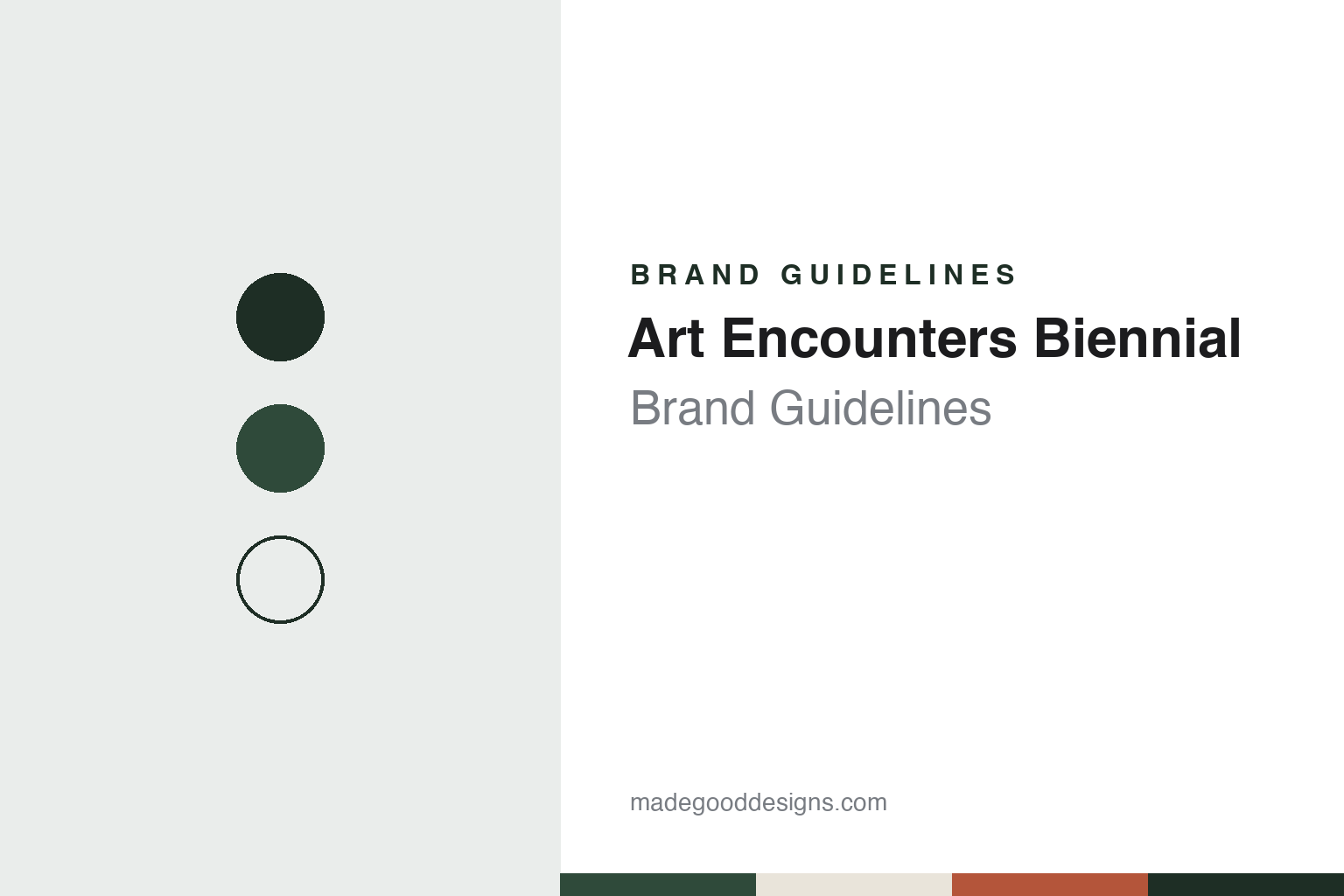
Art Encounters Biennial Brand Guidelines
A biennial that reads the city of Timișoara through its old buildings.
Aa
Two constants: a green, limestone and brick palette and a grotesque sans register. Abstract homage — not an Art Encounters Biennial asset; no logo, poster or artwork is reproduced.
A biennial in the Banat
A foundation, a city and a two-year rhythm.
Art Encounters Biennial is a contemporary art biennial in Timișoara, in western Romania’s Banat region, organised by the Art Encounters Foundation. The foundation’s own website lists its biennials by year and names a small permanent team, including an artistic director, a director, a graphic designer and an assistant curator, working from a building in the city that also houses its offices and its exhibition space.
The biennial began in 2015. When the Romanian daily Evenimentul Zilei reported on the close of the second edition in November 2017, it noted that the foundation’s education programme, My Art Encounters, had been set up with the first edition, and that its programme for children had started in 2015. Since then the event has kept to odd-numbered years: 2017, 2019, 2021, 2023 and 2025.
How the event describes itself has stayed steady. Artforum reported in March 2019 that Art Encounters was “billed as a cross between an experimental arts festival and a contemporary art biennial,” and its March 2021 report used nearly the same words. The foundation’s 2026 announcement again places the biennial “at the intersection between an experimental art festival and a contemporary art biennial,” and calls it the foundation’s flagship project, based on curatorial research into the history and social context of Timișoara.
That city focus shapes the format. Rather than a single exhibition hall, recent editions have been spread across several buildings in Timișoara, and in 2017 also in the nearby city of Arad, so that visiting the biennial means moving through the city itself.
Colour
Four editions, four curatorial teams.
The 2017 edition, the second, was titled “Life a User’s Manual” and ran from 30 September to 5 November 2017. It was curated by Ami Barak and Diana Marincu, according to the edition’s announcement republished by the Biennial Foundation in September 2017. That announcement describes a central exhibition in chapters spread over five venues in Timișoara and Arad, alongside historical exhibitions looking at the 1960s and 1970s, including a reenactment of the exhibition “5 Artists from Timișoara,” first shown in Bucharest in May 1968. Evenimentul Zilei reported that the venues included the Corneliu Miklosi Public Transport Museum, the Timco halls, Casa ISHO, the Timișoara Art Museum and the Arad Art Museum, and that the organisers counted more than 30,000 visitors and more than 300 works by 150 artists.
The 2019 edition, the third, ran from 20 September to 27 October 2019 under two curators, a Stockholm- and Berlin-based curator and a Singapore- and Romania-based curator, Artforum reported in March 2019. The foundation’s own announcement on e-flux said it brought together more than 60 artists, 20 of them commissioned to make new works, and was organised with local institutions and partners.
The 2021 edition, the fourth, was titled “Our Other Us” and ran from 1 October to 14 November 2021, Artforum reported, with two curatorial projects shown at various locations around the city by a pair of curators: a former artistic director of Extra City Kunsthal in Antwerp and a senior curator at Tate Liverpool.
The 2025 edition, “Bounding Histories. Whispering Tales,” ran from 30 May to 13 July 2025, according to the foundation’s website, which describes three exhibitions with more than 60 international artists from 30 countries. Its venues were a former garrison command building on Piața Libertății; FABER, a restored industrial site that was once the Azur chemical factory; and the foundation’s own building, put up in 1904–05 as one of the first structures of the ILSA wool factory and later also used as a kindergarten for the workers’ children.
Typography
Biennials and triennials across regions.
Some biennials are defined less by a city or a theme than by a single commitment: one medium, one format or one host. A biennial of moving image, a photography meeting, an assembly or a summit, or an exhibition run by a museum each sets a rule that stays put while everything else changes. That rule becomes the steadiest part of the identity, more lasting than any poster, title or curator.
Numbering is the simplest tool these events use. An edition count turns a series of separate exhibitions into a sequence, and the way the number is written can carry character of its own: spelled out, set as a numeral, or folded into the name itself. A recurring host institution plays a similar role. When the same museum, arts centre or foundation stages every edition, its building and its name give visitors a fixed point to return to, even when the curatorial team is new each time.
Publications often outlast the exhibitions. Catalogues, readers, companion books and printed handouts record what each edition argued and who took part, and some events present them as part of the edition rather than as souvenirs. A consistent format for these books, or a deliberate change from one edition to the next, says as much about the event as its signage does.
Finding the work is the other half of the identity. A moving-image biennial needs screening schedules and running times; a programme spread over several weekends needs a clear calendar; an exhibition spread across a city needs a map and a route from one venue to the next. For a designer, these practical documents are where the event’s rule becomes visible: in how a timetable is set, how venues are numbered and how a visitor is led from one room to the next.
Aa
A grotesque sans for a biennial of old buildings. (Specimen set in Space Grotesk, a sans STAND-IN; NOT the Art Encounters Biennial logo.)
Art Encounters Biennial
A city read through its buildings.
Two threads run through the biennial’s recent history. The first is its venues. Each edition has used buildings with a past of their own: a public transport museum and industrial halls in 2017, and in 2025 a garrison building, a former chemical works and a former wool factory. The foundation’s 2025 text says it chose to think of the echo, “as both a notion and an event,” when deciding how to occupy those places for an international exhibition.
The second is continuity in its team. Diana Marincu, co-curator of the 2017 edition, is named on the foundation’s website as its artistic director, and is quoted in that role in the July 2026 announcement. That announcement named Philippe Van Cauteren, artistic director of S.M.A.K., the museum of contemporary art in Ghent, as curator of its next edition, and described a longer partnership between Art Encounters and S.M.A.K. built around co-production and professional exchange. The same text notes that Van Cauteren curated the first edition of the Kathmandu Triennale in 2017.
Around the exhibitions, the foundation runs a year-round programme. Its website lists exhibitions, events, publications, residencies, mediation and a curatorial school, and Evenimentul Zilei reported in 2017 that more than 5,100 schoolchildren from Timișoara and other Romanian cities had joined 141 guided tours during that edition, and that a new introduction to contemporary art for adults had been added.
On the visual side, the biennial’s printed and online material changes with each edition’s title, and the foundation lists a graphic designer among its staff; no fixed palette or typeface for the event is documented in the sources used here.
For a design guide, Art Encounters Biennial shows how a biennial can build an identity from the buildings of one city rather than from a single venue. Compare Riga Biennial, another biennial that works across a city’s buildings, and the Kathmandu Triennale. For this guide we use a deep green, a pale limestone and a brick red with a sans, an unofficial interpretation; no product or logo is reproduced.
Explore & save
Keep Art Encounters Biennial’s identity on hand — save it to a board in the Made Good inspiration library.
Art Encounters Biennial identity set
Pin the Art Encounters Biennial green, limestone and brick palette and the grotesque sans register to your own board.
Source & notes
Frequently Asked Questions
What font can I use to match the Art Encounters Biennial look?
This guide describes Art Encounters Biennial’s type as “A grotesque sans for a biennial of old buildings”. Its type specimen is set in Space Grotesk from Google Fonts as a stand-in; Space Grotesk is not Art Encounters Biennial’s own lettering.
What colours are in the Art Encounters Biennial palette?
This guide’s Art Encounters Biennial palette is Banat green #2F4A3A, Garrison ink #1E2E25, Limestone #E9E4DA, Brick oxide #B4553A and Paper #F7F5F0. The tones are the guide’s own unofficial interpretation, not official Art Encounters Biennial hex codes.
When was Art Encounters Biennial founded?
Art Encounters Biennial was founded in 2015 (first edition), in Timișoara, Romania.