Garofalo Brand Guidelines
The Gragnano pasta maker licensed by royal decree in 1789.
Aa
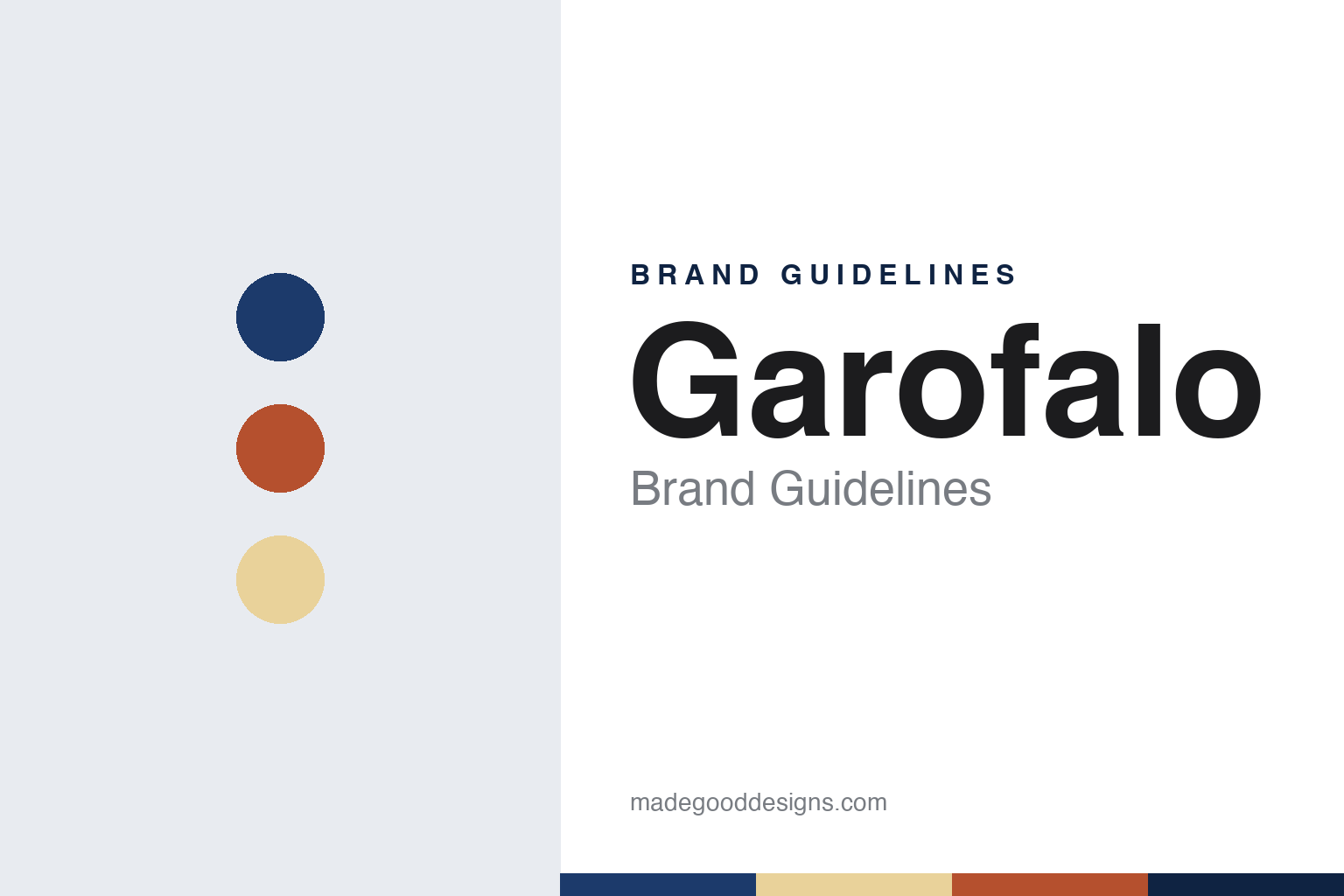
Two constants: a Garofalo blue, semolina and terracotta palette and a soft old-style serif register. Abstract homage — not a Garofalo product or mark; no pack, logo or pasta shape is reproduced.
A licence from the king
A pasta town on the slopes above the Bay of Naples.
Garofalo comes from Gragnano, a hill town in what is now the metropolitan city of Naples, and it still has its registered office and its factory there. The company dates itself to 1789. That year, it says, Michele Garofalo obtained by royal decree an exclusive licence to make pasta in the town, pasta that the decree described as being “of good make.” Italian Wikipedia, citing the company, names the king as Ferdinand IV of Naples, and adds that some sources give an earlier date, 1783; it also flags that the websites it once used as sources for the oldest part of the history can no longer be reached.
The company’s own account presents Gragnano as a home of pasta, with a climate suited to drying it and spring water that once turned the mills. Italian Wikipedia says the royal licence helped the business grow, and that by the early 1920s Garofalo was reportedly among the largest pasta makers in existence, producing about 400 quintals — some 40 tonnes — a day. That figure rests on a single archived trade source, so we treat it as reported rather than established.
The present company has a shorter history. Italian Wikipedia says it was incorporated in 1935, in the centre of Gragnano. In 1987 it built a more modern plant in the town’s industrial area, and from 1993 all production moved there. After a series of changes in ownership, the Menna family, which had held shares in the company since 1952, took full control in 1997; both dates are confirmed by the 2014 press release of the company’s present owner, Ebro Foods. In 2003, Italian Wikipedia says, the site covered about 24,000 square metres, with eight production lines, a capacity of around 80,000 tonnes a year and more than 120 staff. Garofalo was the first Italian pasta maker to be certified under the ISO 9002 quality standard, Italian Wikipedia says, citing a business-school case study.
Colour
Private labels, its own brand, and the cinema.
For much of its modern life Garofalo made pasta that did not carry its name. In 2009 il Giornale reported that the company sold abroad both through lines created for international retail chains — it named Sainsbury’s in Britain, Carrefour and Auchan across Europe and Ito-Yokado in Japan — and under its own brand for its premium products. The company says it launched its branded line in Italy in 2001. The same il Giornale report described Garofalo as a leader of the premium segment in several European countries, among them Sweden, France, Switzerland, the Netherlands and Portugal, and said it had opened local companies to serve Spain, Portugal, and Africa and the Middle East; a French company followed, la Repubblica reported in 2016.
Garofalo built its Italian brand without television. From 2006, Italian Wikipedia says, it turned to the cinema: first by sponsoring feature films, among them Commediasexi and Woody Allen’s To Rome with Love, and then by producing short films under its own name, promoted through its website and social media. In 2011 la Repubblica described how Garofalo had launched its brand on the web while giving up TV advertising, which it considered too expensive. From 2014 the pasta maker was the second main sponsor of the football club SSC Napoli, the club announced.
The business also grew by investment and acquisition. In December 2012 Il Sole 24 Ore reported that Garofalo had completed an €18 million investment in two new production lines, adding 40,000 tonnes a year of capacity, and had bought two plots of land next to its plant on Via dei Pastai. In May 2012, Il Mattino reported, it bought the Russo di Cicciano brand for about €1.1 million, after the pasta maker of that name went bankrupt in 2009. Ebro lists Russo di Cicciano and Santa Lucia as Garofalo brands alongside the main one.
Typography
Design and documentation.
The seven brands in this group all make dried pasta, and all of them come from Italy: Barilla, De Cecco, Garofalo, Rummo, La Molisana, Divella and Voiello. Italian pasta brands in general sit at many different points in the trade, from family firms that still carry a founder’s surname to names that now belong to much larger food groups, and a single brand can be sold everywhere from a neighbourhood grocer to a supermarket shelf abroad.
A pasta brand’s identity is usually carried less by a single shape than by a pack, a name and the town or region it promises, because the company behind the name may have changed hands, moved its factory or grown far beyond the place where it started. That makes the questions behind each name worth asking plainly: who started it, who owns it now, and where its pasta is actually made and packed.
Each guide separates what independent sources record from what the company says about itself — its founding story, its owners over time, where its pasta is made, where its wheat comes from and how its packaging has changed — and marks plainly what rests only on the company’s own word.
Aa
A soft old-style serif for a pasta maker that trades on its 18th-century licence. (Specimen set in Fraunces, a serif STAND-IN; NOT the Garofalo logo.)
Garofalo
From the Menna family to Ebro Foods.
In June 2014 control of Garofalo passed to Spain. Ebro Foods, the Spanish food group, announced that it had bought 52% of Pastificio Lucio Garofalo from the Menna family for €62.5 million. Ebro said the company’s revenue had grown from €30 million in 2002 to more than €134 million in 2013. Corriere della Sera and Il Sole 24 Ore reported the deal the same month. The company now describes Ebro as its majority shareholder, and Italian Wikipedia names Massimo Menna as chief executive.
Growth continued under the new owner. Italian Wikipedia, citing the trade press, gives revenue of €157 million in 2015 and about €220 million in 2020, a year in which the company had 203 employees. The company says it exports to more than eighty countries; older sources gave a figure of more than sixty. It also says its pasta is made in Gragnano, where its headquarters stand on Via dei Pastai; the sources we checked do not document any other Garofalo pasta plant.
The record is not without friction. In February 2009 Italy’s competition authority fined the main Italian pasta makers, Garofalo among them, together with trade associations, almost €12.5 million in total for agreements restricting competition, Corriere della Sera reported. Garofalo said in a statement that it had never taken part in any alleged cartel and reserved the right to act in the appropriate venues.
For a design guide, Garofalo shows how an old Gragnano name was turned into a modern premium brand through film sponsorship and the web rather than television. Compare Voiello, another Neapolitan pasta name now owned by a larger group, and Rustichella d’Abruzzo, a family pasta maker from the Abruzzo. For this guide we use a deep blue, a semolina yellow and a terracotta with a serif, an unofficial interpretation; no product or logo is reproduced.
Explore & save
Keep Garofalo’s identity on hand — save it to a board in the Made Good inspiration library.
Garofalo identity set
Pin the Garofalo blue, semolina and terracotta palette and the soft old-style serif register to your own board.