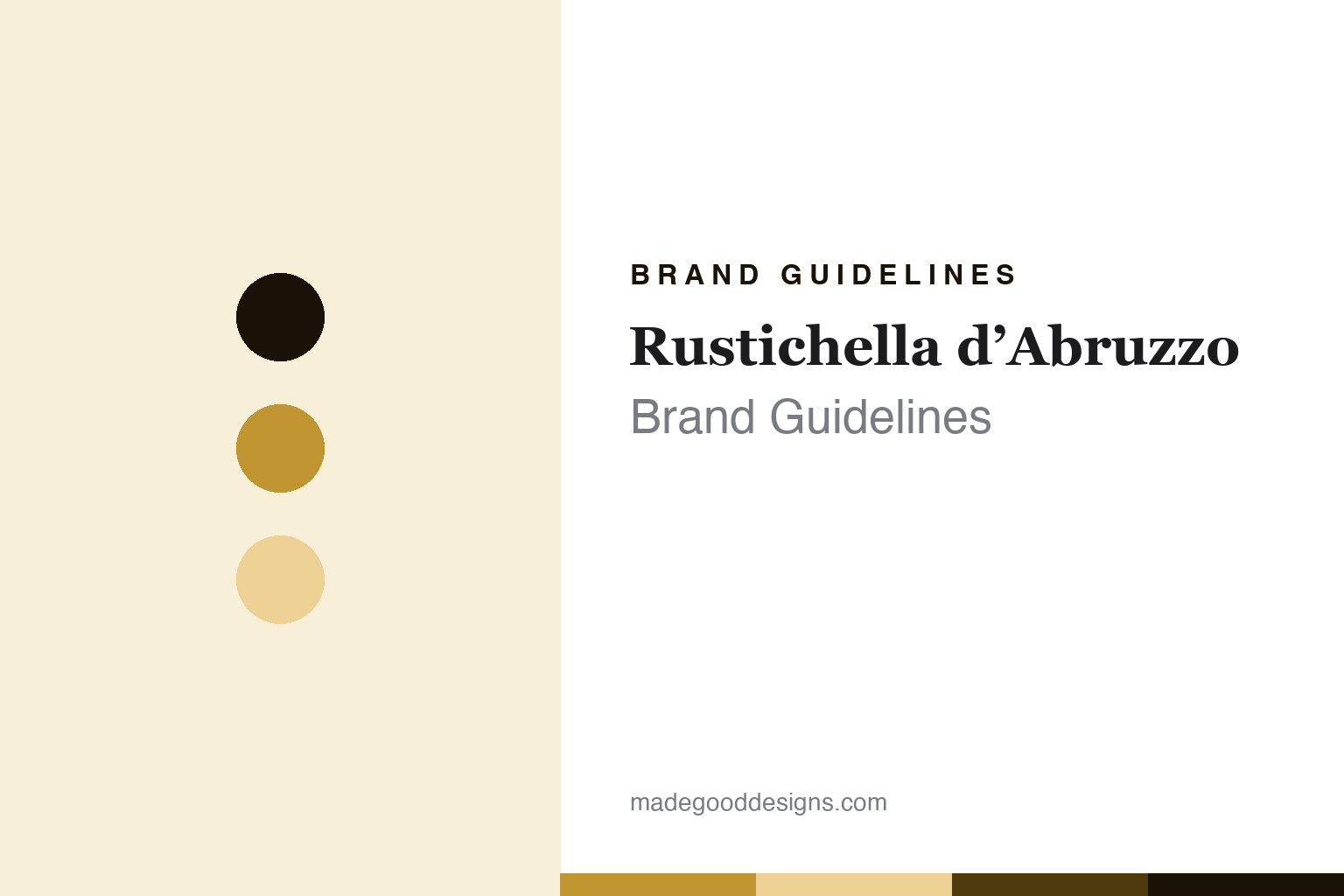
Rustichella d’Abruzzo Brand Guidelines
The bronze-die pasta of Abruzzo.
Aa
Two constants: a semolina-gold palette and a pasta-serif register. Abstract homage — not a Rustichella asset or mark.
The bronze-die pasta of Abruzzo
Rustichella d’Abruzzo is the Peduzzi family’s bronze-die, slow-dried artisan pasta from Pianella.
Rustichella d’Abruzzo opens the good pantry with pasta — the Peduzzi family’s artisan durum-wheat pasta, bronze-die extruded and slowly dried at low temperature, made in Pianella, in the Abruzzo region of Italy. Rustichella makes artisan pasta, and its answer to a round about the pantry is method and heritage: a rough, sauce-gripping pasta made the traditional way, from a family house with a century behind it. A brand, pasta.
Its identity is the bronze-die pasta of Abruzzo. Rustichella’s bronze die, its slow drying and its Peduzzi family are the story here. A brand, artisan. The bronze-die pasta of Abruzzo.
(Honest notes, so the story stays precise. Rustichella d’Abruzzo, at rustichella.it, makes artisan durum-wheat pasta, bronze-die extruded, which gives the rough, sauce-gripping surface, and slow-dried at low temperature, which preserves flavour, across classic cuts, whole-wheat, organic, ancient-grain and egg pasta, with a wider pantry range that also includes sauces and legumes. On heritage, it traces to 1924, which the family narrates as its own heritage, and the Peduzzi family, now a fourth generation, took over and created the modern Rustichella d’Abruzzo brand in the early nineteen-eighties, so we say the Peduzzi family in the early eighties, without asserting an exact first name or year. On where it is made, a star theme of this round, it is made in Pianella, in the province of Pescara, Abruzzo, and we do not assert specific spring-water or single-origin wheat, which is brand storytelling rather than documented sourcing. On ownership, it is family-owned and independent. It is a benchmark artisan pasta, long carried in the United States by the importer Manicaretti and stocked by Dean and DeLuca, and it marked a centenary in 2024. Its paper-wrapped, illustrated packaging is IP we describe but do not reproduce; there is no official brand hex; these tones are an unofficial interpretation. This is design commentary.)
Colour
Rustichella lives in a semolina gold. Click a swatch to copy the hex.
Rustichella’s identity is artisan, Italian and warm — a semolina gold, an ink, a wheat, a deep gold, and a paper. The palette leans semolina gold and wheat: a warm, floury register that nods to golden durum semolina and a kraft-paper wrap rather than a loud palette. It signals an artisan pasta. The honest caveat: with no published brand hex, these values are an original, unofficial interpretation, not first-party colours.
The lesson is a semolina gold signals an artisan, warm identity. Rustichella’s world is a hand-made object. For designers, it is a reminder that a semolina gold and a soft wheat can carry a pantry brand — the tone of durum pasta. Because these tones can fail as small text, keep type dark and let the colour live in the accents, palette and band. The takeaways: keep a method; date a heritage honestly; wrap it in paper; and treat any single hex as unofficial.
Typography
The register is a pasta serif — Italian, artisan, refined.
Rustichella’s identity carries an Italian, artisan, refined spirit — an artisan pasta, not a fashion. A pasta serif captures the mood: warm, refined and confident, the register of a heritage house. Set in a semolina-gold palette, the pasta serif feels Italian and artisan — exactly the personality Rustichella carries. It is a method rather than a logo, mirroring wheat and bronze. (Rustichella’s real paper wrap is a thing we describe but do not reproduce, and the exact typeface is not ours to use.) Because it is not ours to use, the honest description is “a pasta-serif pantry,” shown here in a stand-in. The type behaves like the brand: Italian, artisan and refined.
Aa
A pasta-serif pantry — Italian and artisan. (Specimen set in Cormorant Garamond, a pasta-serif STAND-IN; NOT the Rustichella logo.)
The good pantry
Rustichella d’Abruzzo stands for the bronze-die pasta of Abruzzo.
Rustichella d’Abruzzo opens the good pantry with pasta. A semolina-gold palette, a pasta serif and a bronze die make one thing — the bronze-die pasta of Abruzzo — the whole identity: artisan, Italian and warm. The bronze die and slow drying are the method, and the Peduzzi family is the heritage. The point is a rough, sauce-gripping pasta made the traditional way, from a house with a century behind it.
Put to work, the identity is a method told straight, as design. A maker in this spirit would keep a method, date a heritage honestly, and wrap it in paper. A reader in this spirit would keep the facts right: Rustichella d’Abruzzo makes bronze-die, slow-dried durum pasta, plus a wider pantry; it traces to 1924, with the Peduzzi family, now a fourth generation, creating the modern brand in the early nineteen-eighties; it is made in Pianella, Abruzzo, without an asserted spring-water or single-wheat claim; and it is family-owned and independent, long carried by Manicaretti. Rustichella opens the round’s restorers thread with Rancho Gordo and Anson Mills, the keepers of methods and crops, and it is the pasta entry in a pantry of categories. The honest editorial moves are to say the Peduzzi family in the early eighties, to attribute 1924 to the family, to say made in Pianella, and to skip the sourcing storytelling. The lesson Rustichella teaches is that a method can be a whole identity, and dating the heritage honestly keeps it credible.
For designers and brand-builders, Rustichella opens the good pantry: keep a method — and date a heritage honestly. The lessons: hold a traditional method, like bronze-die extrusion and slow drying; separate a house’s founding from a brand’s modern relaunch; wrap a product in a distinctive material; skip sourcing claims you cannot document; and never reproduce packaging. It is also a reminder to stay precise: Rustichella d’Abruzzo is the Peduzzi family’s bronze-die, slow-dried artisan pasta from Pianella — with the palette here an unofficial interpretation. Read that way, Rustichella is less a box than a method: a bronze-die Abruzzo pasta. The lesson for a brand is that a method and honest heritage reinforce each other, and saying the Peduzzi family keeps the story earned. Rustichella d’Abruzzo made the-bronze-die-pasta-of-Abruzzo the identity — proof that a method can open a round.
Explore & save
Keep Rustichella d’Abruzzo’s identity on hand — save it to a board in the Made Good inspiration library.
Rustichella d’Abruzzo identity set
Pin the semolina-gold palette and the pasta-serif register to your own board.