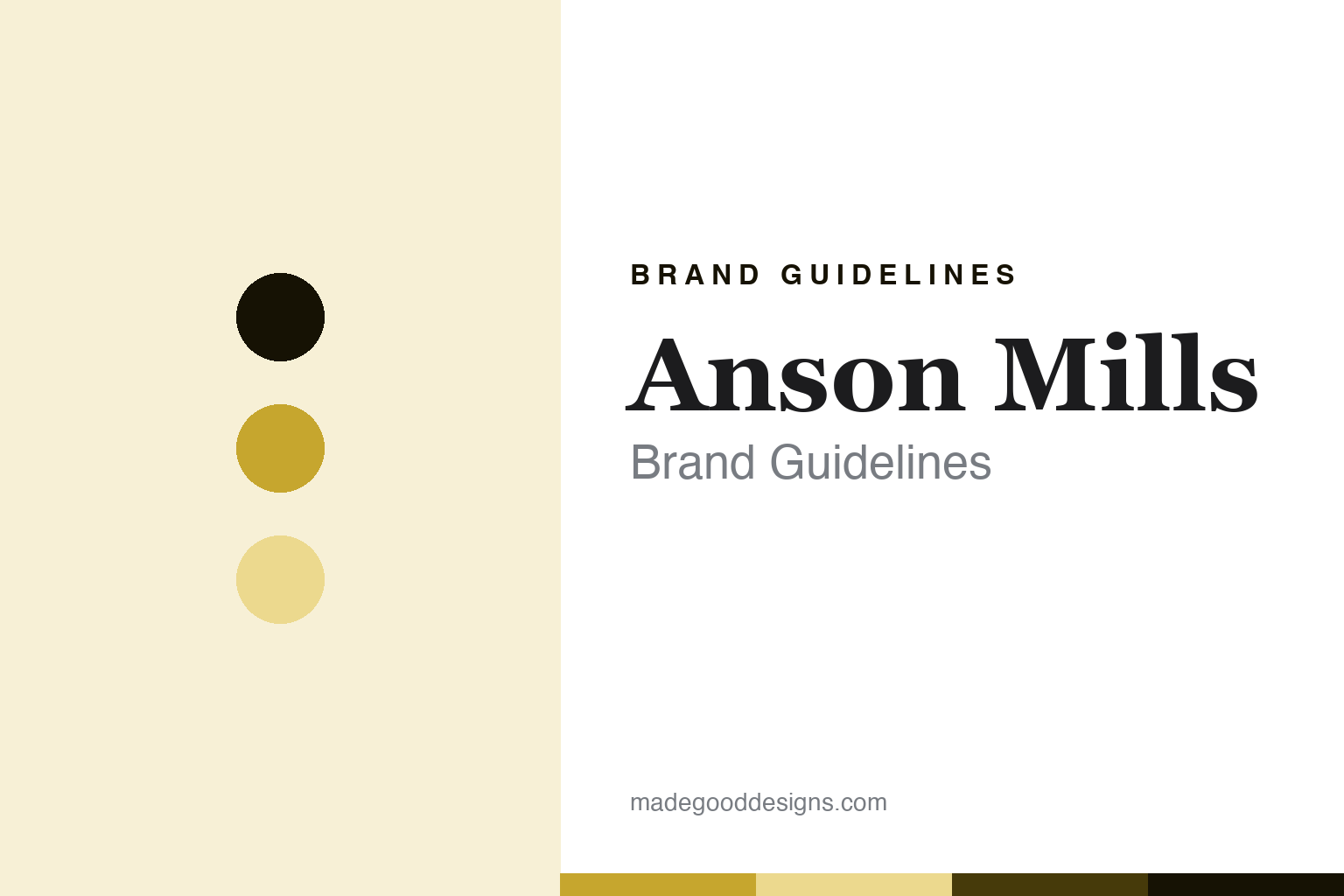
Anson Mills Brand Guidelines
The revival of Carolina Gold rice.
Aa
Two constants: a Carolina-gold palette and a heritage-serif register. Abstract homage — not an Anson Mills asset or mark.
The revival of Carolina Gold rice
Anson Mills is Glenn Roberts’ South Carolina house restoring heirloom Southern grains like Carolina Gold rice.
Anson Mills brings the round grains, restored — the South Carolina house, founded by Glenn Roberts, that revived near-extinct heirloom Southern grains, above all Carolina Gold rice, and mills them fresh to order. Anson Mills makes heirloom grains, and its answer to a round about the pantry is restoration: a landrace crop bred for flavour, brought back from the edge, cold-milled and shipped fresh. A brand, grains.
Its identity is the revival of Carolina Gold rice. Anson Mills’ heirloom grains, its restoration mission and its Southern heritage are the story here. A brand, restored. The revival of Carolina Gold rice.
(Honest notes, so the story stays precise, and the heritage stays honest. Anson Mills, at ansonmills.com, makes organic heirloom and landrace grains, including Carolina Gold rice, grits, polenta, cornmeal, heritage wheat flours and farro, cold-milled to order on granite stone mills and shipped fresh. It was founded by Glenn Roberts in Columbia, South Carolina, and we say around 1998, since the site itself gives both 1996 and 1998. On its mission, a theme of this round, it restores near-extinct grains, manages a network of growers, distributes heirloom seed to farmers, and grows Hopi blue corn for the Hopi Nation. On its heritage, a matter we treat honestly, Carolina Gold rice and the Lowcountry rice culture it revives were built on the labour, agronomic skill and knowledge of enslaved African and African American people, which is a documented historical fact that we state respectfully rather than sanitise. On ownership, it is independent and founder-led. We do not cite specific awards or named chefs we could not verify. Its name is IP we describe but do not reproduce; the grain names are generic; there is no official brand hex; these tones are an unofficial interpretation.)
Colour
Anson Mills lives in a Carolina gold. Click a swatch to copy the hex.
Anson Mills’ identity is heritage, restored and Southern — a Carolina gold, an ink, a wheat, a deep gold, and a paper. The palette leans Carolina gold and wheat: a warm, grain register that nods to golden Carolina Gold rice and a stone mill rather than a loud palette. It signals a restored heirloom grain. The honest caveat: with no published brand hex, these values are an original, unofficial interpretation, not first-party colours.
The lesson is a Carolina gold signals a heritage, restored identity. Anson Mills’ world is a restored, made object. For designers, it is a reminder that a Carolina gold and a soft wheat can carry a pantry brand — the tone of a heritage grain. Because these tones can fail as small text, keep type dark and let the colour live in the accents, palette and band. The takeaways: restore a crop; mill it fresh; tell a heritage honestly; and treat any single hex as unofficial.
Typography
The register is a heritage serif — Southern, restored, refined.
Anson Mills’ identity carries a Southern, restored, refined spirit — a heritage grain, not a fashion. A heritage serif captures the mood: refined, scholarly and confident, the register of a restoration house. Set in a Carolina-gold palette, the heritage serif feels Southern and restored — exactly the personality Anson Mills carries. It is a revival rather than a logo, mirroring a grain and a mill. (Anson Mills’ real packaging is a thing we describe but do not reproduce, and the exact typeface is not ours to use.) Because it is not ours to use, the honest description is “a heritage-serif pantry,” shown here in a stand-in. The type behaves like the brand: Southern, restored and refined.
Aa
A heritage-serif pantry — Southern and restored. (Specimen set in Playfair Display, a heritage-serif STAND-IN; NOT the Anson Mills logo.)
The good pantry
Anson Mills stands for the revival of Carolina Gold rice.
Anson Mills brings the round grains, restored. A Carolina-gold palette, a heritage serif and a restoration mission make one thing — the revival of Carolina Gold rice — the whole identity: heritage, restored and Southern. The heirloom grain is the substance, and the restoration is the meaning. The point is a near-extinct landrace crop, brought back, cold-milled and shipped fresh.
Put to work, the identity is a restoration told straight, as design. A maker in this spirit would restore a crop, mill it fresh, and tell a heritage honestly. A reader in this spirit would keep the facts right: Anson Mills makes organic heirloom grains, Carolina Gold rice, grits, polenta, cornmeal, heritage flours and farro; it was founded by Glenn Roberts in Columbia, South Carolina, around 1998; it restores near-extinct grains, manages growers and shares heirloom seed; and Carolina Gold rice and Lowcountry rice culture were built on the labour and knowledge of enslaved African and African American people, which we state honestly. Anson Mills joins Rancho Gordo and Rustichella on the round’s restorers thread, and it is the grains entry in the pantry. The honest editorial moves are to date it to around 1998, to lead with the restoration mission, to state the enslaved-labour heritage respectfully, and to treat grain names as generic. The lesson Anson Mills teaches is that a restoration can be a whole identity, and telling the heritage honestly keeps it credible.
For designers and brand-builders, Anson Mills continues the good pantry: restore a crop — and tell a heritage honestly. The lessons: bring a near-extinct grain back to the table; mill fresh to order; represent a foodway’s history truthfully, including the enslaved labour that built it; keep variety names generic; and never reproduce packaging. It is also a reminder to stay precise: Anson Mills is Glenn Roberts’ South Carolina house restoring heirloom Southern grains like Carolina Gold rice — with the palette here an unofficial interpretation. Read that way, Anson Mills is less a bag than a restoration: a revived heirloom grain. The lesson for a brand is that a restoration and an honest heritage reinforce each other, and stating the history truthfully keeps the story earned. Anson Mills made the-revival-of-Carolina-Gold-rice the identity — proof that a restoration can define a brand.
Explore & save
Keep Anson Mills’s identity on hand — save it to a board in the Made Good inspiration library.
Anson Mills identity set
Pin the Carolina-gold palette and the heritage-serif register to your own board.