Louise Breslau painted people who are busy thinking. Her sitters read, look away, hold a piece of fruit, or lean on a table among friends, and the picture is organised around that pause. For a designer the interest lies in how she builds it: a shallow room, a plain wall, two or three figures set at different depths, and a palette that is mostly neutral until one colour is allowed to speak.
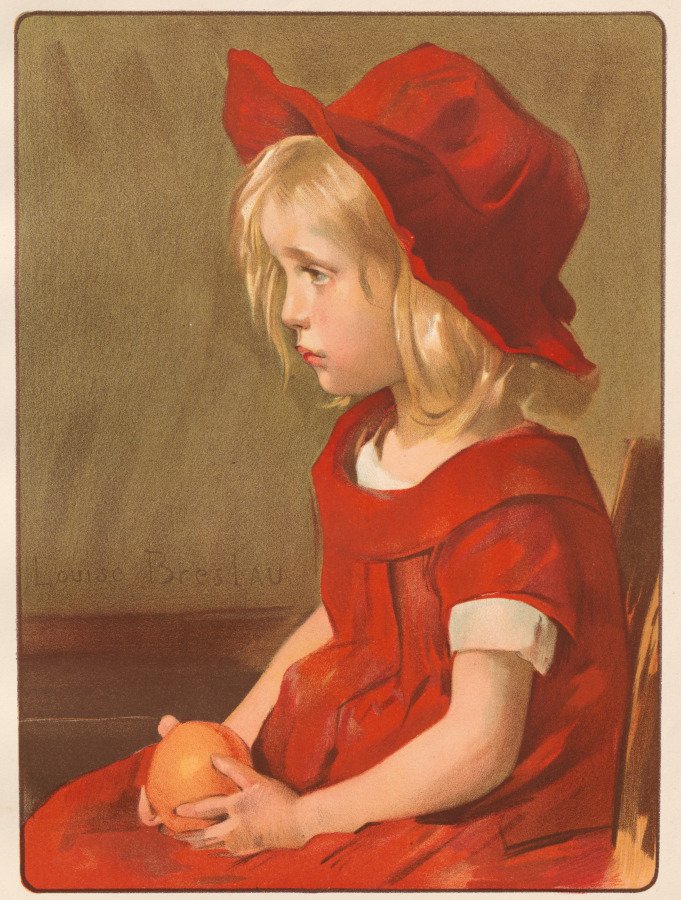
One note on pictures. Most of her paintings and pastels are in French and Swiss museums. The Cleveland Museum of Art releases one work by her under CC0, the colour lithograph Fillette à l’Orange, reproduced below; the others are described in text. Browse more cleared imagery in the MGD museum inspiration collection.
Who was Louise Breslau?
The Historical Dictionary of Switzerland records that she was born in Munich on 6 December 1856, the daughter of a physician, and that the family lived in Zurich from 1858. She took drawing lessons there with the portraitist Eduard Pfyffer; the research group AWARE (Archives of Women Artists, Research and Exhibitions), writing in partnership with the Musée d’Orsay, dates those lessons to 1874–76. She then left for Paris. The Städel Museum in Frankfurt places the move in 1876, and the Historical Dictionary of Switzerland dates her years at the Académie Julian to 1878–81.
At Julian’s she studied alongside the diarist and painter Marie Bashkirtseff, who, according to AWARE, wrote of her as the most promising student in the class and regarded her as a rival. Breslau exhibited at the Paris Salon from 1879, and in 1881 her group portrait Portrait des amis earned an honourable mention there. AWARE and the Städel Museum both record the award.
Recognition followed steadily. The Städel Museum lists gold medals at the Paris Expositions of 1889 and 1900, and the Historical Dictionary of Switzerland also records the 1900 medal. From 1890 she showed with the Société Nationale des Beaux-Arts, and in 1901 she was made a knight of the Legion of Honour. The Swiss dictionary names Jules Bastien-Lepage, Henri Fantin-Latour and Edgar Degas among the friends who shaped her work.
She shared her life with Madeleine Zillhardt (1863–1950), a fellow student at Julian’s whom the Städel Museum and AWARE both describe as her partner, and who appears in many of her pictures. During the First World War, AWARE records, she drew portraits of soldiers leaving for the front and gave them to their families. In her last years she turned mainly to still life. She died on 12 May 1927 at Neuilly-sur-Seine, on the edge of Paris. Zillhardt gave much of the work to French museums.
What to look at in a Louise Breslau picture
- Groups arranged as a conversation. In Portrait des amis the canvas is nearly twice as wide as it is high (85 by 160 centimetres, according to AWARE’s caption for the Geneva picture). The frieze-like format lets heads sit at different heights and turn different ways, so the eye moves from one to the next as if following dialogue.
- The averted gaze. Her sitters seldom perform for the viewer. A profile or a downward glance turns a likeness into a study of attention, which is why the pictures feel private without being staged.
- Shallow, plain rooms. A wall, a table edge, the corner of a chair. Backgrounds are reduced to broad tonal fields, so the figure reads as a clear silhouette.
- Restraint, then one accent. The Swiss dictionary describes her early interiors and portraits as under the spell of Édouard Manet’s painting, built from broad areas of tone. Against that, a single garment or object carries the colour.
- Children treated seriously. AWARE notes that she was sought after for portraits of children, usually in pastel, because she caught character as well as likeness.
- Signature as part of the design. In the lithograph shown above, her name is drawn in open capitals across the background tone, sitting in the picture space like a caption, not tucked into a corner.
Key works and where they are
These works can be dated and located from museum and scholarly records; dimensions follow AWARE’s published captions.
- Portrait des amis (1881), oil on canvas, Musée d’art et d’histoire, Geneva.
- Chez soi, also called Intimité (1885), oil on canvas, 127 by 154 centimetres, Musée des Beaux-Arts, Rouen. AWARE identifies the sitters as her mother and sister.
- Portrait of Jean Carriès in his studio (1886–87), oil on canvas, 176 by 165 centimetres, Petit Palais, Paris.
- Self-portrait (1891), oil on mahogany panel, 46 by 39 centimetres, Musée d’Art moderne et contemporain, Strasbourg.
- La petite fille au chien blanc, a portrait of Adeline Poznanska (early 1890s), pastel, Musée d’Orsay.
- Fillette à l’Orange (1899), colour lithograph, Cleveland Museum of Art; AWARE also illustrates an impression in the British Museum.
- La Table du goûter (1924), oil on canvas, Musée de Grenoble. A late still life.
Technique: oil, pastel and the printed page
Oil first. Her reputation in the 1880s rested on large oils, and the formats are instructive: a long horizontal for a group of friends, a near-square for a sculptor in his studio. The canvas shape follows the number of figures.
The turn to pastel. The Historical Dictionary of Switzerland dates her move to pastel to about 1889 and says it brought a hatched, stroke-by-stroke way of applying colour. Pastel suited quick sittings with children, and it sits close to what Degas and Mary Cassatt were doing with the medium in the same city. Our guide to Impressionism covers that wider circle.
The lithograph. Fillette à l’Orange was made for L’Estampe Moderne, a Paris publication that issued original prints by subscription in monthly parts between May 1897 and April 1899. The Cleveland Museum of Art catalogues its impression within the second annual volume, a bound book of fifty lithographs, and names Imprimerie Champenois as the printer. The image measures 32.8 by 24.1 centimetres, and the museum notes the publication’s blindstamp in the lower right corner of the sheet. The print translates her pastel manner into lithography: crayon-like hatching in the background, soft modelling in the face, and flat, strong colour in the dress.
A palette from Fillette à l’Orange
These values were measured from the museum’s scan of this impression with a simple colour quantisation. They describe the digital image, not the original inks.
- #b03721: the full red of the dress and hat, and the dominant note.
- #783325: the brown-red of the shadowed folds.
- #8c6b42: the olive-ochre ground behind the figure.
- #e8ae80: the warm light of the skin, the hair and the orange.
The scheme is close to monochrome: reds and their darker and lighter relatives, set on a dulled yellow-green that makes the red look brighter than it is. The orange in the child’s hands is close in hue to the dress, yet it reads as a focal point because it is a light, warm shape at the base of the triangle formed by hat, face and hands. Sample the scan yourself with our image colour picker.
How designers can borrow from Louise Breslau
- Let the subject look away. For editorial portraits, About pages and book covers, a profile or a lowered gaze suggests thought. Leave the empty space on the side the sitter is facing, as she does in the lithograph, so the gaze has room to travel.
- Pick the format for the cast. One person, upright. Three or four, go wide and stagger the heads.
- One colour family, one neutral. Build a layout from a single saturated hue, its shadow and its tint, then set it against a greyed complement.
- Use small props as anchors. An orange, a book, a pen. A single object in the hands gives a portrait a second focal point and a reason for the pose.
- Integrate the credit. Draw a signature, caption or logotype in a tone close to the background and place it inside the picture area. It becomes part of the composition instead of an afterthought.
Where to see her work
Most of her work is in France and Switzerland: AWARE’s illustrated entry draws on the Musée d’Orsay and the Petit Palais in Paris, the museums of Rouen, Strasbourg and Grenoble, and the Musée d’art et d’histoire in Geneva. After her death, memorial exhibitions were held at the École des Beaux-Arts in Paris in 1928 and in Geneva in 1929. Later surveys were held at the Musée cantonal des Beaux-Arts in Lausanne in 2001–02 and at the Musée des Beaux-Arts in Dijon in 2005–06.
Frequently asked questions
What is Louise Breslau known for?
She is known for portraits and intimate interior scenes in oil and pastel, including the 1881 group portrait Portrait des amis, and for sensitive portraits of children.
Was Louise Breslau Swiss or German?
She was born in Munich in 1856 and grew up in Zurich from 1858. The Historical Dictionary of Switzerland records that she held Zurich citizenship from 1892, and the Cleveland Museum of Art catalogues her as Swiss. She spent her working life in and around Paris.
Where did Louise Breslau train?
She first studied drawing in Zurich with Eduard Pfyffer, then at the Académie Julian in Paris, a private school that took women students when, as AWARE notes, the École des Beaux-Arts did not. The Historical Dictionary of Switzerland dates her time there to 1878–81.
Can I use images of Louise Breslau’s work?
The Cleveland Museum of Art releases its impression of Fillette à l’Orange under CC0, so that image can be reused. For works in other museums, check each institution’s image terms.