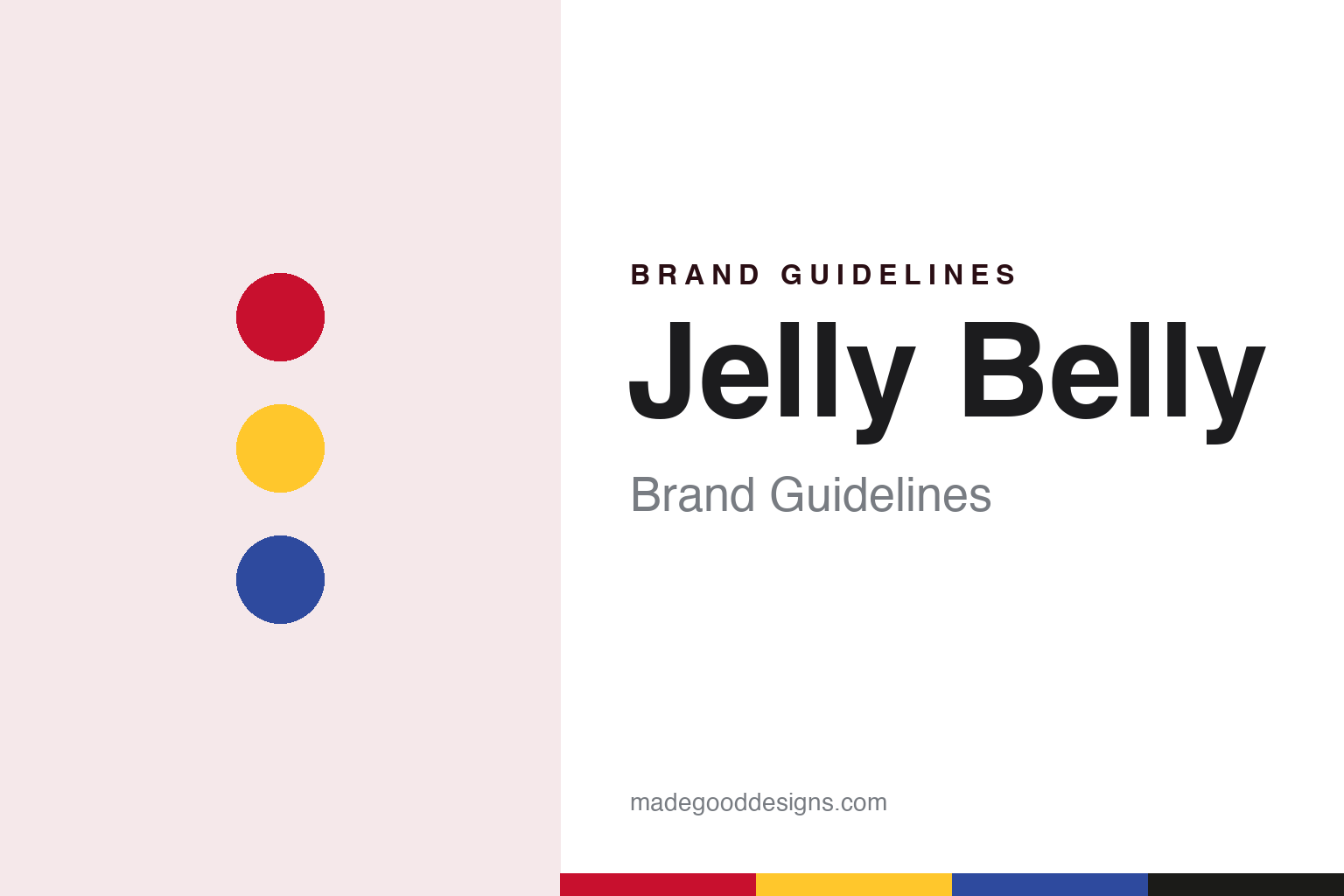
Jelly Belly Brand Guidelines
The Goelitz family jelly bean, from Reagan’s jar to the Ferrara sale.
Aa
Two constants: a Jelly Belly cherry, lemon and blueberry palette and a rounded sans register. Abstract homage — not a Jelly Belly product or mark; no bean, pack or logo is reproduced.
Belleville, 1869
A German immigrant family and its candy business.
The company behind Jelly Belly is far older than its bean. English Wikipedia traces it to Gustav Goelitz, who came to the United States from Germany in 1866 and in 1869 started a confectionery business in Belleville, Illinois, later joined by his younger brothers Albert and George; the International Directory of Company Histories instead credits the Belleville shop to Albert, so the sources differ on the founder’s name. When the company was sold in 2023, the National Confectioners Association reported that it traced its origins to 1869 in Illinois. In 1898, Wikipedia says, the business began making mellowcreme candies, including candy corn; it opened factories in Cincinnati in 1900 and Chicago in 1904, and moved to North Chicago in 1913.
A second branch of the family went west. Gustav’s son Herman Goelitz set up the Herman Goelitz Candy Company, which Wikipedia says settled in Oakland, California, in 1924; the company-history directory dates his move to California to 1922. In the 1960s the California company widened its range to jelly beans, and in 1965, Wikipedia says, it developed a Mini Jelly Bean flavoured in the centre as well as in the shell. The company now says it was the first to flavour a jelly bean’s centre as well as its shell; that is its own claim.
The third generation took over in the 1960s, the directory says, with Herman Rowland, Herman Goelitz’s grandson, leading the California business. In 1986 it moved to Fairfield, in Solano County, where it built a new factory and headquarters and opened its doors to factory tours, according to the company’s own timeline and the directory. The two family companies — the Goelitz Confectionery Company in Illinois and the Herman Goelitz Candy Company in California — merged in 2001 as the Jelly Belly Candy Company, the directory says.
Colour
A distributor’s idea, a family factory and a president’s jar.
The bean itself arrived in 1976. Wikipedia says David Klein, a candy and nut distributor, worked with Herman Rowland on a jelly bean made with natural flavourings, building on the Mini Jelly Bean, and hired the Herman Goelitz Candy Company as his contract manufacturer. Klein coined the name “Jelly Belly” as a tribute to the blues musician Lead Belly, and Wikipedia credits him with the design of the brand’s red and yellow trademark. He first sold the beans that year at Fosselman’s, an ice-cream parlour in Alhambra, California, and it was his idea to sell each flavour separately rather than as a mix. The first eight flavours included Very Cherry, Licorice, Root Beer and Cream Soda; the company says seven of the eight are still among its most popular.
In 1980 Klein sold the trademark to Rowland. Wikipedia’s article on the company gives the price as $4.8 million, paid in monthly instalments over 20 years and shared with a partner; its article on Klein gives $5 million. Wikipedia says the trademark was registered on 3 August 1982 and that the Mr. Jelly Belly character was introduced in 1983. It also credits Marinus van Dam, the company’s product developer and plant manager, with overseeing the bean’s development.
The bean’s best-known customer was Ronald Reagan. The Ronald Reagan Presidential Library says he began eating “Goelitz Mini Jelly Beans” when he ran for governor of California in 1966, as part of giving up pipe smoking, and that the company sent a monthly shipment to his office through both of his terms in Sacramento; Wikipedia, citing People magazine, dates his first taste to 1969. For the 1981 inaugural festivities, the library says, three and a half tons of red, white and blue Jelly Belly beans were shipped to Washington; Blueberry had been developed in 1980 to complete the flag colours alongside Very Cherry and Coconut. The company supplied the White House for all eight years of his presidency, and in February 1981 it was authorised to make a jar bearing the Presidential Seal, which Reagan gave to visiting dignitaries, the library says. His favourite flavour, it adds, was licorice.
Typography
Sweets and documentation.
The seven brands in this group all make sweets and gummies, and they come from Germany, Sweden, Britain and the United States: Katjes, Trolli, Werther’s Original, Cloetta, Maynards Bassetts, Swizzels and Jelly Belly. Sweet and gummy brands in general sit at many different points in the trade, from family firms that still carry a founder’s surname to names that now belong to much larger confectionery groups, and a single brand can be sold everywhere from a corner shop to a supermarket aisle.
A sweet brand’s identity is usually carried less by a single product than by a pack, a name and the treat it promises, because the company behind the name may have changed hands, moved its factory or grown far beyond the town where it started. That makes the questions behind each name worth asking plainly: who started it, who owns it now, and where its sweets are actually made and packed.
Each guide separates what independent sources record from what the company says about itself — its founding story, its owners over time, where its sweets are made and how its packaging has changed — and marks plainly what rests only on the company’s own word.
Aa
A rounded sans — our register for a brand that stamps its name on every bean. (Specimen set in Fredoka, a sans STAND-IN; NOT the Jelly Belly logo.)
Jelly Belly
From a family business to Ferrara.
For well over a century the business stayed with one family. When the sale was announced on 18 October 2023, the National Confectioners Association reported that Jelly Belly had remained under the stewardship of several generations of the Rowland family, with Herman Rowland Sr. as board chairman and Lisa Brasher as president and chief executive. The buyer was the Ferrara Candy Company of Chicago, acting through its holding company CTH Invest; terms were not disclosed, and the deal covered about 800 employees and sites in California, Illinois and Thailand. Ferrara, which English Wikipedia says the Ferrero Group acquired in 2017, announced completion on 30 November 2023, naming Jeff Brown, previously Jelly Belly’s executive vice-president of global operations and distribution, as chief executive.
Wikipedia lists three manufacturing plants: Fairfield; North Chicago, Illinois; and Rayong, Thailand, a 50,000-square-foot plant opened in October 2008 to make confections for the international market. A distribution and visitor centre in Pleasant Prairie, Wisconsin, closed in 2020. In February 2026, CBS News Sacramento reported, Ferrara said it would lay off 69 corporate employees at the Fairfield campus as it consolidated corporate work at its Chicago headquarters, while manufacturing, distribution and the visitor centre would stay; the site then employed 374 people. The company says its beans now reach more than 70 countries, and from 1 May 2026 it stopped selling online through its own website, pointing shoppers to retailers instead.
The bean carries its own label. The company says it began stamping its name on every bean in 1996; the company-history directory gives 1997. In May 2026 the brand launched a refreshed look under the campaign “Bean Appétit,” with new packaging, a redesigned website and short films; the release credited the design identity to Team Créatif Group and the creative to the agency MONO, and introduced curated collections including Signature 10 and Signature 20.
For a design guide, Jelly Belly shows how a single stamped name and a run of named flavours can carry a candy brand through changes of owner. Compare Ferrero Rocher, from the group that bought Ferrara in 2017, and See’s Candies, another California candy maker. For this guide we use cherry red, lemon yellow and blueberry with a rounded sans, an unofficial interpretation; no product or logo is reproduced.
Explore & save
Keep Jelly Belly’s identity on hand — save it to a board in the Made Good inspiration library.
Jelly Belly identity set
Pin the Jelly Belly cherry red, lemon yellow and blueberry palette and the rounded sans register to your own board.