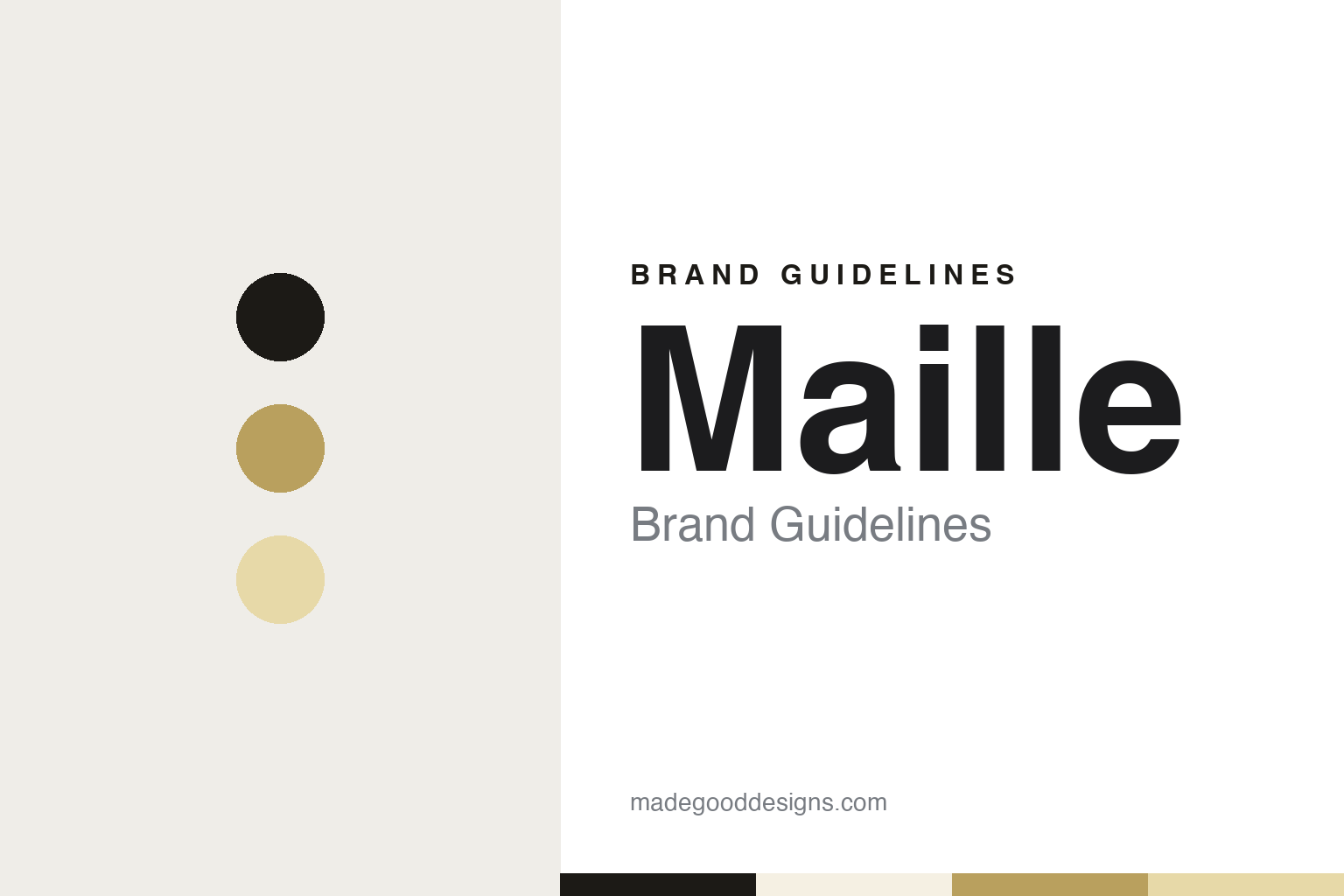
Maille Brand Guidelines
A Paris vinegar-maker’s shop, a Dijon boutique and three centuries of mustard.
Aa
Two constants: a shop black, old gold and Dijon cream palette and a classical display serif register. Abstract homage — not a Maille product or mark; no jar, label or logo is reproduced.
A vinegar-maker in Paris
A shop, a royal warrant and a partner.
Maille counts its years from 1747. That year, both English and French Wikipedia say, the distiller and vinegar-maker Antoine-Claude Maille opened his first shop on the rue Saint-André-des-Arts in Paris, selling vinegars and mustards. French Wikipedia says he went on to create a long list of flavoured vinegars and mustards, and quotes the gastronome Grimod de La Reynière calling him the leading mustard man of Europe.
Royal custom followed. Both encyclopedias say Maille received the warrant of the King of France in 1769 and that of Catherine II of Russia in 1771; they give different years for an earlier appointment to the Hungarian court, so we leave that date aside. In 1789, French Wikipedia says, Maille took a partner, André-Arnoult Acloque, a former brewer, and around the turn of the century the business passed to Acloque. In 1819 the two men’s sons went into partnership, and Robert Maille later served as vinegar-maker to Charles X, to the King of England from 1830 and to Louis-Philippe from 1836, both encyclopedias say.
The house’s link with Burgundy dates from 1845, when a Maille shop opened in Dijon; French Wikipedia cites the trade weekly LSA for the date. The Dijon boutique, at 32 rue de la Liberté, is still trading, and French Wikipedia’s page on the shop says the Maille name eventually replaced that of Grey Poupon, another Dijon mustard house, on the shopfront and its wall plaques.
Colour
Rothschild, Grey Poupon and a run of owners.
The modern company took shape in the twentieth century. In 1930 the wine-maker Philippe de Rothschild bought Maille, French Wikipedia says, citing Le Journal du Dimanche in 2012 and a 2018 France Info radio series on brands, and production became industrial. In 1952 Rothschild sold the brand to André Ricard and Joseph Poupon, the deputy managing director of Grey-Poupon; the two Dijon names were then run side by side, and Maille entered supermarkets in 1961, the business magazine Capital reported in 2018.
Its slogan has two origin stories in print. French Wikipedia says the line “Il n’y a que Maille qui m’aille” — roughly, “only Maille suits me” — was coined by André Ricard in 1982, or, citing Capital, by Jean Herbout, Rothschild’s right-hand man during the brand’s relaunch in the 1930s; English Wikipedia dates a version of it to 1931.
A chain of corporate owners followed. In the early 1970s, French Wikipedia says, Ricard and Poupon sold their shares to Chocolat Poulain, which grouped its food brands in a company known as SEGMA; that business passed to Clin-Midy in 1978 and the next year to Jimmy Goldsmith’s Générale Occidentale, which also owned Amora. In 1980 the food division went to BSN, renamed Danone in 1994. In 1996 Danone grouped Maille with Amora and Liebig, a regional television report archived by the INA said at the time, and in 1997 sold Amora-Maille to Paribas Affaires Industrielles. In November 1999 Unilever agreed to buy Amora Maille for 4.7 billion French francs, Les Echos reported.
October 1996 also brought a shop on the Place de la Madeleine in Paris, Capital reported, where mustard is sold from the pump as well as in jars. Further boutiques followed abroad, in London’s Piccadilly Arcade in 2013, and in Paris’s Carrousel du Louvre and in Bordeaux in 2015, according to LSA and the company’s own boutique pages as cited by French Wikipedia.
Typography
Design and documentation.
The seven brands in this group all make mustard, and they come from four countries: Maille, Colman’s, Amora, Edmond Fallot, Develey, Thomy and Löwensenf, from France, Britain, Germany and Switzerland. Mustard brands in general sit at many different points in the trade, from family firms that still carry a founder’s surname to names that now belong to much larger food groups, and a single brand can be sold everywhere from a specialist shop to a supermarket shelf.
A mustard brand’s identity is usually carried less by a single product than by a jar, a name and the table it promises, because the company behind the name may have changed hands, moved its factory or grown far beyond the town where it started. That makes the questions behind each name worth asking plainly: who started it, who owns it now, and where its mustard is actually milled and packed.
Each guide separates what independent sources record from what the company says about itself — its founding story, its owners over time, where its mustard is made and how its packaging has changed — and marks plainly what rests only on the company’s own word.
Aa
A classical display serif for a house that dates its shop to 1747. (Specimen set in Cormorant Garamond, a serif STAND-IN; NOT the Maille logo.)
Maille
One Burgundy factory and a new parent in prospect.
Maille mustard is no longer made in the city of Dijon itself. Amora and Maille mustard had been produced at a historic factory in Dijon, and cornichons were packed at Appoigny, in the Yonne. Unilever announced the closure of the Dijon factory in November 2008, Le Monde reported, and the plant shut on 15 July 2009, LSA reported; production moved to the group’s site at Chevigny-Saint-Sauveur, near Dijon. French Wikipedia puts the job losses at 144 and says the Chevigny site now makes all the Amora and Maille mustard sold in France and around the world. The mustard seed itself comes mainly from Canada, BBC News Afrique reported in 2022; the “Dijon” in Dijon mustard names a recipe rather than an origin.
Ownership is set to change again. On 31 March 2026 Unilever and the American spice company McCormick announced an agreement to combine Unilever’s foods business with McCormick, in a deal valuing the foods arm at about $44.8 billion. Unilever’s announcement named Maille, alongside Cholula and Frank’s, among the brands it saw as having high growth potential. The companies said they expected the deal to close in mid-2027, subject to shareholder and regulatory approval, with Unilever and its shareholders holding 65% of the combined company.
The brand’s retail face has stayed close to its origins. The boutiques sell mustards, vinegars and oils, and mustard drawn from porcelain pumps, which English Wikipedia says the company introduced in 1996 for limited-edition recipes such as a mustard made with Chablis wine. English Wikipedia also lists Maille shops or counters in New York from 2014 and in several other American cities, and says the brand has sold online since 2007.
For a design guide, Maille shows how a shop date, a royal-warrant past and a boutique counter can carry a supermarket mustard. Compare Grey Poupon, the Dijon house it was paired with from 1952, and Amora, its sister brand at Chevigny. For this guide we use shop black, an old gold and a Dijon cream with a classical serif, an unofficial interpretation; no product or logo is reproduced.
Explore & save
Keep Maille’s identity on hand — save it to a board in the Made Good inspiration library.
Maille identity set
Pin the Maille shop black, old gold and Dijon cream palette and the classical display serif register to your own board.


