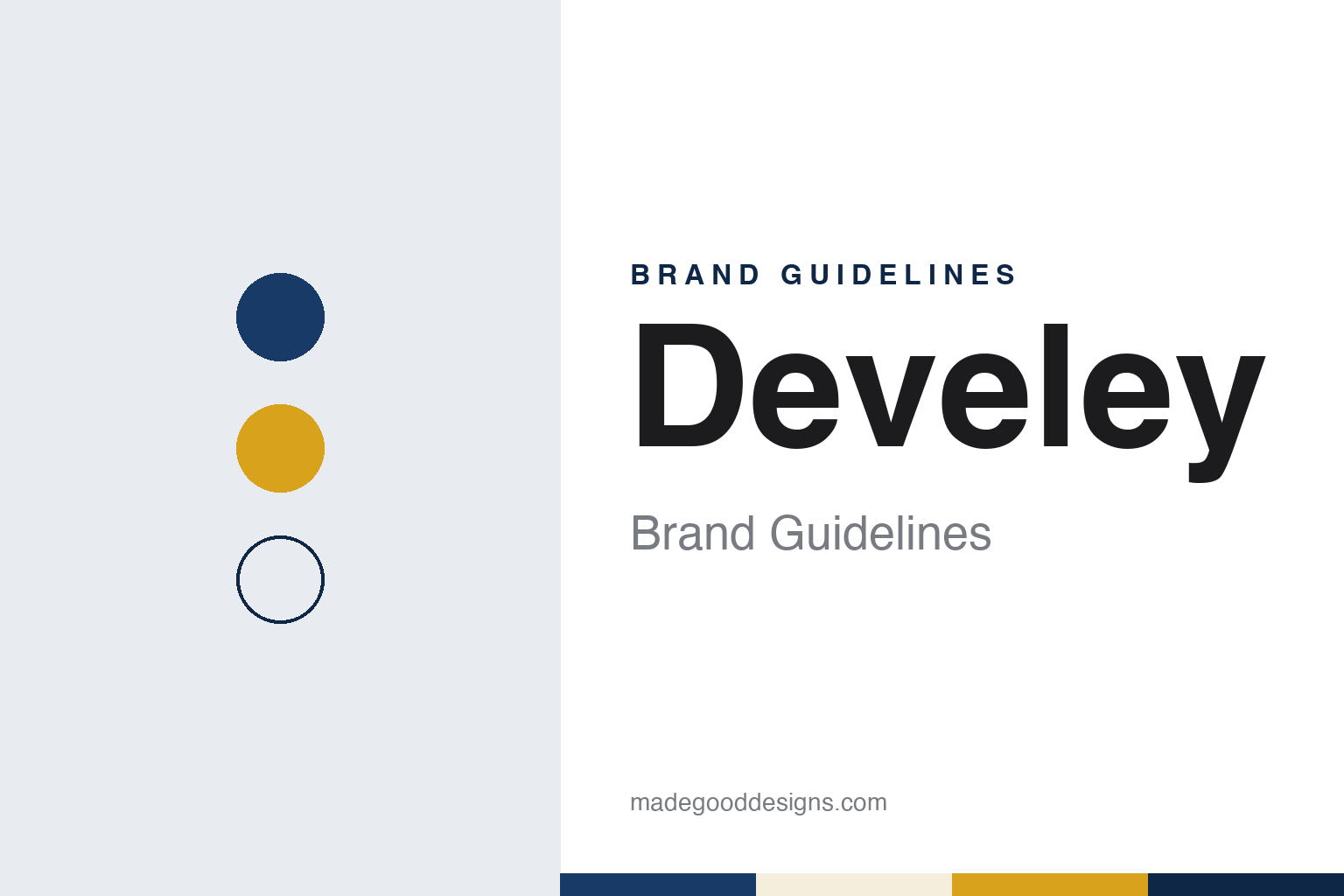
Develey Brand Guidelines
The Munich mustard house behind sweet Bavarian mustard.
Aa
Two constants: a Bavarian blue, sweet-mustard yellow and caramel palette and a royal-purveyor serif register. Abstract homage — not a Develey product or mark; no jar, tube, label or logo is reproduced.
Kaufingerstraße, 1845
A merchant from Lindau and a sweeter mustard.
Develey takes its name from its founder, Johann Conrad Develey, who was born in Lindau on Lake Constance in 1822. German Wikipedia says he trained as a merchant in Augsburg and moved to Munich in 1844. In 1845 he opened a mustard manufactory on the Kaufingerstraße, in the heart of the city, the company says. At first he made mustard to French recipes, medium-hot and hot.
The product that made the name came nine years later. In 1854, the company says, Develey mixed caramelised sugar and spices into sharp mustard and created sweet mustard. German Wikipedia describes the recipe as hot Dijon mustard, caramelised sugar, spirit vinegar and a secret spice blend, and credits Develey with being the first to make sweet mustard commercially.
Recognition followed. German Wikipedia says Develey received the medal for progress at the Vienna World Exhibition of 1873, and from 1874 he was allowed to call himself “Royal Bavarian Purveyor to the Court”. The company names King Otto of Bavaria and Prince Regent Luitpold among the customers from the royal house of Wittelsbach. Develey died in Munich in 1886 and is buried, with his wife Louise, in the Alter Südfriedhof, the city’s old southern cemetery; German Wikipedia notes that the purveyor’s title is carved on the gravestone.
The founder’s heritage is still part of how the brand presents itself: the company keeps a separate website about Johann Conrad Develey, and its own history opens with the Kaufingerstraße workshop of 1845.
Colour
A sauerkraut family, a burger chain and a string of mustard brands.
The modern Develey was shaped in the 20th century by acquisitions. In 1968 the company bought Specht, a Lower Bavarian brand of pickled delicacies from Pfarrkirchen, the company says. In the 1970s Develey itself passed to the Durach family, whose business until then had been pickled cucumbers and sauerkraut; Handelsblatt reported this in 2013 and Lebensmittel Zeitung repeated it in 2021. The family has owned the company ever since.
A second turning point came in 1971, when, the company says, it began a partnership with McDonald’s that continues today. Lebensmittel Zeitung reported in 2021 that the relationship began in the early 1970s, when the chain needed a mustard suited to the German market, and that Develey now supplies mustard to McDonald’s in about 40 countries, along with ketchup, salad dressings and burger sauces.
From the 1990s Develey gathered other mustard houses. It bought Bautz’ner Senf & Feinkost in 1992, the mustard that German Wikipedia calls the market leader in the former East German states; the French premium mustard Reine de Dijon, which German Wikipedia says was founded in 1840, in 1995; and Düsseldorf’s Löwensenf in 2001. In 2002 it took over Mautner Markhof Feinkost, the Austrian mustard market leader in Vienna, together with its subsidiary Born in Thuringia, German Wikipedia says, citing the Austrian Wirtschaftsblatt. It opened a plant in Warsaw in 1998, began a cooperation with the Turkish company Fersan in 2012 and added the horseradish maker KOCH’s, which dates from 1908, in 2021, the company says. Since 2007 it has also distributed Kikkoman and Tabasco products under a distribution partnership, according to its timeline.
The latest step was the United States. In March 2016 the State of Tennessee announced that Develey Mustard & Condiments Corporation would build its first North American plant in Dyersburg, north of Memphis. The builder, Forcum Lannom, says the 126,000-square-foot factory held its grand opening on 7 August 2018, was expected to create 150 jobs and was the company’s first American plant among 17 plants in ten countries.
Typography
Design and documentation.
The seven brands in this group all make mustard, and they come from four countries: Maille, Colman’s, Amora, Edmond Fallot, Develey, Thomy and Löwensenf, from France, Britain, Germany and Switzerland. Mustard brands in general sit at many different points in the trade, from family firms that still carry a founder’s surname to names that now belong to much larger food groups, and a single brand can be sold everywhere from a specialist shop to a supermarket shelf.
A mustard brand’s identity is usually carried less by a single product than by a jar, a name and the table it promises, because the company behind the name may have changed hands, moved its factory or grown far beyond the town where it started. That makes the questions behind each name worth asking plainly: who started it, who owns it now, and where its mustard is actually milled and packed.
Each guide separates what independent sources record from what the company says about itself — its founding story, its owners over time, where its mustard is made and how its packaging has changed — and marks plainly what rests only on the company’s own word.
Aa
A bookish serif for a royal purveyor of 1874. (Specimen set in Libre Baskerville, a serif STAND-IN; NOT the Develey logo.)
Develey today
A family group in Unterhaching with plants across Europe.
Develey is no longer in central Munich. The group’s parent, Develey Management GmbH, is based in Unterhaching, just south of the city, and German Wikipedia names Herbert, Michael and Stefan Durach as its management; Lebensmittel Zeitung described the brothers Michael and Stefan Durach as joint chief executives in 2021. German Wikipedia, citing the group accounts filed in the Bundesanzeiger, gives revenue of €761 million and 2,712 employees for 2022.
The brands are made in many places. German Wikipedia lists German sites at Unterhaching, Dingolfing, Bautzen, Pfarrkirchen, Vaterstetten, Düsseldorf, Arnstadt and Bad Langensalza, and production abroad in Dijon, Vienna, Warsaw, Kanash in Russia, Liptovský Mikuláš in Slovakia, Dobruška in the Czech Republic and Izmir in Turkey, as well as the American plant in Dyersburg. Its list of subsidiaries runs from Bautz’ner in Bautzen and Born in Erfurt to companies in Italy, Hungary and Poland.
The company has also made the environment part of its public story. It says it won the German Sustainability Prize in 2019, and Lebensmittel Zeitung, naming Develey its Zuckerhut prize winner in 2021, reported that the company had halved carbon dioxide emissions at its German sites over ten years and invested about €15 million in environmental measures, with solar panels on the Unterhaching factory roof. The Süddeutsche Zeitung covered the same environmental work in 2019.
Its sauces reach far beyond Bavaria, but the founding story stays local: a merchant from Lindau, a shop on the Kaufingerstraße and a sweet mustard first made in 1854, which the company still presents as its invention.
For a design guide, Develey shows how a court purveyor’s title and one regional recipe can anchor a group that has grown by buying other mustard brands. Compare Löwensenf, the Düsseldorf mustard it has owned since 2001, and Tabasco, the American sauce it distributes. For this guide we use a Bavarian blue, a sweet-mustard yellow and a caramel brown with a serif, an unofficial interpretation; no product or logo is reproduced.
Explore & save
Keep Develey’s identity on hand — save it to a board in the Made Good inspiration library.
Develey identity set
Pin the Develey Bavarian blue, sweet-mustard yellow and caramel palette and the royal-purveyor serif register to your own board.