Löwensenf Brand Guidelines
The Metz-born mustard of Düsseldorf’s lion.
Aa
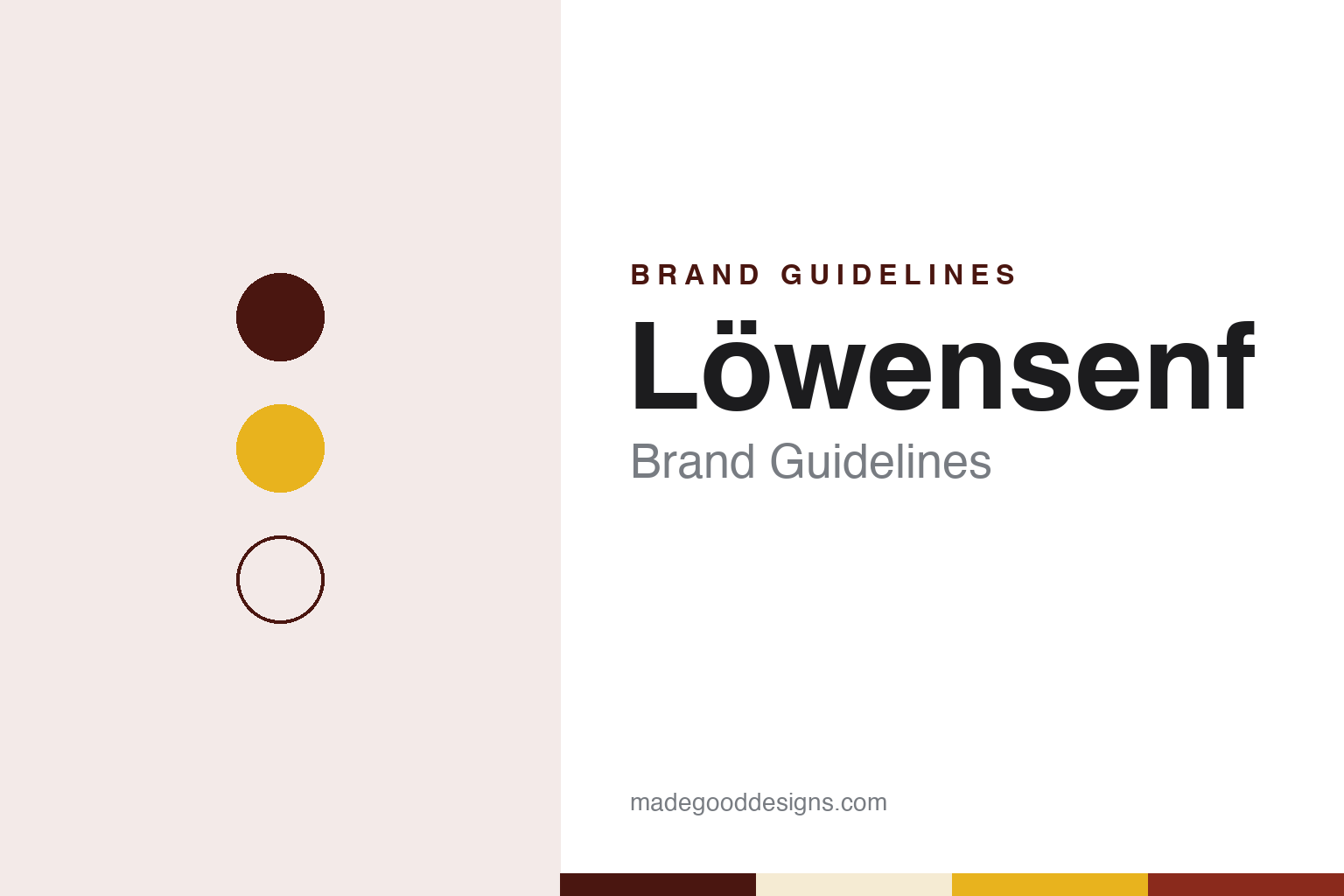
Two constants: a lion red, mustard yellow and stoneware cream palette and a sturdy slab serif register. Abstract homage — not a Löwensenf product or mark; no jar, label or logo is reproduced.
From Metz to the Rhine
A vinegar and mustard works in Lorraine, rebuilt in Düsseldorf.
Löwensenf is one of the best-known mustards of Düsseldorf, but it did not start there. German and English Wikipedia, citing a company history written by an employee in 1966, say Otto Frenzel founded the Erste Lothringische Essig- und Senffabrik — the First Lorraine Vinegar and Mustard Factory — in Metz on 1 November 1903; a Rheinische Post article marking the centenary in November 2003 gave the date as 15 November. Metz was then part of the German Empire. The company today names Otto and his wife Frieda Frenzel together as its founders.
The First World War ended that first business. After 1918, German Wikipedia says, residents of Lorraine with German citizenship had to leave, and the Frenzels built a new works in Düsseldorf; the firm moved there in 1920 as the Neue Düsseldorfer Senfindustrie Otto Frenzel. The company says the couple chose Düsseldorf because the city was already Germany’s leading mustard town, where the mustard maker ABB had been founded in 1726, and that they brought a recipe “rescued from France”: a mustard made only from brown mustard seed that is nonetheless light in colour, because the husks are spun out during production.
Otto Frenzel died in 1936, and Frieda Frenzel ran the business on as Düsseldorfer Senfindustrie O. Frenzel, German Wikipedia says. Production was interrupted by the Second World War and restarted in 1948. The company says it grew from 1950 and became known abroad, and that Frieda Frenzel received the Federal Cross of Merit, first class, in 1963. It still quotes her rule for the recipe: use only ingredients of the best quality, prepare them naturally and leave out anything artificial.
Colour
Extra, a city lion and a little barrel of glass.
The product that made the name is Löwensenf Extra, launched in 1920. German Wikipedia calls it the company’s best-known product and says it is made by the Dijon method; the company goes further and calls it the first German mustard made that way, and says its name comes from its particular heat. “Löwensenf” means “lion mustard.” The lion refers to the Bergish lion in Düsseldorf’s coat of arms, German Wikipedia says, and the company says the lion was registered as its trademark in 1920, modelled on the city’s arms. The brand name later passed to the company itself.
The jar is the other part of the identity. The company says its early stoneware pots were marked “OFD,” for Otto Frenzel Düsseldorf, and that in 1925 it became the first German company to pack mustard in glass and fill it under vacuum, so that the mustard kept its heat without preservatives. Its own account of the jar runs from stoneware pots, which could not be sealed well, to crystal glasses with push-on lids, to a tinplate tube, and finally to a glass jar with an airtight twist-off lid, shaped after the traditional stoneware pot. Because of that shape, the company says, the jar was nicknamed the “Tönnchen” — the little barrel — and it still uses the name.
The range widened slowly. The company dates its Medium mustard to 1984, a sweet mustard to 1991 and an organic medium-hot mustard to 2008, and in 2020 it marked a hundred years of Extra, which it says is still made from four natural ingredients. German Wikipedia adds speciality mustards such as an Altbier mustard and a fig mustard, and mustard creams for seasoning dishes such as beef roulades and meatballs.
Typography
Design and documentation.
The seven brands in this group all make mustard, and they come from four countries: Maille, Colman’s, Amora, Edmond Fallot, Develey, Thomy and Löwensenf, from France, Britain, Germany and Switzerland. Mustard brands in general sit at many different points in the trade, from family firms that still carry a founder’s surname to names that now belong to much larger food groups, and a single brand can be sold everywhere from a specialist shop to a supermarket shelf.
A mustard brand’s identity is usually carried less by a single product than by a jar, a name and the table it promises, because the company behind the name may have changed hands, moved its factory or grown far beyond the town where it started. That makes the questions behind each name worth asking plainly: who started it, who owns it now, and where its mustard is actually milled and packed.
Each guide separates what independent sources record from what the company says about itself — its founding story, its owners over time, where its mustard is made and how its packaging has changed — and marks plainly what rests only on the company’s own word.
Aa
A sturdy slab serif for a mustard with a city lion. (Specimen set in Roboto Slab, a serif STAND-IN; NOT the Löwensenf logo.)
Löwensenf
Düsseldorf’s oldest mustard names, then Develey.
In the mid-1960s Löwensenf took over two older Düsseldorf mustard makers, ABB and Radschläger, German and English Wikipedia say; the company dates its purchase of A.B. Bergrath, which it calls the city’s oldest mustard factory, to 1965. ABB’s initials are those of Adam Bernhard Bergrath, and its grey stoneware pot with blue initials and an anchor appears in a still life painted by Vincent van Gogh at Nuenen in 1884, now in the Van Gogh Museum in Amsterdam, German Wikipedia says. Since August 2012 the name Düsseldorfer Mostert has been a protected geographical indication under EU law, reserved for mustard from Düsseldorf. Its factory near Düsseldorf Airport, in Lichtenbroich, had stood on that site since 1965, the trade press reported in 2025.
Ownership changed in 2001. That year Löwensenf began working with Develey Senf & Feinkost, the family-owned mustard and sauce maker based in Unterhaching near Munich, which took over distribution; German Wikipedia, citing the trade paper AHGZ and later press, says Develey took the company over fully in 2001 and that it has since been a Develey subsidiary with its own plant in Düsseldorf. On 17 February 2014 the company name was shortened from Düsseldorfer Löwensenf GmbH to Löwensenf GmbH.
In February 2025 Develey announced that it would end Löwensenf production in Düsseldorf and move it chiefly to its subsidiary Born Senf & Feinkost in Erfurt, in Thuringia, Lebensmittel Praxis reported, citing a lack of development prospects for the rented site, which produced about 6,000 tonnes of mustard a year. Develey chief executive Stefan Durach said the decision had been very hard because the company felt bound to Düsseldorf by tradition. Reports that month tied the timing to a lease running until the end of 2026; in June 2025 Lebensmittel Praxis, the Lebensmittel Zeitung and t-online reported that production would wind down by the end of 2025, with 48 employees affected and a social plan agreed. Develey said the mustard would be made at other group sites with an unchanged recipe and quality, and that its Löwensenf mustard shop in Düsseldorf’s old town, opened in 2004 with a small historical exhibition, would stay open.
For a design guide, Löwensenf shows how a civic emblem and a jar shape can carry a brand through a border change, a war and a change of owner. Compare Develey, the Munich-area group that owns it, and Grey Poupon, another mustard built on the Dijon method. For this guide we use a lion red, a mustard yellow and a stoneware cream with a slab serif, an unofficial interpretation; no product or logo is reproduced.
Explore & save
Keep Löwensenf’s identity on hand — save it to a board in the Made Good inspiration library.
Löwensenf identity set
Pin the Löwensenf lion red, mustard yellow and stoneware cream palette and the sturdy slab serif register to your own board.