Knorr Brand Guidelines
Heilbronn chicory, the Erbswurst and the stock cube.
Aa
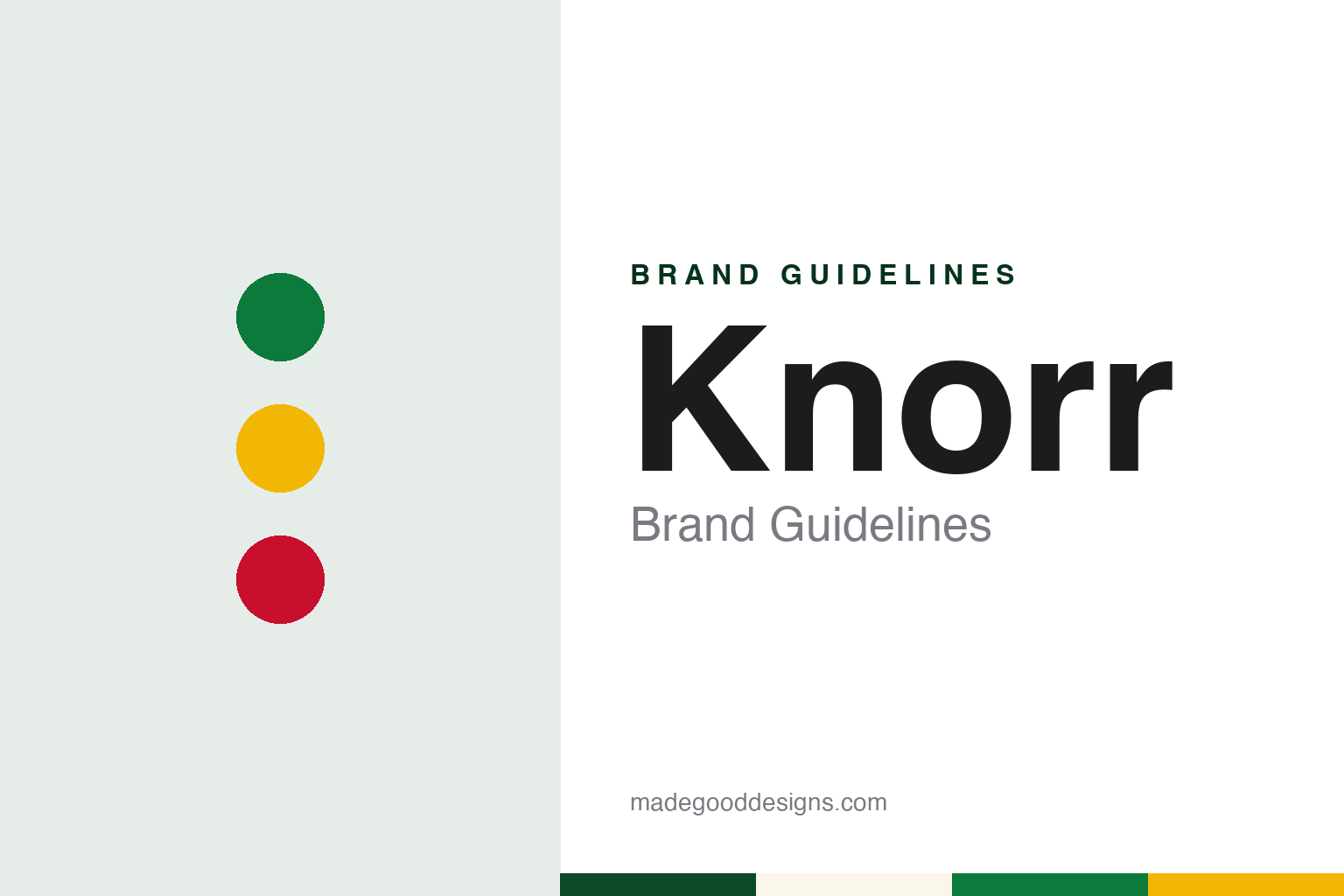
Two constants: a Knorr green, stock-cube gold and tomato red palette and a warm old-style serif register. Abstract homage — not a Knorr product or mark; no pack, cube or logo is reproduced.
Chicory in Heilbronn
A grocer, a dowry and a coffee substitute.
Knorr dates itself to 1838, but it did not begin with soup. Carl Heinrich Theodor Knorr, a merchant born in 1800 at Meerdorf near Braunschweig, came to Heilbronn on business, married Caroline Seyffardt, the daughter of a Heilbronn merchant, in April 1838, and that year opened a grocery shop in the town, announcing it in a local newspaper advertisement dated 29 August 1838, German Wikipedia says, citing a family chronicle published in 1959. Two-thirds of his starting capital came from her dowry.
His first factory made chicory, the roasted root sold as a coffee substitute. Knorr received the concession to build it on 28 September 1838; it grew to 53 workers, then the largest factory in Heilbronn, and sold its chicory coffee in Württemberg, Baden, Bavaria and Switzerland before he sold the works in 1855. A cloth mill he founded in 1857 failed within a year, and Knorr turned to the wholesale trade in rice, barley, sago and other farm produce, dealing across the German states and as far as Hungary.
Food production came with his sons. Carl Heinrich Eduard and Alfred Knorr joined the business in 1866 and 1870, and in the early 1870s the firm began milling flours from green spelt, peas, beans and lentils, sold under a beehive trademark — a symbol, German Wikipedia says, of an industrious people. In 1873 it began making soup preparations from pulse flour, dried vegetables and spices, an early form of packet soup; the sons had come across the idea in France. Carl Heinrich Knorr died in 1875, and his sons built the business into a large soup factory.
Colour
Tablets, a pea sausage and the stock cube.
Knorr grew through new formats. According to German Wikipedia, its soups were sold as powder in bags, as tablets from 1886, in sausage form as the Erbswurst, a pea-soup “sausage,” from 1889 — made until 2018 — and as soup cubes from 1910; a liquid seasoning followed in 1908 and beef stock cubes in 1911. English Wikipedia gives 1912 for the first Knorr bouillon cube. Fridtjof Nansen’s polar expedition of 1893 lived on Knorr products, and at Heilbronn’s trade and industry exhibition of 1897 the company showed a pressed vegetable block of one cubic metre, said to make 70,000 portions of soup.
The firm became a joint-stock company, C. H. Knorr AG, in 1899 and built abroad: factories at Wels in Austria and at Thayngen in Switzerland in 1907, a bouillon plant at Nancy in 1909 and a soup factory at Monza in 1912. The First World War cost it its French and Italian branches and cut the Swiss plant off from Heilbronn; in 1922 Thayngen became a separate company, Knorr-Nährmittel AG. There, German Wikipedia says, citing the Bern newspaper Der Bund, Knorr launched the seasoning Aromat in 1953.
Knorr also built characters. In Switzerland a gnome-like figure called Knorrli, with a pointed cap, clogs and a cooking spoon, designed by Hans Tomamichel, has advertised the brand since the 1940s, German Wikipedia says, citing the Swiss National Museum; in 1960s Germany the mascots were an ox called Knorri and a potato in a flat cap called Stocki.
Typography
Design and documentation.
The seven brands in this group all make the seasonings, stocks, tomatoes and sauces that sit behind a meal, and they come from Switzerland, Germany, Italy, Britain, Hong Kong and the United States: Maggi, Knorr, Mutti, Cirio, Patak’s, Lee Kum Kee and Old El Paso. Brands in this part of the store cupboard in general sit at many different points in the trade, from family firms that still carry a founder’s surname to names that now belong to much larger food groups, and a single brand can be sold everywhere from a corner shop to a supermarket shelf on another continent.
A sauce or stock brand’s identity is usually carried less by a single product than by a jar, a cube, a tin, a name and the kitchen it promises, because the company behind the name may have changed hands, moved its factory or grown far beyond the town where it started. That makes the questions behind each name worth asking plainly: who started it, who owns it now, and where its products are actually made and packed.
Each guide separates what independent sources record from what the company says about itself — its founding story, its owners over time, where its products are made and how its packaging has changed — and marks plainly what rests only on the company’s own word.
Aa
A warm old-style serif for a soup maker with nearly two centuries behind it. (Specimen set in Fraunces, a serif STAND-IN; NOT the Knorr logo.)
Knorr
Maizena, Bestfoods, Unilever — and McCormick next.
The Knorr family gave up control in stages. The Hamburg company Deutsche Maizena-Werke, which German Wikipedia describes as a subsidiary of the American group CPC, bought into Knorr from 1922 and became majority owner in 1958–59 with 58.4% of the shares; Alexander Knorr, the last of the family on the management board, left in 1958. In 1964 CPC and a subsidiary of Ajinomoto brought Knorr soups to Japan, where, English Wikipedia says, Ajinomoto still makes them under licence. Maizena built an automated soup factory in Heilbronn in 1969 and moved its head office there from Hamburg in 1987. In 1998 the group became Bestfoods, and in 2000 Unilever bought Bestfoods.
Under Unilever, the home plant has been both kept and questioned. In October 2016 Unilever announced it would close its Heilbronn development centre and move the 220 staff to the Netherlands. In October 2019 the Heilbronner Stimme reported plans to close the Heilbronn factory, then employing 550 people; in June 2020 a revised wage agreement with smaller pay rises secured the site and its jobs until 2030, the Stuttgarter Nachrichten reported, and in 2024 the Heilbronner Stimme reported that the plant would take over production from a site in Saxony. At Thayngen, Unilever cut 60 of 160 production jobs in 2020 and said Swiss production would concentrate on the home market, SRF reported. Unilever says Knorr, sold in eight countries in 1957, is now sold in more than 90.
The next change of owner is agreed but not complete. On 31 March 2026 Unilever and the American spice company McCormick announced a deal to combine Unilever’s food business, about 70% of whose sales come from Knorr and Hellmann’s, CNBC reported, with McCormick, in a transaction valued at $44.8 billion. Unilever’s shareholders would own 55.1% of the combined company and Unilever itself 9.9%; the deal excludes Unilever’s food business in India and some smaller markets and is expected to close by mid-2027, subject to shareholder and regulatory approval, Financier Worldwide reported.
For a design guide, Knorr shows how a brand built on formats — the tablet, the pea sausage, the cube — can carry a founder’s surname through nearly two centuries and several owners. Compare Hellmann’s, the mayonnaise that came to Unilever with Bestfoods, and French’s, the mustard McCormick owns. For this guide we use a Knorr green, a stock-cube gold and a tomato red with a serif, an unofficial interpretation; no product or logo is reproduced.
Explore & save
Keep Knorr’s identity on hand — save it to a board in the Made Good inspiration library.
Knorr identity set
Pin the Knorr green, stock-cube gold and tomato red palette and the warm old-style serif register to your own board.