Di Martino Brand Guidelines
The 1912 Gragnano pasta family that grew into a group.
Aa
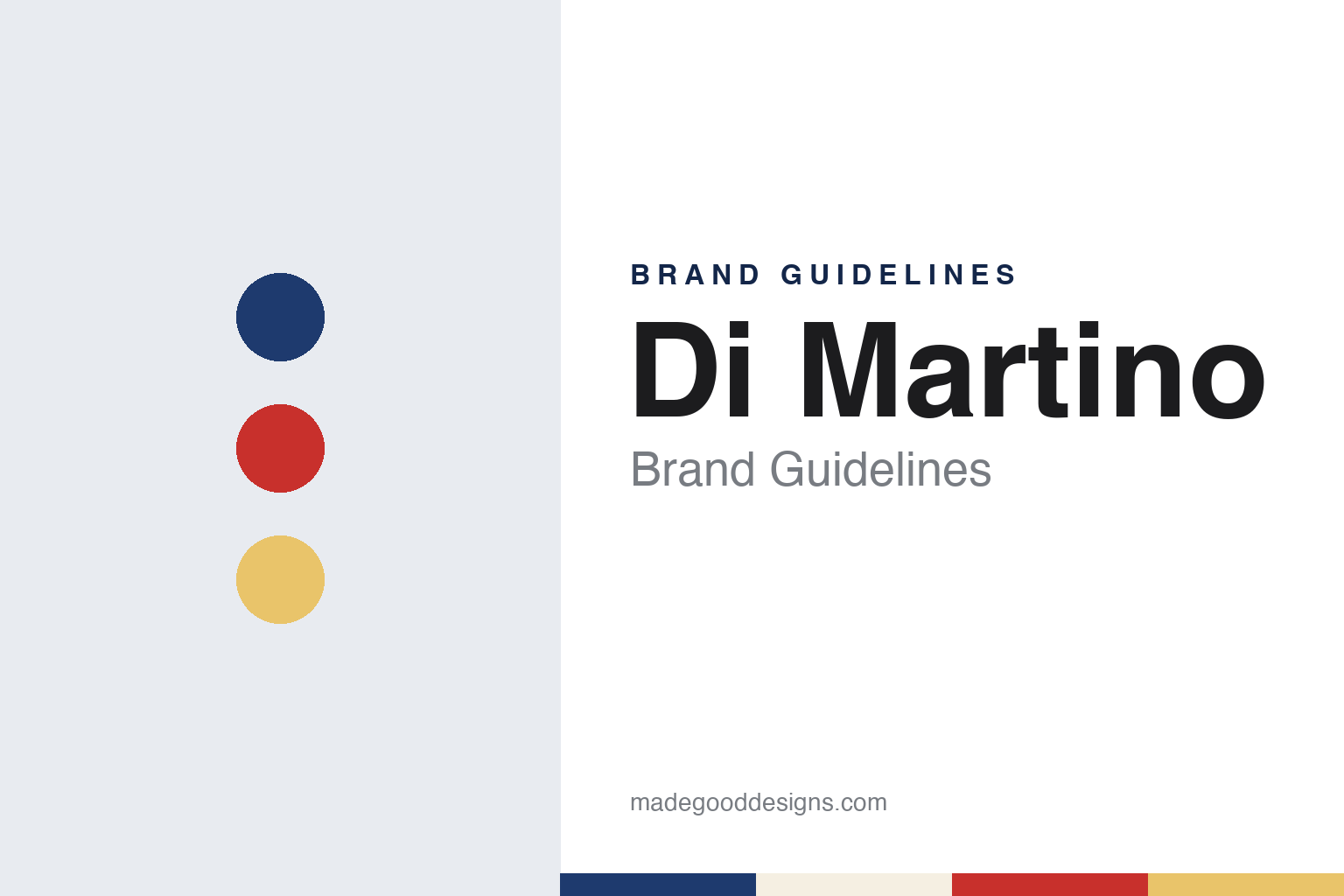
Two constants: a Gragnano blue, band red and semolina palette and a high-contrast Italian serif register. Abstract homage — not a Di Martino product or mark; no pack, logo or pasta is reproduced.
A pasta town and a family
Gragnano, 1912, and a company that kept its name.
Di Martino comes from Gragnano, the hill town above the Bay of Naples whose dried pasta has been protected in the European Union as Pasta di Gragnano IGP since 2013. The company’s own timeline says Giuseppe Di Martino founded a pasta factory under his own name there in 1912, and English Wikipedia, citing The Washington Post and Slow Food USA, gives the same founding year. The company is still run by the family: the BBC, in a 2019 travel feature on Gragnano, described the chief executive, also called Giuseppe Di Martino, as the third generation of the family in the business.
The company’s account of its early decades is one of interruptions. It says that in the 1940s the fascist regime made it trade as “Pastificio Impero,” and that the factory was bombed during the war and looted by retreating German troops. In 1944, the timeline continues, the founder’s sons Giovanni and Gaetano joined the business, and in 1948 production resumed under the family name; two more sons, Valerio and Vincenzo, followed. The company also says it sent the first pasta through the Panama Canal in 1915 and installed one of Italy’s first continuous production lines in 1954 — both claims that appear in its own history rather than in independent sources.
In 1977, the company says, the founder’s sons Gaetano, Valerio and Lucio took over. Three years later the 1980 Irpinia earthquake devastated the plant; the family says operations were running again within six months and that a new wing opened in 1983. The legal name recorded on English Wikipedia, Pastificio Di Martino Gaetano & F.lli, still carries the name of one of those sons and “brothers.”
Colour
From one factory to seven.
Growth came in the 2000s and 2010s. The company says it opened a plant at Pastorano, in the province of Caserta, in 2006, and in 2009 launched Pastificio dei Campi, a separate premium brand made in Gragnano. In 2012 the group added a historic name from Salerno. Antonio Amato, founded in 1958 by the man it was named after and known in Italy as a sponsor of the national football team, had been declared bankrupt by the court of Salerno in July 2011. Italian Wikipedia says Di Martino won the auction to lease the business in May 2012, relaunched the brand on 15 October 2012 with 30 shapes and completed the purchase in March 2014; the company dates the arrival of Antonio Amato, and its own centenary, to 2012.
The next step took Di Martino beyond dried pasta. In May 2017 it bought a 66.67% majority of Grandi Pasti Italiani, an Emilia-Romagna maker of fresh pasta and of fresh and frozen gnocchi, Just Food reported; the deal, signed on 2 May, brought four fresh-pasta brands — Italgnocchi, Bertarini, Pasta di Casa Mia and Le Delizie del Pastaio — into the group. Just Food said it took the number of production sites to seven, across Campania, Emilia-Romagna and Lombardy, and quoted Giuseppe Di Martino, as managing director, on the group’s plans to grow turnover; ESM Magazine reported the deal the same week.
Alongside the factories, the family built places to show the pasta off. A Di Martino dining space opened at FICO Eataly World in Bologna, the food theme park that The New York Times previewed in December 2017; Wikipedia dates the Di Martino space to 2018. In 2020 the group became main sponsor of the Teatro di San Carlo, the Naples opera house, and in November 2021 it opened its first New York shop, La Devozione, which Eater NY and The New York Times listed among the city’s openings that month.
Typography
Design and documentation.
The seven brands in this group all make pasta, and all of them come from Italy: Granoro, Pastificio dei Campi, Di Martino, Setaro, Benedetto Cavalieri, Agnesi and Giovanni Rana. Italian pasta makers in general sit at many different points in the trade, from small family workshops that still carry a founder’s surname to names that now belong to much larger food groups, and the same word, pasta, covers both dried shapes made from durum wheat semolina and fresh or filled pasta sold from the chiller.
A pasta brand’s identity is usually carried less by a single shape than by a pack, a name and the place it promises, because the company behind the name may have changed hands, moved its factory or grown far beyond the town where it started. That makes the questions behind each name worth asking plainly: who started it, who owns it now, and where its pasta is actually made and packed.
Each guide separates what independent sources record from what the company says about itself — its founding story, its owners over time, where its pasta is made and how its packaging has changed — and marks plainly what rests only on the company’s own word.
Aa
A high-contrast Italian serif for a Gragnano family name. (Specimen set in Bodoni Moda, a serif STAND-IN; NOT the Di Martino logo.)
Di Martino
Tiles, a family table and a fashion house.
Di Martino’s best-documented design moment is a collaboration with Dolce & Gabbana. In November 2017 the Milan fashion house and the pasta maker announced a limited range of packs, and the design site MOLD reported that the new boxes replaced the brand’s usual red and blue bands with the majolica-style tile patterns associated with Dolce & Gabbana. MOLD described a line drawing of three generations of a family around a table and the slogan “la famiglia, la pasta, l’Italia!”, along with a limited-edition tin, numbered at 5,000 worldwide, of which about 1,000 were set aside for the United States. English Wikipedia, citing i-Italy, and the company’s own timeline date the Dolce & Gabbana packaging to 2018, when it reached shops; the announcement came at the end of 2017.
The Di Martino label is one name in a wider family portfolio. The group sells dried pasta from Campania under the Di Martino, Pastificio dei Campi and Antonio Amato names, and, since 2017, the fresh-pasta and gnocchi brands from Emilia-Romagna reported by Just Food.
For a design guide, Di Martino shows how a family pasta name can borrow a fashion house’s tiles for a season and still return to its own red-and-blue bands. Compare Garofalo, another Gragnano maker, and Pastificio dei Campi, the family’s premium Gragnano brand. For this guide we use a Gragnano blue, a band red and a semolina yellow with a high-contrast serif, an unofficial interpretation; no product or logo is reproduced.
Explore & save
Keep Di Martino’s identity on hand — save it to a board in the Made Good inspiration library.
Di Martino identity set
Pin the Di Martino Gragnano blue, band red and semolina palette and the high-contrast Italian serif register to your own board.