Lay’s Brand Guidelines
From a Nashville warehouse to a sun on every shelf.
Aa
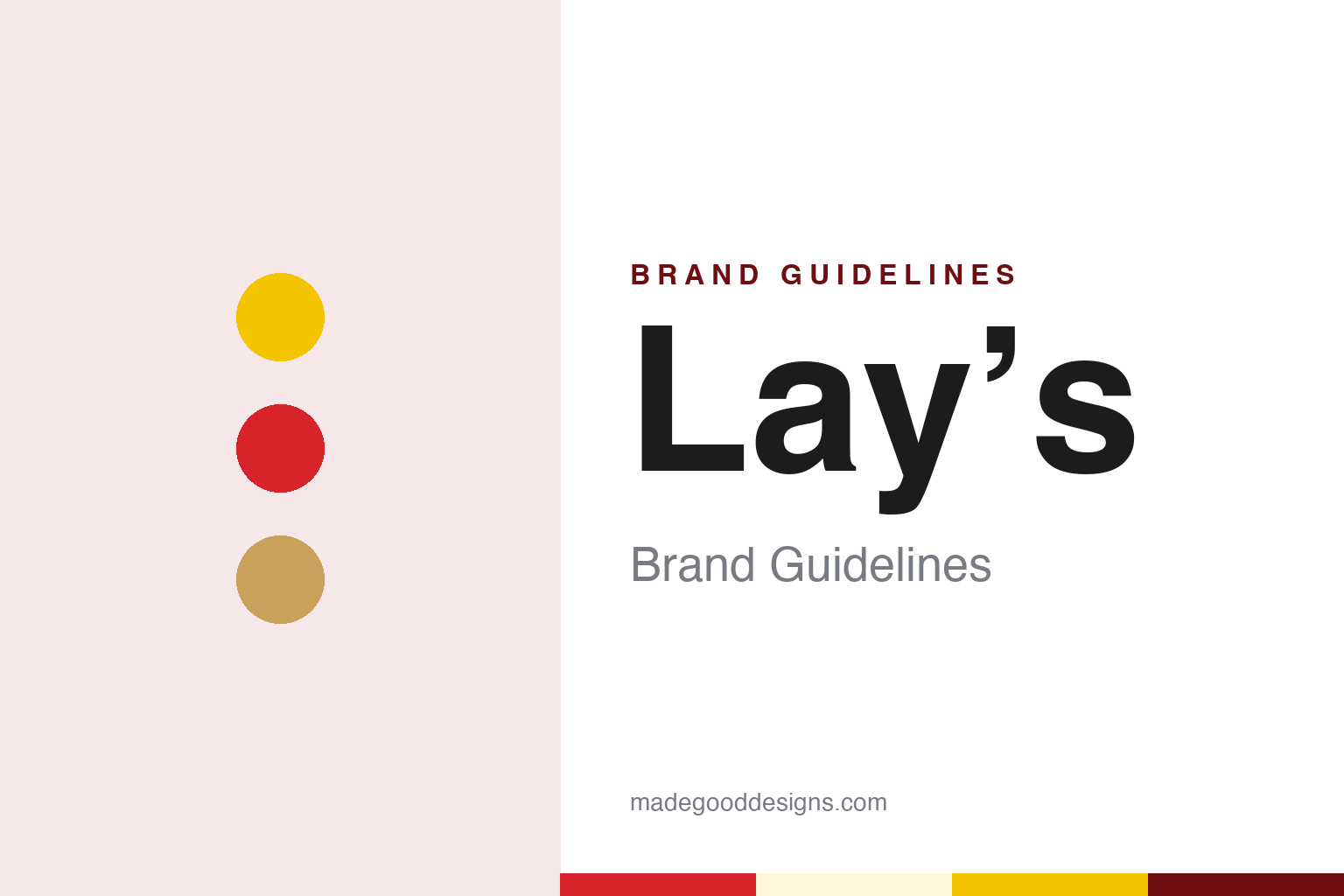
Two constants: a banner red, sun yellow and chip gold palette and a bold friendly display sans register. Abstract homage — not a Lay’s product or mark; no pack, logo or chip is reproduced.
A salesman’s chips
A warehouse in Nashville, a bought plant in Atlanta and a new name.
Lay’s takes its name from Herman W. Lay, a salesman born in Charlotte, North Carolina, in 1909, whose death in Dallas in December 1982 was reported by The New York Times under the headline that his success was “tied to potato chips.” English Wikipedia’s history of Frito-Lay, drawing on the International Directory of Company Histories, says Lay was selling potato chips around the American South from his car by 1931. In 1932 he went to work for the Barrett Food Products Company of Atlanta, which made Gardner’s Potato Chips, and took over Barrett’s warehouse in Nashville, Tennessee, as its distributor. A 2011 PepsiCo staff history, cited by English Wikipedia, says he started out on $100 of borrowed money.
The business grew quickly. Lay hired his first salesman in 1934, and by 1937 he had 25 employees and a larger plant that also made popcorn and peanut-butter sandwich crackers. In 1938 Barrett offered to sell him its plants in Atlanta and Memphis for $60,000; Lay borrowed half from a bank and persuaded Barrett to take the rest in preferred stock. He moved his headquarters to Atlanta and in 1939 formed H.W. Lay & Company, later adding plants in Jacksonville, Jackson, Louisville and Greensboro.
The chips themselves did not carry his name at first. Lay kept selling them under Barrett’s Gardner trademark until 1944, when the product was renamed Lay’s Potato Chips, according to Dirk E. Burhans’ history Crunch! A History of the Great American Potato Chip (2008). By 1956, the food historian Andrew F. Smith writes in Eating History (2009), H.W. Lay & Company had more than 1,000 employees and plants in eight cities, and was the largest maker of potato chips and snack foods in the United States.
Colour
Fritos, Pepsi-Cola and a famous bet.
Lay’s became part of a bigger company through a partnership with a Texan rival. In 1945 the Frito Company of Dallas, maker of Fritos corn chips, gave H.W. Lay & Company an exclusive franchise to make and distribute Fritos in the Southeast. In September 1961 the two firms merged as Frito-Lay, Inc., with headquarters in Dallas and annual revenues of $127 million, English Wikipedia says, citing a Gale company profile. Four years later Herman Lay, as Frito-Lay’s chairman and chief executive, and Donald M. Kendall of Pepsi-Cola brought their companies together: shareholders of both approved the merger on 8 June 1965, creating PepsiCo, Inc. Frito-Lay then had 46 manufacturing plants, according to Edward M. Mazze and Ronald D. Michman’s The Food Industry Wars (1998).
The brand’s best-known line dates from the same years. “Betcha can’t eat just one” was a 1963 campaign written for Lay’s by the agency Young & Rubicam, with television spots starring the comic actor Bert Lahr, the Cowardly Lion of The Wizard of Oz, who appeared in a series of different costumes; a Lay’s newspaper advertisement in the Salt Lake Tribune carried the line in March 1965. In 1992, The New York Times reported, the slogan was reworked as “Too good to eat just one” for spots with the basketball players Larry Bird and Kareem Abdul-Jabbar.
The range widened from the 1990s. English Wikipedia says the company introduced a crisper formulation in 1991, and Brandweek reported the national rollout of Lay’s Wavy in January 1994; baked and kettle-cooked varieties followed, along with Lay’s Stax, a stackable chip. In July 2012 Lay’s launched its first US “Do Us a Flavor” contest, inviting the public to propose a new flavour. Cheesy Garlic Bread won the public vote in May 2013, beating Sriracha and Chicken & Waffles, and its creator, a librarian from Wisconsin, received the $1 million prize, trade and local press reported. Walkers had run its own “Do Us a Flavour” contest in Britain from July 2008.
Typography
Design and documentation.
The seven brands in this group are savoury snack and crisp brands, mostly British, with one global sister brand: Hula Hoops, Monster Munch, Quavers, Wotsits, McCoy’s, Burts and Lay’s. Snack brands in general sit at many different points in the trade, from small makers that still carry a founder’s name to names that now belong to much larger food groups, and a single brand can be sold everywhere from a corner shop to a supermarket aisle.
A snack brand’s identity is usually carried less by a single product than by a pack, a name and the shape or flavour it promises, because the company behind the name may have changed hands, moved its factory or grown far beyond the town where it started. That makes the questions behind each name worth asking plainly: who started it, who owns it now, and where its snacks are actually made and packed.
Each guide separates what independent sources record from what the company says about itself — its founding story, its owners over time, where its snacks are made and how its packaging has changed — and marks plainly what rests only on the company’s own word.
Aa
A bold friendly display sans for a chip sold under one banner and many names. (Specimen set in Lilita One, a sans STAND-IN; NOT the Lay’s logo.)
Lay’s
One banner, many local names.
Lay’s is now a PepsiCo brand made and sold by Frito-Lay, which has its headquarters in Plano, Texas, and forms part of PepsiCo’s North American business. Outside the United States and Canada, PepsiCo sells the same kind of chip under the Lay’s name in many countries but keeps local names in others: Walkers in Britain and Ireland, Smith’s in Australia, Sabritas in Mexico, Chipsy in Egypt and the western Balkans, and Margarita in Colombia, while in Israel the Strauss group sells the chips as Tapuchips, English Wikipedia says. Several of those names came through acquisitions: PepsiCo bought Sabritas in 1966, Walkers in 1989 and Smith’s in Australia in 1998. In Belgium and the Netherlands, the Smiths chips that PepsiCo acquired in 1992 were renamed Lay’s in 2001, De Standaard reported, and in France Lay’s replaced the Croky name in 2003, according to Capital.
What ties those names together on the shelf is the banner. English Wikipedia describes the Walkers logo as a red ribbon around a yellow sun, noticeably similar to Lay’s, and notes that the Mexican Sabritas mark keeps the red ribbon but puts a stylised smiling face where the sun would be. In Britain the same parent also owns Wotsits, which Walkers bought from Golden Wonder in 2003.
In October 2025 PepsiCo unveiled what it called the largest redesign in the brand’s nearly 100-year history. The company says the yellow sun was made warmer and more distinct, with new rays “a nod to the light that helps potatoes grow,” that pack colours were tuned to flavours such as pickle green, hickory brown and savoury red, and that photography was changed to show the colour and texture of the chips, while the red ribbon seal stayed as it was. The work was done in-house by PepsiCo’s Design & Innovation team, led by Carl Gerhards, its senior director of design for global Lay’s, who described it as a flexible design system for the brand’s flavours around the world.
For a design guide, Lay’s shows how one sun-and-ribbon banner can carry a single potato chip across dozens of markets while the name printed on it changes. Compare Fritos, the corn chip it merged with in 1961, and Ruffles, its ridged Frito-Lay stablemate. For this guide we use a banner red, a sun yellow and a chip gold with a bold sans, an unofficial interpretation; no product or logo is reproduced.
Explore & save
Keep Lay’s’s identity on hand — save it to a board in the Made Good inspiration library.
Lay’s identity set
Pin the Lay’s banner red, sun yellow and chip gold palette and the bold friendly display sans register to your own board.