Kettle Chips Brand Guidelines
The Oregon chip that settled in Norwich.
Aa
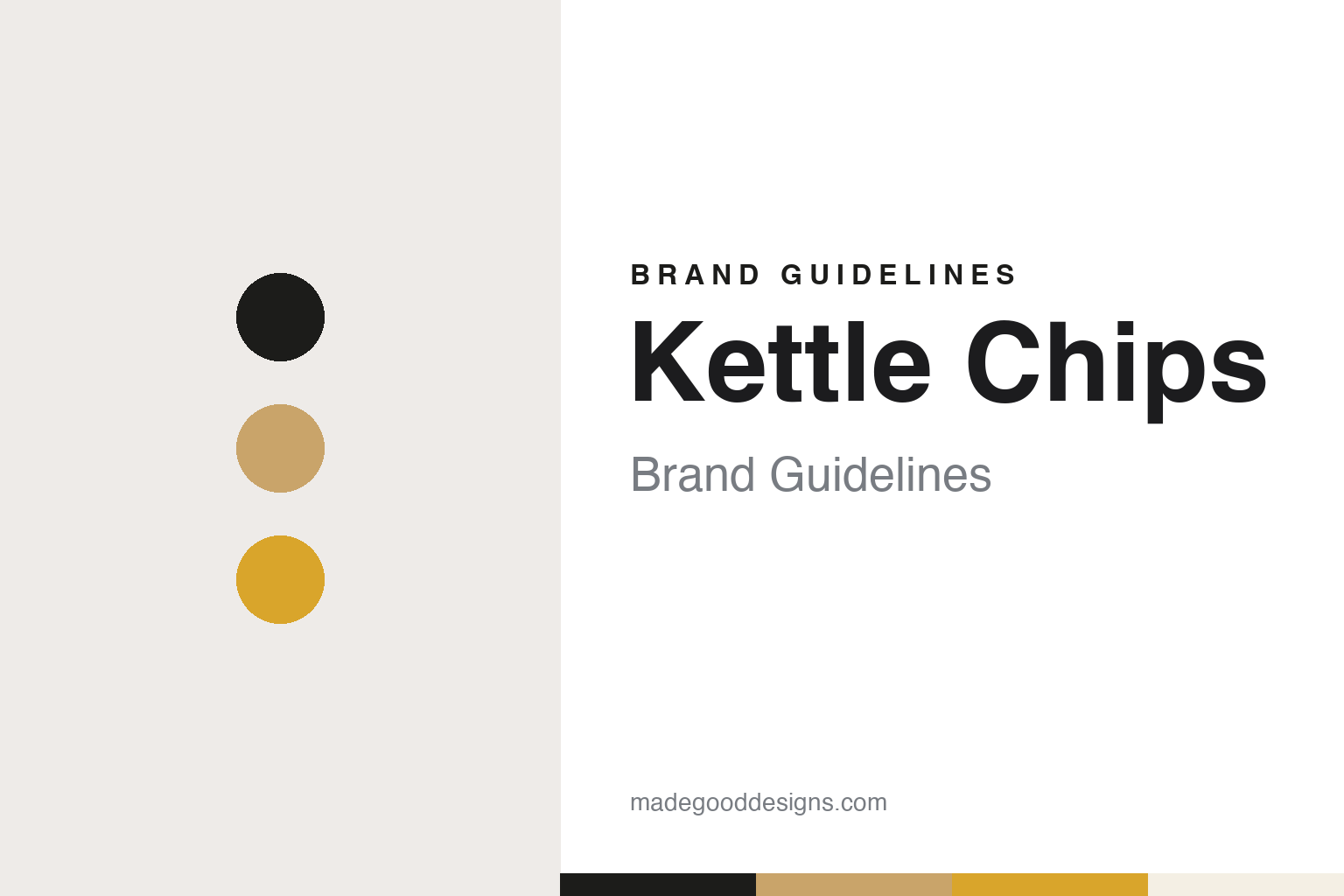
Two constants: a kettle black, kraft brown and potato gold palette and a sturdy slab serif register. Abstract homage — not a Kettle Chips product or mark; no pack, logo or chip is reproduced.
Pot chips
An Oregon wholesaler, a Hawaiian chip and a kettle.
Kettle Chips began in Salem, Oregon. Cameron Healy set up the business as the N. S. Khalsa Company, after his Sikh name, Nirbhao Singh Khalsa, selling natural foods such as nuts, cheese and trail mix to health-food stores, according to the International Directory of Company Histories (2003). That history dates the company to 1978; English Wikipedia gives 1977 in its text and 1978 elsewhere. The company made its first potato chips in 1982.
The chip came out of a visit to Hawaii. The Directory says Healy studied the traditional methods of a potato-chip maker on Maui before launching his own, cooked in batches in large kettles. He considered calling them “pot chips,” an old East Coast term, before settling on Kettle Chips, a name that described the cooking method. The early bags, the Directory says, were paper sacks printed in earth tones with a logo showing a man stirring chips in a kettle. In 1988, the same history says, the company took the name Kettle Foods.
The British business grew out of a holiday. Wikipedia says the UK branch followed a motorcycle trip taken by the founder; the Directory dates the trip to 1987 and names Tim Meyer, a Salem native living in London, as Healy’s partner in the venture. Production began in Norwich in 1988 in a former shoe factory on Vulcan Road, near the city’s airport, the Eastern Daily Press reported in 2011; the Directory says Kettle at first rented part of a factory belonging to the British chip maker Tuckers. In 1993 the company moved to a newly built factory at Bowthorpe, on the outskirts of Norwich, where its British crisps are still made.
Colour
Two continents, two owners.
Kettle’s ownership has split along the Atlantic. In 2006 the business was sold to the British private-equity firm Lion Capital, Wikipedia says, for a reported $280–320 million. Lion sold it in 2010 to California’s Diamond Foods, owner of Pop Secret popcorn, for $615 million. Snyder’s-Lance completed its takeover of Diamond Foods in February 2016, and in March 2018 Snyder’s-Lance, with Kettle, was bought by the Campbell Soup Company.
Campbell kept the British side for little more than a year. On 11 October 2019 it completed the sale of its European chips business, made up of the Norwich-based Kettle Foods Limited and the Dutch company Yellow Chips B.V., to Valeo Foods, an Irish food group then owned by the private-equity firm CapVest, for about £66 million, Campbell announced. Campbell kept the Kettle Brand business in the United States and in every other market except Europe and the Middle East. In 2021 CapVest agreed to sell Valeo Foods to Bain Capital; Food Manufacture reported the agreement that May, and the deal closed that September. Kettle Chips in Britain and Kettle Brand in America have therefore had different owners since 2019. The “Kettle” chips sold in Australia by Snack Brands Australia are a separate brand, unaffiliated with Kettle Foods, Wikipedia says.
In the United States, Kettle Foods remains based in Salem, where Wikipedia says it installed the largest solar array in the Pacific Northwest in 2003. In September 2007 it opened a second American plant in Beloit, Wisconsin, the first manufacturing plant to be awarded gold certification under the LEED green-building programme, according to Wikipedia. Campbell, which now trades as The Campbell’s Company, sells those chips as Kettle Brand.
Typography
Design and documentation.
The seven brands in this group all make crisps, and all of them come from Britain and Ireland: Walkers, Kettle Chips, Tyrrells, Pipers, Golden Wonder, Seabrook and Tayto. British and Irish crisp brands in general sit at many different points in the trade, from family firms that still carry a founder’s name to names that now belong to much larger food groups, and a single brand can be sold everywhere from a village pub to a supermarket shelf.
A crisp brand’s identity is usually carried less by a single product than by a packet, a name and the flavour or snack it promises, because the company behind the name may have changed hands, moved its factory or grown far beyond the town where it started. That makes the questions behind each name worth asking plainly: who started it, who owns it now, and where its crisps are actually made and packed.
Each guide separates what independent sources record from what the company says about itself — its founding story, its owners over time, where its crisps are made and how its packaging has changed — and marks plainly what rests only on the company’s own word.
Aa
A sturdy slab serif for a chip named after its cooking pot. (Specimen set in Roboto Slab, a serif STAND-IN; NOT the Kettle Chips logo.)
Kettle Chips
Norfolk potatoes and a growing family of snacks.
In Britain the brand is made and run from Norfolk. Kettle Foods Ltd says its head office sits alongside the KETTLE® Chips factory at Bowthorpe in Norwich and that it has been making snacks in the city for more than 30 years; the company styles the brand name in capitals. It says it works with local farmers through a KETTLE Growers Group, and that a £1 million grant from the European Agricultural Fund for Rural Development went towards a £2.7 million building at Bowthorpe for taking in potatoes. It describes KETTLE Chips as the nation’s favourite hand-cooked brand, which is the company’s own claim.
The Norwich business has also become a small snack group. Kettle Foods Ltd says it bought the Metcalfe’s popcorn business, with a factory in Wednesbury, in 2016, and a snacks factory in Gateshead, bringing in Manomasa tortilla chips, in 2020. Its place in the market was set out by the Eastern Daily Press in 2011: by September 2008 Kettle had sales of about £59 million and a 4.2% share of the British crisp market, making it the third-largest crisp brand, and the paper said the arrival of Walkers’ premium Sensations range in 2002 had unsettled the market. More recently, in April 2025, Valeo Foods UK named KETTLE Chips the official crisps supplier to the Women’s Rugby World Cup 2025, held in England.
For a design guide, Kettle Chips shows how a cooking method can become a brand name, and how that name can carry on after being split between owners on two continents. Compare Tyrrells, another British hand-cooked crisp, and Walkers, whose Sensations range took on the premium crisp market. For this guide we use kettle black, a kraft brown and a potato gold with a slab serif, an unofficial interpretation; no product or logo is reproduced.
Explore & save
Keep Kettle Chips’s identity on hand — save it to a board in the Made Good inspiration library.
Kettle Chips identity set
Pin the Kettle Chips kettle black, kraft brown and potato gold palette and the sturdy slab serif register to your own board.