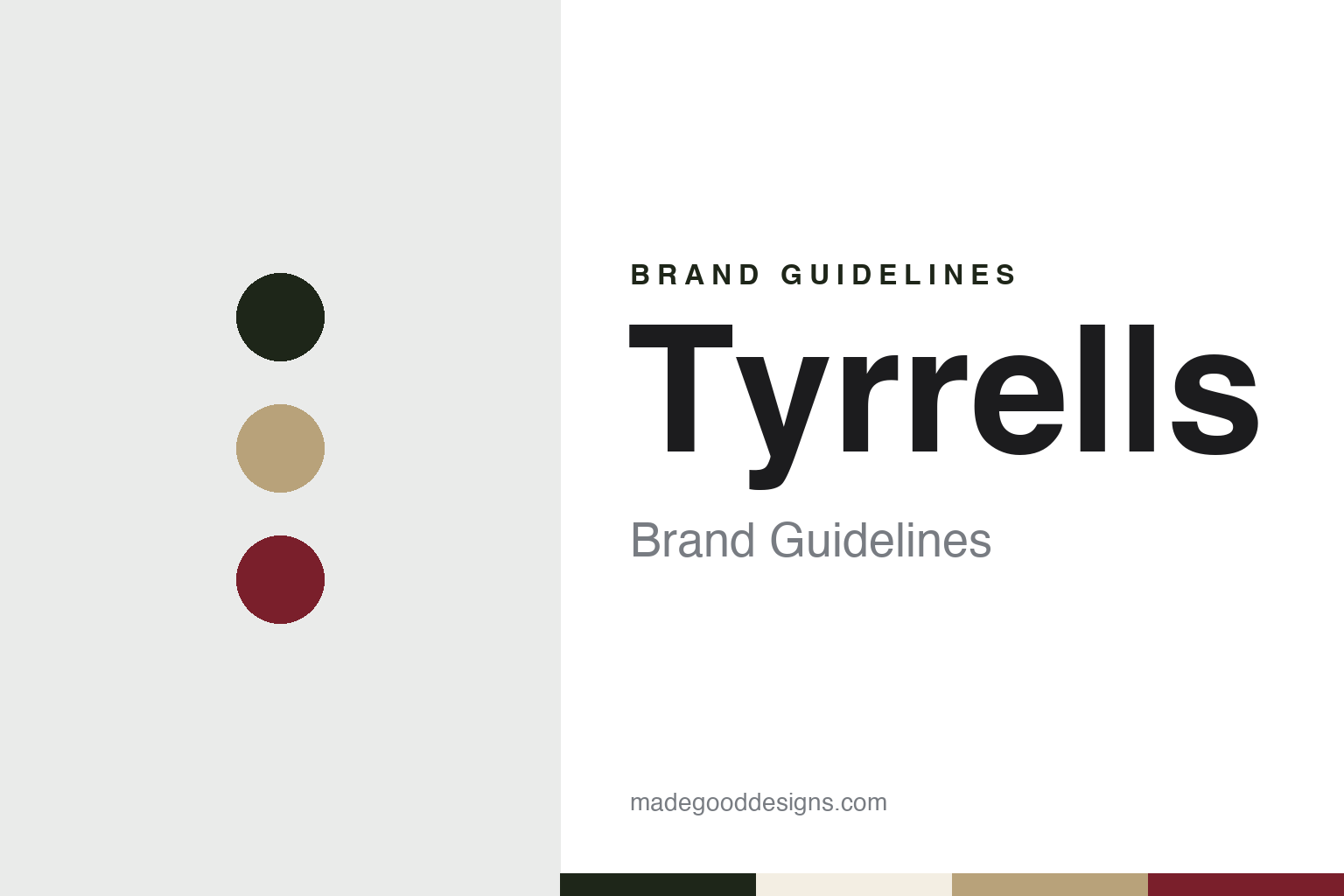
Tyrrells Brand Guidelines
The Herefordshire farm crisp with a box of old photographs.
Aa
Two constants: a hedgerow green, sepia and claret palette and an English bookish serif register. Abstract homage — not a Tyrrells product or mark; no pack, logo or photograph is reproduced.
A potato farmer’s sideline
A Herefordshire farm, a fryer and a row with Tesco.
Tyrrells began on a farm. English Wikipedia, citing a 2008 Time profile, says the brand was founded in 2002 in Leominster, Herefordshire, by the farmer William Chase; The Guardian described it in 2016 as a business started as a sideline by Chase, then a struggling Herefordshire potato farmer.
From the start Chase sold Tyrrells as a farm product with a premium price, and he chose where it went. He sold to delicatessens and farm shops and refused to supply Tesco. The Guardian reported the dispute in September 2006, quoting Chase’s complaint that his earlier farming business had collapsed when the large supermarkets, led by Tesco, began sourcing produce from overseas to push down costs. In a 2011 interview with the same paper, Chase said Tesco had wanted to sell his crisps at the same price as Walkers, while he wanted to keep the price of Tyrrells high.
The first change of ownership came in April 2008, when Chase sold a majority stake to the private-equity firm Langholm Capital for about £40 million, The Guardian reported. The new owners changed the route to market. According to The Guardian in 2013, Langholm put Tyrrells into Tesco straight away, moved away from the farm shops and delis that had built the brand, and later stopped buying potatoes from Chase’s farm when it found it could get them cheaper elsewhere. Chase went on to make vodka from potatoes at the same Herefordshire farm, under the Chase name.
Colour
“The Entertaining Crisp” and a box of old photos.
The look most people know dates from 2010. The London agency Big Fish says that Tyrrells’ chief executive David Milner, who had joined that year, asked it to work on the branding and marketing after the Langholm acquisition. In the agency’s account, Tyrrells had been built on its position as the “farm crisp”, but competitors had copied that identity and left it exposed. The company already had a fondness for old-fashioned photographs, which it had put on some of its packs. Big Fish says it began by amplifying the brand’s Englishness, changing the product from “chip” to “crisp” and removing Americanisms, then combined those elements into a visual identity and a tone of voice it called “The Entertaining Crisp”. English Wikipedia credits Perry Haydn Taylor of Big Fish with creating the “quintessentially English” identity.
The photographs have drawn academic attention. In a 2018 article in the Journal of Aesthetics & Culture, Karin Wagner of the University of Gothenburg used Tyrrells as a case study of how old photographs travel through modern media. She describes quirky old photographs as a vital part of its packaging design, website and social channels, and Monty Python-style collages that conjure up the English eccentric, a style of marketing she calls “ironic nostalgia”. Wagner traces the pictures from press agencies to stock-image databases and on to crisp packets, and notes that the empty packs themselves are sometimes upcycled by craft makers into bags sold online.
The range grew beyond potato. The Guardian reported in 2016 that, under its previous owner, Tyrrells had added organic and gluten-free lines, and named products such as parsnip crisps and sour-cream tortillas with poppy seeds; English Wikipedia lists crisps, popcorn and tortilla chips among its products, including vegetable crisps.
Typography
Design and documentation.
The seven brands in this group all make crisps, and all of them come from Britain and Ireland: Walkers, Kettle Chips, Tyrrells, Pipers, Golden Wonder, Seabrook and Tayto. British and Irish crisp brands in general sit at many different points in the trade, from family firms that still carry a founder’s name to names that now belong to much larger food groups, and a single brand can be sold everywhere from a village pub to a supermarket shelf.
A crisp brand’s identity is usually carried less by a single product than by a packet, a name and the flavour or snack it promises, because the company behind the name may have changed hands, moved its factory or grown far beyond the town where it started. That makes the questions behind each name worth asking plainly: who started it, who owns it now, and where its crisps are actually made and packed.
Each guide separates what independent sources record from what the company says about itself — its founding story, its owners over time, where its crisps are made and how its packaging has changed — and marks plainly what rests only on the company’s own word.
Aa
An English bookish serif for a crisp that plays with old photographs. (Specimen set in Playfair Display, a serif STAND-IN; NOT the Tyrrells logo.)
Tyrrells
Four owners in ten years, then KP Snacks.
After Chase sold his stake, the company changed hands again in 2013, 2016 and 2018. In July 2013 Langholm sold the company to the investment firm Investcorp for £100 million, The Guardian reported. Investcorp pushed the brand abroad. In 2015 Tyrrells bought Yarra Valley Snack Foods of Melbourne, the Australian trade title Convenience and Impulse Retailing reported, and English Wikipedia says the Melbourne business now makes Tyrrells for the Australian market. The Guardian reported in 2016 that sales had more than doubled under Investcorp and that the share of sales outside the UK had risen from 20% to almost 40%.
In August 2016 Investcorp sold Tyrrells for £300 million to Amplify Snacks, the American owner of SkinnyPop popcorn, The Guardian reported. Milner, quoted at the time, called it a tremendous achievement for a small, UK farm-based business, and the company said it would remain based at the Herefordshire farm where Chase had launched it. Amplify was itself bought by The Hershey Company at the end of 2017.
Hershey did not keep the British business for long. In May 2018 it agreed to sell Tyrrells to KP Snacks, the UK arm of the German family-owned Intersnack Group; Talking Retail reported the agreement on 17 May 2018, and trade titles including Just Food reported that the deal completed on 5 July 2018, on undisclosed terms. KP said at the time that the business it was taking on included a head office and two UK manufacturing sites, the German snack maker Aroma Snacks, Yarra Valley in Australia and manufacturing in the United States.
For a design guide, Tyrrells shows how a stock of old photographs and a deliberately English voice can turn a farm crisp into a brand that survives four changes of owner. Compare Kettle Chips, another premium British crisp, and Pipers, another farmer-founded English crisp. For this guide we use a hedgerow green, sepia and claret with a serif, an unofficial interpretation; no product or logo is reproduced.
Explore & save
Keep Tyrrells’s identity on hand — save it to a board in the Made Good inspiration library.
Tyrrells identity set
Pin the Tyrrells hedgerow green, sepia and claret palette and the English bookish serif register to your own board.


