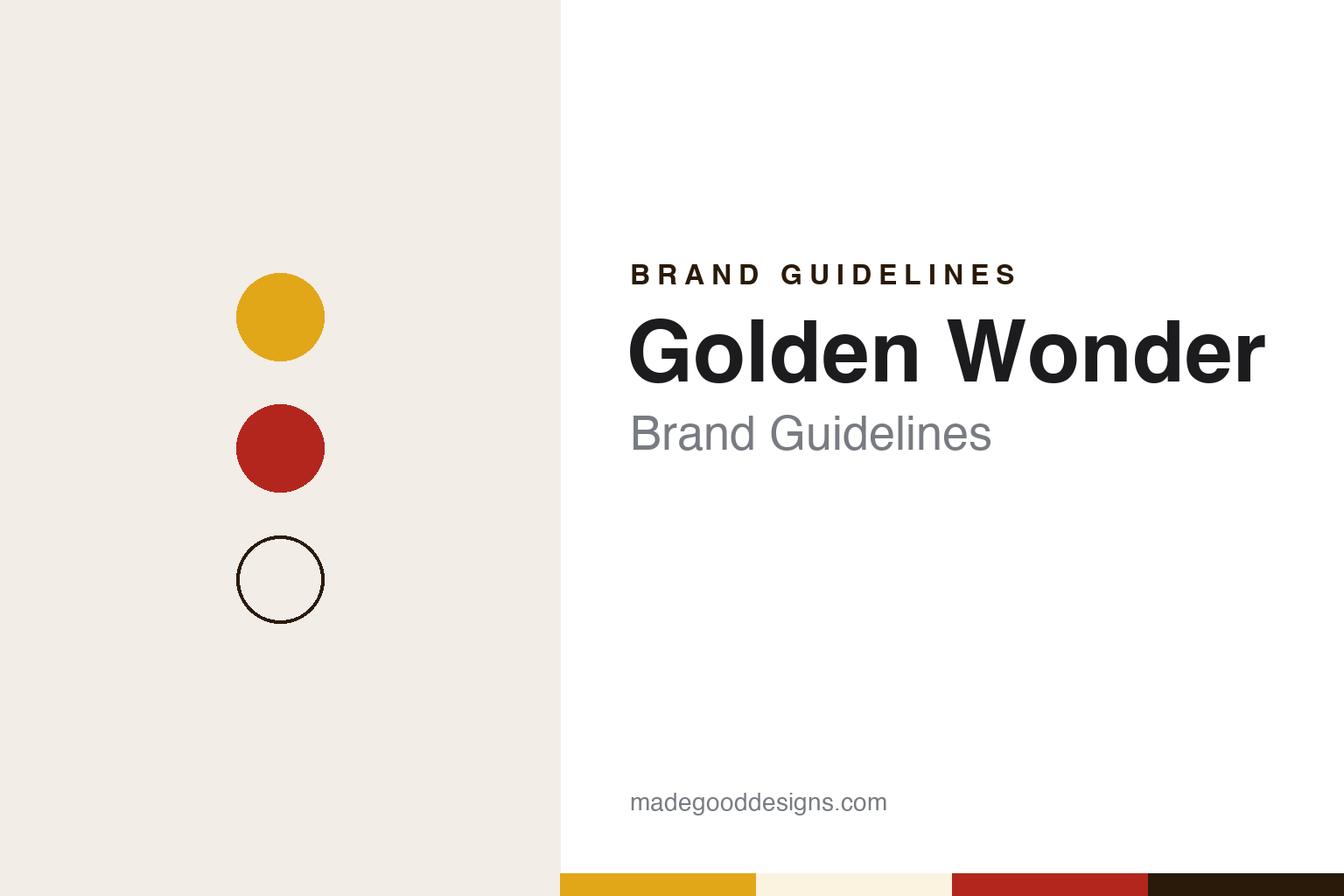
Golden Wonder Brand Guidelines
The Edinburgh baker’s crisp, owned by Tayto Group since 2006.
Aa
Two constants: a Golden Wonder gold, red and cream palette and a soft heritage serif register. Abstract homage — not a Golden Wonder product or mark; no pack, logo or crisp is reproduced.
A baker’s spare fryers
Doughnut fryers, a potato variety and a Scottish start.
Golden Wonder began in Edinburgh in 1947. Its founder, William Alexander, was a baker with a shop in Stockbridge, and, according to a 2022 BBC News feature cited by English Wikipedia, he started frying crisps to use spare capacity in the deep-fat fryers he normally used for doughnuts. He named the business after the Golden Wonder potato, the variety he believed made the best crisps. The brand’s own site still opens with that story: it was “started in Edinburgh by a baker called William Alexander in 1947.”
The business soon outgrew the bakery. In 1952, English Wikipedia says, it moved to a purpose-built factory at Sighthill, on the west side of Edinburgh. In 1961 it was bought by Imperial Tobacco, and under its new owner production spread well beyond Scotland, with factories at Broxburn, Widnes and Corby. A site at Crumlin, in Wales, made Pot Noodle, which the company also owned.
The 1960s were Golden Wonder’s peak. By the end of the decade, English Wikipedia says, it had become the most popular crisp brand in Britain, overtaking Smiths. A flavour helped. English Wikipedia, citing Ian Harrison’s The Book of Firsts (2003), credits Golden Wonder with introducing cheese & onion crisps to Britain in 1962, a flavour first developed in Ireland by Tayto in the 1950s. In the 1970s the company also made Rock ’n’ Roller crisps.
Colour
From tobacco owner to administration.
Golden Wonder changed hands several times after Imperial Tobacco. In 1987, after Hanson’s takeover of Imperial, it was sold to the agricultural and food group Dalgety, English Wikipedia says. A year later, in 1988, a fire at the Corby site destroyed much of the company’s historical paperwork. Dalgety added to the business in February 1992 by buying Sooner Snacks, maker of Nik Naks and Wheat Crunchies, from the American company Borden, The Guardian reported at the time, and folded it into Golden Wonder.
The 1990s split the group up. In 1995 Pot Noodle was sold to Best Foods, and the crisp and snack business went to its managers in a management buyout valued at £54.6 million, English Wikipedia says. In 2000 the private equity firm Bridgepoint Capital bought Golden Wonder for £156 million, The Guardian reported in July that year. In May 2002 The Independent reported that Walkers had bought Wotsits, one of the snack brands Golden Wonder had owned.
By then the brand had lost its lead. BakeryandSnacks reported in February 2006 that Walkers had taken more than half of the British crisp market by the mid-1990s, and that Golden Wonder had lost £10.8 million on sales of £87.8 million in 2004. On 9 January 2006 the company went into administration, putting around 800 jobs at risk, The Guardian reported. Within days, the Northern Irish crisp maker Tayto, of Tandragee in County Armagh, agreed to take over the Corby site and its contract to make Mini Pringles for Procter & Gamble, and on 20 January the BBC reported that Tayto would buy all of Golden Wonder’s UK operations, including the factory at Scunthorpe. Nik Naks and Wheat Crunchies were sold on to United Biscuits and now belong to KP Snacks.
Advertising had carried the brand through those years. In the 1980s Golden Wonder billed itself as “Britain’s Noisiest Crisp,” and a later television campaign promised “You’ll never grow old in Golden Wonderland!”, English Wikipedia says.
Typography
Design and documentation.
The seven brands in this group all make crisps, and all of them come from Britain and Ireland: Walkers, Kettle Chips, Tyrrells, Pipers, Golden Wonder, Seabrook and Tayto. British and Irish crisp brands in general sit at many different points in the trade, from family firms that still carry a founder’s name to names that now belong to much larger food groups, and a single brand can be sold everywhere from a village pub to a supermarket shelf.
A crisp brand’s identity is usually carried less by a single product than by a packet, a name and the flavour or snack it promises, because the company behind the name may have changed hands, moved its factory or grown far beyond the town where it started. That makes the questions behind each name worth asking plainly: who started it, who owns it now, and where its crisps are actually made and packed.
Each guide separates what independent sources record from what the company says about itself — its founding story, its owners over time, where its crisps are made and how its packaging has changed — and marks plainly what rests only on the company’s own word.
Aa
A soft heritage serif for a crisp brand founded by a Scottish baker. (Specimen set in Fraunces, a serif STAND-IN; NOT the Golden Wonder logo.)
Golden Wonder
A Scottish name inside a Northern Irish family group.
Golden Wonder has been part of Tayto Group since 2006. The group was founded in Tandragee in 1956 by Thomas Hutchinson and two partners, English Wikipedia says, and its own site describes it as still family-owned. Tayto Group says it runs five UK sites and produces more than five million packs a day; its brands include Tayto, Golden Wonder, Real and Mr Porky. In the years after the Golden Wonder deal it also bought Real Crisps in 2007, Red Mill Snack Foods in 2008 and Jonathan Crisp in 2009, English Wikipedia says. The Scunthorpe Telegraph reported in 2017 that Golden Wonder’s Scunthorpe factory employed 360 people.
Tayto moved quickly to revive the name. Marketing Week reported in April 2007 that the brand would be relaunched the following month with the old Golden Wonder logo retained on more contemporary packaging, backed by television and press advertising that started in Scotland. For its 75th anniversary in 2022, Talking Retail reported, Golden Wonder brought back Beef & Onion and Chip Shop Curry and sold Cheese & Onion in classic 1970s packs.
In June 2025 the brand unveiled what Scottish Grocer called its first major packaging refresh in a decade. The trade press described a simplified Golden Wonder logo, brighter colours and photographs of crisps across impulse packs, multipacks and sharing bags, built around the line “More Punch Per Crunch.” Salt & Chilli Chicken joined the range, Chip Shop Curry became a permanent multipack flavour, and the relaunch was backed by radio, YouTube and social media advertising. Today the range on the brand’s site runs from standard crisps to Ringos, Transform-A-Snack and Rough Cuts.
For a design guide, Golden Wonder shows how a brand can lose its market lead, pass through several owners and still trade on the same name, a founding date and one signature flavour. Compare Walkers, the rival that overtook it, and McVitie’s, another brand that began with an Edinburgh baker. For this guide we use a gold, an onion red and a bakery cream with a serif, an unofficial interpretation; no product or logo is reproduced.
Explore & save
Keep Golden Wonder’s identity on hand — save it to a board in the Made Good inspiration library.
Golden Wonder identity set
Pin the Golden Wonder gold, red and cream palette and the soft heritage serif register to your own board.