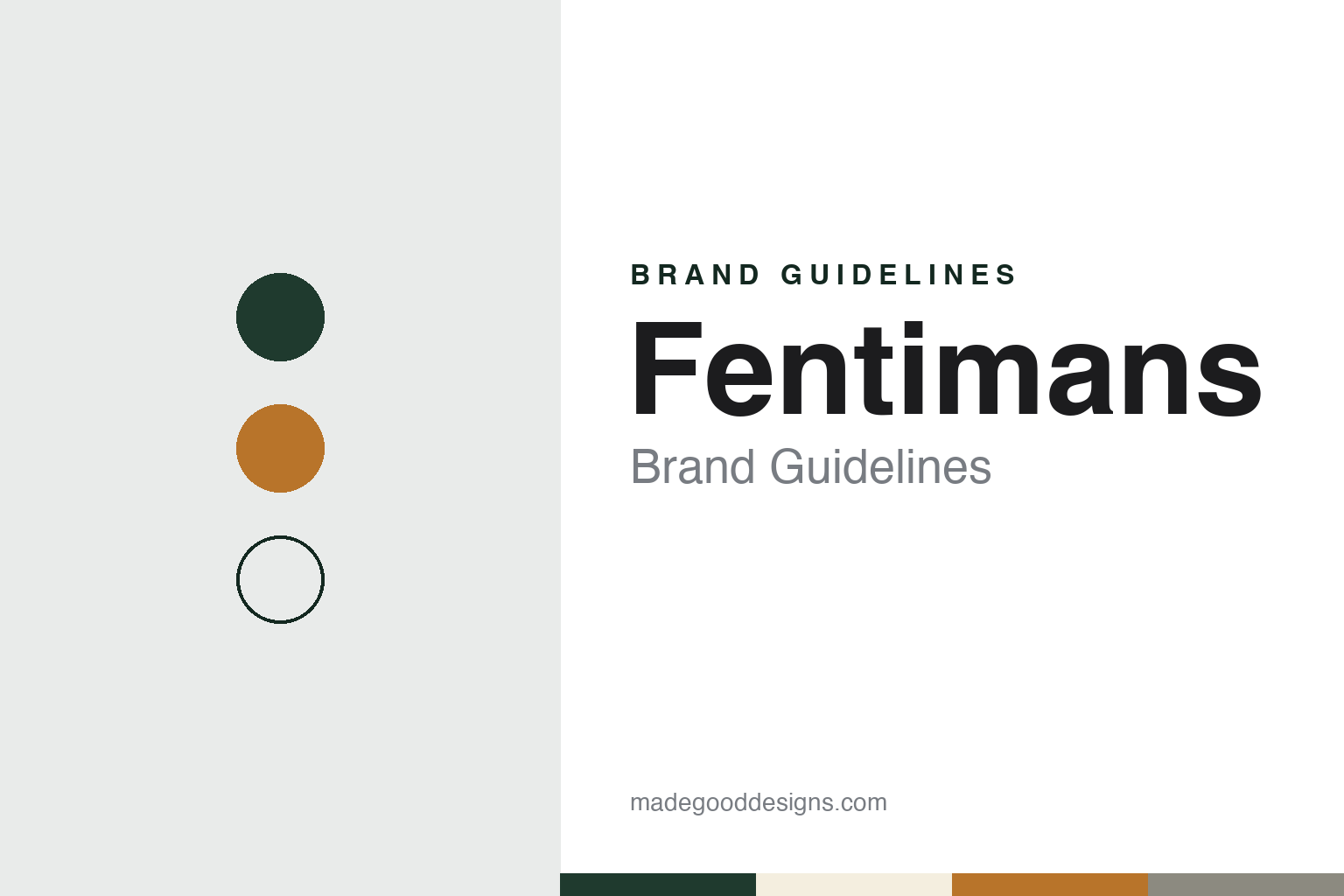
Fentimans Brand Guidelines
The botanical ginger beer guarded by a dog called Fearless.
Aa
Two constants: a bottle green, ginger and cream palette and a Victorian label serif register. Abstract homage — not a Fentimans product or mark; no bottle, label or dog portrait is reproduced.
A recipe for a loan
An iron puddler, an unpaid debt and a jar called a grey hen.
Fentimans dates itself to 1905 and to Cleckheaton, in West Yorkshire. That year, the company says, Thomas Fentiman, an iron puddler, was approached by a fellow tradesman for a loan; a recipe for botanically brewed ginger beer was offered as security, the loan was never repaid, and the recipe became his. He sold the ginger beer door to door from a horse and cart, in stoneware jars known as “grey hens.” English Wikipedia, drawing on the company’s account, says the drink sold well and the business opened several brewing and production sites in the north of England.
The brand’s emblem came from the family household. The company says the dog that appears on every bottle is Fearless, Thomas Fentiman’s own dog, and that at first there was no company logo at all: the grey hens carried the surnames of family members instead. Fearless’s portrait is still the logo, and the company’s head office is named Fearless House. English Wikipedia describes Fearless as a German Shepherd, and both it and Small Business UK say the dog won the obedience class at Crufts in 1933 and 1934.
The first business did not survive the arrival of the supermarkets. Newcastle’s The Journal reported in 2009 that as supermarkets moved into soft drinks, sales of the grey hens slumped, and the company closed in the mid-1960s.
It came back in 1988, when Thomas Fentiman’s great-grandson Eldon Robson re-established it, setting out to make the drinks in the original way with the traditional ginger beer recipe. The revived company was based in Hexham, the Northumberland market town that became its home. According to Small Business UK, the recipe had survived with Robson’s uncle Joe, who had run the family’s factory in Leeds before it closed, “tucked away in a drawer.” Robson told the site that in resurrecting the craft process “I suppose by doing that I was a little ahead of my time.”
Colour
Botanical brewing, rose lemonade and a redrawn arch.
The company’s defining claim is its process, which it calls “botanical brewing”: a combination of infusion, blending and fermentation of plant ingredients such as roots, bark and flowers. Its own description of Thomas Fentiman’s method, as summarised by English Wikipedia, has ginger root milled and simmered in copper steam-jacketed pans, then mixed with herbs, sugar, spring water and brewer’s yeast and left to ferment in wooden vats before going into the stone jars. Today’s drinks are pasteurised to extend their shelf life, and mild carbonation was introduced to replace the gas lost in the process, the same account says. In March 2024 its marketing director, Jayne Andrews, told Just Drinks that “every single drink that comes out of Fentimans goes through a botanical brewing process.”
Fermentation leaves a trace of alcohol, which once made headlines. In 2009 the US state of Maine stopped sales of Fentimans Victorian Lemonade to anyone under 21 after a schoolboy in Houlton noticed that its label said it contained “up to 0.5%” alcohol, The Guardian reported; Fentimans said the real figure was closer to 0.3%.
The range grew from ginger beer into colas, lemonades and, later, tonics and mixers; among its best-known lines are Curiosity Cola, Rose Lemonade and Victorian Lemonade. Andrews told Just Drinks in 2024 that the brand was sold in 70 markets, that the UK accounted for just under half of turnover and the Netherlands was its second-largest market, and that its packaging drew on “an old-fashioned British aesthetic.”
That packaging was redrawn in 2018. In January that year The Spirits Business reported a £1.2 million redesign, the first major one in ten years, with the agency Brand Tonic redrawing the labels and the brand marque and Greeves Design handling the bottles; the new look reached shops from February 2018. Packaging News reported that the brand arch was redrawn with a new typeface, the 275ml bottle made taller and more slender, the Fearless dog applied consistently on every neck label and bold colour coding introduced to help shoppers find flavours. The small on-trade bottles moved from green glass to clear, under a new strapline, “Botanically Brewed. Exquisitely Crafted.” The marketing director at the time, Andrew Jackson, called it “the biggest single change to the presentation of the Fentimans brand in a generation.”
Typography
Design and documentation.
The seven brands in this group all make soft drinks or cordials, and all of them come from Britain: Irn-Bru, Vimto, Ribena, Lucozade, Tango, Fentimans and Belvoir Farm. British soft-drink brands in general sit at many different points in the trade, from family firms that still carry a founder’s name to names that now belong to much larger drinks groups, and a single brand can be sold everywhere from a corner shop to a supermarket shelf.
A soft-drink brand’s identity is usually carried less by a single recipe than by a bottle, a colour, a name and the moment it promises, because the company behind the name may have changed hands, moved its bottling or grown far beyond the town where it started. That makes the questions behind each name worth asking plainly: who started it, who owns it now, and where its drinks are actually made and bottled.
Each guide separates what independent sources record from what the company says about itself — its founding story, its owners over time, where its drinks are made and how its packaging has changed — and marks plainly what rests only on the company’s own word.
Aa
A Victorian label serif for a brand built on a 1905 recipe. (Specimen set in Playfair Display, a serif STAND-IN; NOT the Fentimans logo.)
Fentimans
From a family firm in Hexham to the makers of IRN-BRU.
The drinks are not all made in one place. Andrews told Just Drinks in March 2024 that the company brewed its botanical base and made all its flavours in-house in Hexham, while “the actual production happens in a couple of different sites,” where the drinks are put into bottles or cans and carbonated. In the United States, English Wikipedia says, Fentimans is made under a franchise in Pennsylvania, using the same recipe and brewing method.
For more than a century the business stayed in the founder’s family, and as recently as March 2024 Just Drinks described it as privately owned. That changed in 2026. On 2 February 2026 A.G. Barr, the Scottish maker of IRN-BRU, completed its purchase of Fentimans for about £38 million, paid in cash and debt, it told the London Stock Exchange the next day, alongside the £13 million purchase of the Devon juice maker Frobishers. A.G. Barr said both brands operated in the adult soft-drinks market, which it said was benefiting from people drinking less alcohol. Just Drinks reported that Fentimans’ revenue in 2024 was £35.7 million.
Integration followed quickly. In March 2026 The Spirits Business reported that A.G. Barr had proposed 37 job cuts at Fentimans; the company later confirmed that it would close the Fentimans office in Hexham in a phased wind-down over the summer, with 29 redundancies, The Grocer and the Hexham Courant reported. An A.G. Barr spokesperson told The Spirits Business that it had bought Fentimans “for the opportunity to invest in and grow the brand for the long term.”
For a design guide, Fentimans shows how a founder’s dog, a stone jar and a 1905 recipe can carry a heritage story into a modern range. Compare IRN-BRU, now its stablemate at A.G. Barr, and Belvoir, another British maker of botanical soft drinks. For this guide we use bottle green, ginger and cream with a serif, an unofficial interpretation; no product or logo is reproduced.
Explore & save
Keep Fentimans’s identity on hand — save it to a board in the Made Good inspiration library.
Fentimans identity set
Pin the Fentimans bottle green, ginger and cream palette and the Victorian label serif register to your own board.