Princes Brand Guidelines
The Liverpool lobster importer that became a listed food group.
Aa
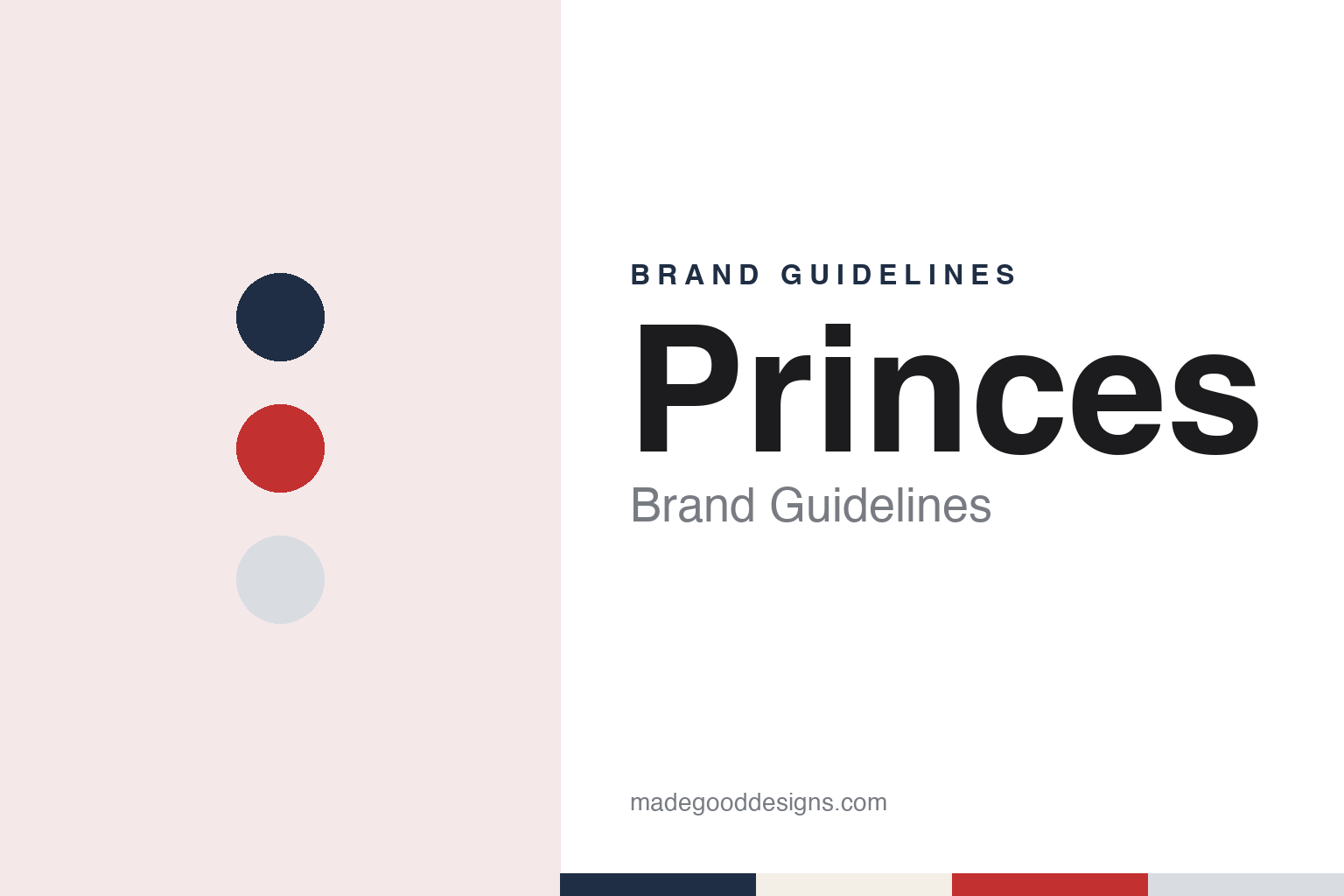
Two constants: a Pier Head slate, tomato red and tin silver palette and a classic serif register. Abstract homage — not a Princes product or mark; no can, label or logo is reproduced.
Simpson Roberts
Two partners, Canadian lobster and a Liverpool quay.
Princes began in Liverpool in 1880 as a partnership between two importers: William Muirhead Simpson (1842–1926), who was British, and Frank Roberts (1853–1938), a Canadian. English Wikipedia, citing a history of the company published by the brand-history site Let’s Look Again, says the firm traded as Simpson Roberts and began by importing tinned lobster from Canada. The company’s own timeline also dates its founding to 1880 in Liverpool and describes its start as a canned fish business that grew up around the city’s docks.
Simpson Roberts sold its goods under several brand names before one stuck. The same history lists Maypole from 1891, Mikado from 1895 and Princes from 1900. Lobster remained the core of the trade: by 1915, Wikipedia says, Simpson Roberts was the world’s largest exporter of lobster, handling about a third of the world trade, and the company’s timeline marks 1915 with the same claim. The partnership was incorporated as a limited company in 1919.
The business moved from trading into making after the Second World War. The company dates its first canned-food factory to 1946, and it opened in the Netherlands in 1960, its first step into continental Europe. In 1962 the firm took the name of its best-known brand and became Princes Foods, Wikipedia says, so that a label chosen in 1900 became the name of the company.
Colour
Bibby, Buitoni, Nestlé and Mitsubishi.
Princes then passed through a run of owners. In 1964 it was bought by J Bibby & Sons, the maker of Trex cooking fat, and in 1973 the combined business was sold to the Italian food group Buitoni, English Wikipedia says. When Nestlé bought Buitoni in 1988, Princes was sold on, and in 1989 it became a wholly owned subsidiary of the Japanese trading house Mitsubishi Corporation. Since 1982 the company has had its head office in the Royal Liver Building at Liverpool’s Pier Head, at first as one of several tenants.
Under Mitsubishi, Princes grew by buying. The company’s timeline lists the purchase of a soft-drinks site in Bradford in 1991, a tuna operation in Mauritius in 1999, the Napolina brand of Italian-style ingredients in 2001 and, in 2005, the cooking-oils business Edible Oils Limited, a joint venture with Archer Daniels Midland. In 2011 it took on the Crosse & Blackwell and Farrow’s brands along with canning sites at Wisbech and Long Sutton, and in 2012 it bought a tomato-processing factory in Foggia, in southern Italy, the Liverpool Daily Post reported in May 2012. Wikipedia, citing the same company history as before, says Princes was the UK’s largest supplier of tinned food by 2013.
Not every year was a growth year. In February 2018 Food Manufacture reported that Princes had begun a business review after its net profit fell to £0.5m, and in October 2018 the magazine reported that factories in Manchester and Chichester would close as the group automated its canning. In January 2023 The Grocer reported that Mitsubishi was looking for a buyer for the business, and in March 2023 the regional news site The Business Desk named Valeo Foods and Aurelius among the suitors reported to be weighing bids.
Typography
Design and documentation.
The seven brands in this group all sit in the British store cupboard: Princes, John West, Batchelors, Ambrosia, Bird’s, Paxo and Saxa. British store-cupboard brands in general sit at many different points in the trade, from names that still carry a founder’s surname to names that now belong to much larger food groups, and a single brand can be sold everywhere from a corner shop to a supermarket shelf.
A store-cupboard brand’s identity is usually carried less by a single product than by a pack, a name and the meal or kitchen job it promises, because the company behind the name may have changed hands, moved its factory or grown far beyond the town where it started. That makes the questions behind each name worth asking plainly: who started it, who owns it now, and where its products are actually made and packed.
Each guide separates what independent sources record from what the company says about itself — its founding story, its owners over time, where its products are made and how its packaging has changed — and marks plainly what rests only on the company’s own word.
Aa
A classic serif for a Liverpool name that dates from 1900. (Specimen set in Libre Baskerville, a serif STAND-IN; NOT the Princes logo.)
Princes
An Italian owner, a London listing and a landmark.
The buyer was Italian. On 27 May 2024 Princes announced that Newlat Food S.p.A, a dairy, pasta and bakery group listed in Milan, intended to buy the entire Princes Group from Mitsubishi in a deal valued at £700m; the company says the purchase was completed in July 2024. Newlat already owned the British food maker Symington’s. In April 2025 Newlat renamed itself NewPrinces S.p.A, after the business it had bought. In July 2025 Princes said it had bought the Grade I listed Royal Liver Building, its home since 1982, as part of a £60 million investment, a purchase BBC News also reported.
Then Princes went public in its own right. Conditional dealings in Princes Group plc began on the London Stock Exchange on 31 October 2025, with the shares priced at the bottom of their range for a market value of about £1.16bn, Food Manufacture reported; the pricing announcement put the new money raised at about £400m and the expected free float at about 13%, with NewPrinces subscribing for a large block of the new shares. In December 2025 the shares joined the FTSE 250 index, according to FTSE Russell’s quarterly review. The chair is Angelo Mastrolia, who founded Newlat; the chief executive, appointed in April 2024, is Simon Harrison.
Princes is a maker as well as a brand owner. English Wikipedia, drawing on the company’s pages, lists 11 production sites: canning at Long Sutton in Lincolnshire and at Wisbech in Cambridgeshire, where the site includes a Grade II listed Art Deco building that Historic England lists as the Smedley Canning Factory; soft drinks in Cardiff, Bradford and Glasgow; edible oils at Belvedere and Erith in south-east London and at Szamotuły in Poland; tomatoes at Foggia; and two tuna plants at Port Louis, Mauritius. Besides the Princes range itself, its brands include Napolina, Crosse & Blackwell, Mazola and Trex, and it makes Batchelors peas under licence from Premier Foods and Branston beans under licence from Mizkan.
For a design guide, Princes shows how a brand name picked by Liverpool importers in 1900 outlasted a chain of owners to become the name of the whole group, and then of its Italian parent too. Compare Batchelors, whose peas Princes makes under licence, and Branston, whose name it uses on its beans. For this guide we use a Pier Head slate, a tomato red and a tin silver with a classic serif, an unofficial interpretation; no product or logo is reproduced.
Explore & save
Keep Princes’s identity on hand — save it to a board in the Made Good inspiration library.
Princes identity set
Pin the Princes Pier Head slate, tomato red and tin silver palette and the classic serif register to your own board.