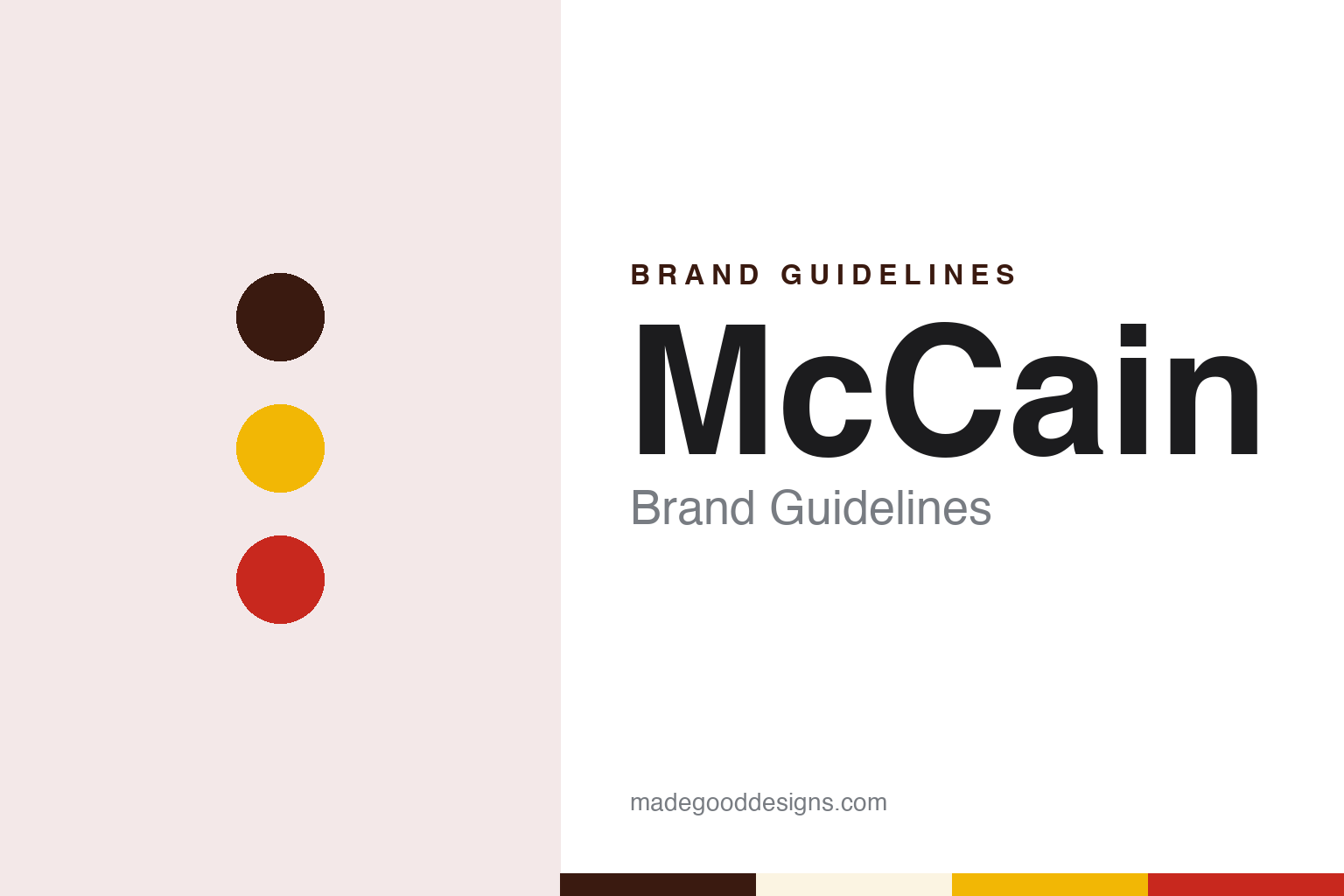
McCain Brand Guidelines
The New Brunswick chip maker that built its first overseas plant in Scarborough.
Aa
Two constants: a chip gold, ketchup red and soil brown palette and a bold friendly sans register. Abstract homage — not a McCain product or mark; no pack, logo or product is reproduced.
Four brothers and a potato town
Seed potatoes, a fry plant and an early move to Britain.
McCain comes from Florenceville, a potato-farming community in the Saint John River valley of New Brunswick, Canada, now part of Florenceville-Bristol. The McCain family was already in the potato trade: English Wikipedia says the brothers’ father, Andrew Davis McCain, ran A. McCain & Sons, which had sold seed potatoes across New Brunswick since 1900 and exported them to Cuba and Latin America.
The frozen food company was started by two of his sons, Harrison McCain and Wallace McCain, with the help of their older brothers Robert and Andrew, the Associated Press reported in 2011. The company’s own timeline dates its founding to 1957, when its first French fry plant opened in Florenceville; English Wikipedia’s biography of Harrison McCain gives 1956. In its first year, English Wikipedia says, the business had 30 employees and sales of more than $150,000.
Britain came early in the story. McCain says its products entered the UK market in 1965, and that its first British French fry plant, which was also the company’s first plant outside Canada, opened in Scarborough, North Yorkshire, in 1968; the trade directory PotatoPro says construction began that year and the first McCain chips came off the line in 1969. Exports to the United States followed in 1969 and a plant in Daylesford, Australia, in 1971, according to the company. In 1976 McCain opened a second British plant, at Whittlesey, near Peterborough in Cambridgeshire.
Colour
Oven Chips and “It’s all good.”
The product that made McCain a household name in Britain was Oven Chips, launched in 1979, eleven years after the Scarborough plant opened. The date is confirmed by the anniversaries the company has marked since: the trade magazine The Manufacturer reported the Oven Chip’s 35th birthday in 2014, and Campaign covered an advertising campaign built around a 1970s-style house when it turned 30 in 2009. A television advertisement for Oven Chips from 1979 survives in the Internet Archive.
Its best-documented campaign came in the mid-2000s. According to a case study entered in the Institute of Practitioners in Advertising’s Effectiveness Awards in 2008, prepared with the agency BMB, McCain’s oven chips had a perception problem before 2006, as public debate about “junk food” grew, and the company answered with a multi-media campaign under the line “It’s all good.” A later write-up of the case, published by WARC in October 2012, says the campaign ran on television, outdoor posters and sponsorship, and that “It’s all good” became a business idea for the company, shaping its new products, packaging, employee engagement and corporate affairs.
The line lasted. In October 2011 BMB made a campaign showing McCain chips being tested for crispiness and fluffiness on a “Good Unlimited Farm,” and McCain’s head of brand, Mark Hodge, told The Drum that it continued the “It’s all good” story by showing the care that goes into each chip, from the farm to the plate. On its UK website today McCain sells chips, fries, wedges, hash browns, jacket potatoes and Smiles, the face-shaped potato bites.
Typography
Design and documentation.
The seven brands in this group all make frozen food, pies or pasties sold in Britain: Birds Eye, McCain, Aunt Bessie’s, Young’s, Chicago Town, Ginsters and Pukka. Brands in this part of the British food trade sit at many different points in it, from family firms that still carry a founder’s name to names that now belong to much larger food groups, and a single brand can be sold everywhere from a football ground or a petrol-station counter to a supermarket freezer.
A frozen or savoury food brand’s identity is usually carried less by a single product than by a pack, a name and the meal it promises, because the company behind the name may have changed hands, moved its factory or grown far beyond the place where it started. That makes the questions behind each name worth asking plainly: who started it, who owns it now, and where its food is actually made and packed.
Each guide separates what independent sources record from what the company says about itself — its founding story, its owners over time, where its food is made and how its packaging has changed — and marks plainly what rests only on the company’s own word.
Aa
A bold friendly sans for a brand built on chips. (Specimen set in Rubik, a sans STAND-IN; NOT the McCain logo.)
McCain
A family company, a feud and a Yorkshire head office.
McCain Foods has stayed private and in the McCain family, though not without strain. In 1994 a dispute between Harrison and Wallace over who should succeed them led to Wallace being pushed out as co-chief executive, The New York Times reported at the time; English Wikipedia says Wallace and his son Michael left the company, and Wallace bought Maple Leaf Foods in 1995. Harrison named his nephew Allison McCain, son of their brother Andrew, as his successor in 2002, and died in March 2004; Wallace died in May 2011, the Associated Press and The New York Times reported. Max Koeune, who joined McCain in 2012 as chief financial officer, became president and chief executive on 1 November 2017, succeeding Dirk Van de Put, the company announced.
The business has grown far beyond Florenceville. English Wikipedia puts its 2023 revenue at C$14 billion with about 20,000 employees, and gives its head office as Toronto. The company calls itself the world’s largest maker of frozen potato products and says one in four French fries in the world is a McCain fry, a figure reported by the Twin Falls Times-News in 2017. Its acquisitions include the Ellio’s pizza brand in 1988, English Wikipedia says, and, according to the company’s timeline, the Ore-Ida foodservice business in the United States for US$500 million in 1997, the Belgian potato processor Lutosa in 2014 and the Dutch company Scelta Products in 2022.
In Britain McCain is still run from Yorkshire. The company says its UK head office is in Scarborough, that it has four factories in the UK, and that its sites in Britain and Ireland include Scarborough, Whittlesey, Hull, Wombourne, Montrose and Dublin, with about 1,400 staff. It says it buys about a fifth of the British potato crop from more than 250 growers and owns a seed potato business in Montrose, in Scotland.
For a design guide, McCain shows how a family name from a Canadian potato town, and a single product launched in 1979, can carry a brand on both sides of the Atlantic. Compare Aunt Bessie’s, another British frozen potato brand, and Birds Eye, the frozen food name with American roots. For this guide we use chip gold, ketchup red and soil brown with a bold sans, an unofficial interpretation; no product or logo is reproduced.
Explore & save
Keep McCain’s identity on hand — save it to a board in the Made Good inspiration library.
McCain identity set
Pin the McCain chip gold, ketchup red and soil brown palette and the bold friendly sans register to your own board.