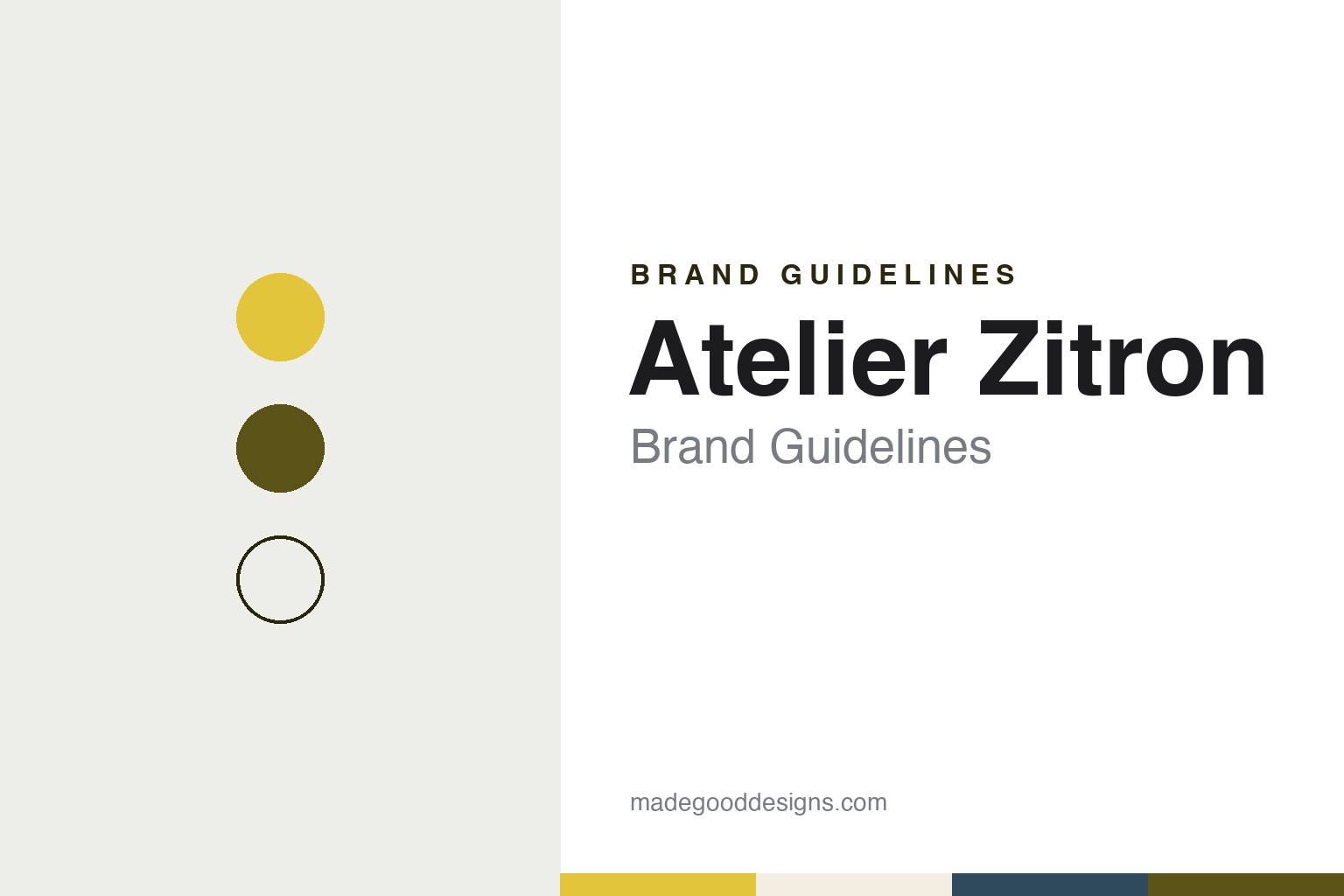
Atelier Zitron Brand Guidelines
The Wickede yarn house that sells only through yarn shops.
Aa
Two constants: a lemon, olive and cream palette and a geometric sans register. Abstract homage — not an Atelier Zitron product or mark; no yarn, label or logo is reproduced.
Wickede
A yarn house in the Ruhr valley.
Atelier Zitron is a German hand-knitting yarn brand based in Wickede (Ruhr), a municipality in the Kreis Soest district of North Rhine-Westphalia. Its website describes it simply as “Handstrickgarne aus Deutschland” — hand-knitting yarns from Germany.
The business is a small one, and it publishes little about itself. Its imprint names Marita Zitron as publisher and Klemens Zitron as responsible for the content, and gives no company suffix such as GmbH. The website has no history page, and we found no founding date in the sources we checked, so we give none. The earliest firm evidence is the website itself: the Internet Archive first captured atelierzitron.de in February 2007, under the title “Ideen in Handstrick” — ideas in hand knitting.
That early site, built in Adobe GoLive, already carried the company’s statement of philosophy in almost the same words it uses today — “human care and love of the product come first at Atelier Zitron” — together with pages for knitting needles as well as yarn. Archived pages from 2007 to 2009 list yarns including Trekking, Trekking Natura and Trekking XXL, and pages for the lace-weight Filigran appear from 2010.
One detail about the name needs care. The hyphenated address atelier-zitron.de, which now forwards to the company’s site, was a parked “domain for sale” page in 2011 and 2012, according to Internet Archive captures, so older material found under that address is not the brand’s.
Colour
Developed with a dyehouse in the Neckar valley.
Where Atelier Zitron’s yarn is made is the central question for a brand built on the words “Made in Germany,” and the answer is more specific than most yarn labels offer. The company says all of its yarns are “Eigenentwicklungen” — its own developments — made with its partner Textilfärberei Hirschhorn, and produced exclusively for Atelier Zitron. That statement, on its website, is signed by Klemens Zitron and by Michael Thierling of the dyehouse.
Textilfärberei Hirschhorn is in Hirschhorn, a small town in the Neckar valley in southern Hesse, between Heidelberg and Heilbronn. On its own website, the dyehouse traces its site to 1878, when Philipp Theodor André moved a silk dyeworks there from Offenbach; it says Harald and Hannelore Groß founded the present Textilfärberei Hirschhorn GmbH in 1982 as successor to J. A. André Sohn, and that Thierling bought it in 2005, turning a commission dyer into a firm that develops yarns and colours for whole collections. It says its dyeing, printing and finishing all take place in Hirschhorn.
Neither company names a spinning mill. The dyehouse says it obtains raw yarn through “our network of proven spinning mills and yarn manufacturers,” and Atelier Zitron says it oversees production “from the purchase of raw yarn to the finished ball” under German environmental rules. The company says its yarns come “exclusively from German production”; we give that as its claim, and could not identify the spinner.
The colour is the visible part. The Trekking product page credits “our dyeing specialists in Hirschhorn” with giving the sock yarn its face, and the company says its website shows more than 900 colour variants. Every yarn, it says, is certified to OEKO-TEX Standard 100, product class 1 — the class for baby articles — is colourfast to saliva — “babyspeichelecht” — and is free of mulesing. On its certificate page for 2025–26 it describes itself as the only hand-knitting yarn maker producing in Germany that meets those criteria with all of its yarns, a claim we could not test.
Typography
Seven yarn brands, seven countries.
The seven brands in this group all sell yarn for hand knitting and crochet, and they come from six countries on two continents: Filcolana from Denmark, Kelbourne Woolens and Harrisville Designs from the United States, Rosários 4 from Portugal, La Bien Aimée from France, Koigu from Canada and Atelier Zitron from Germany. Most knitters meet them first as a name on a ball band or a skein tag in a yarn shop, rather than as a company.
Behind those labels the yarn trade takes several shapes. Some brands own the mill that spins their fibre; others design a yarn and its colours and have it spun, dyed or finished by partners; still others dye undyed yarn by hand in small batches. A label’s country is not always the country where every step happened, and “made in” can mean spinning, dyeing or only the final winding.
Each guide sets out what independent sources record about the brand — who founded it, who owns it and where its yarn is made — and separates that from what the company says about itself, marking plainly what rests only on the company’s own word.
Aa
A geometric sans for a plain-spoken yarn house. (Specimen set in Jost, a sans STAND-IN; NOT the Atelier Zitron logo.)
Atelier Zitron
Sock yarn, fine merino and specialist shops.
The range today falls into three groups on the company’s website: “Exklusivgarne,” some fifty named yarns; “Sockengarne,” the sock yarns; and undyed “Rohgarne.” The best known outside Germany is Trekking, a sock and sport yarn of 75 per cent wool and 25 per cent polyamide in four- and six-ply versions, each in multicoloured and tweed forms. Alongside it sit Lifestyle, a pure extra-fine merino the company recommends for baby clothes; Tasmanian Tweed, a merino tweed it calls its own new development; a kid mohair called Extraklasse; a yak-and-merino blend; and Liebelei, a lyocell-and-linen yarn which, the company says, took almost two years to develop and uses no animal-derived materials from fibre to dye.
Atelier Zitron sells only through the specialist trade. Its website says, more than once, that its yarns can be bought “ausschließlich im Fachhandel” — only from specialist yarn shops — and its imprint says the same of its needles and patterns. The website’s login is for retailers. Patterns are written by a roster of freelance designers credited in the imprint, and some are free downloads.
Abroad, the company lists distributors in Japan, Luxembourg, Poland, Romania, Russia and Spain, and names the knitting wholesaler Skacel Collection for the United States and Canada; we give that list as the company’s own.
The brand’s visual identity is undocumented. We found no published logo history, typeface or colour code. The family name happens to echo Zitrone, German for lemon, and we take that as the cue for this guide’s palette — a reading of ours, not the company’s.
For a design guide, Atelier Zitron shows how a small yarn house can build its identity on a claim of origin and a single, named production partner rather than on its own mill. Compare Opal, another German sock-yarn name, and Schoppel, a German yarn maker. For this guide we use lemon, olive and merino cream with a geometric sans, an unofficial interpretation; no product or logo is reproduced.
Explore & save
Keep Atelier Zitron’s identity on hand — save it to a board in the Made Good inspiration library.
Atelier Zitron identity set
Pin the Atelier Zitron lemon, olive and cream palette and the geometric sans register to your own board.