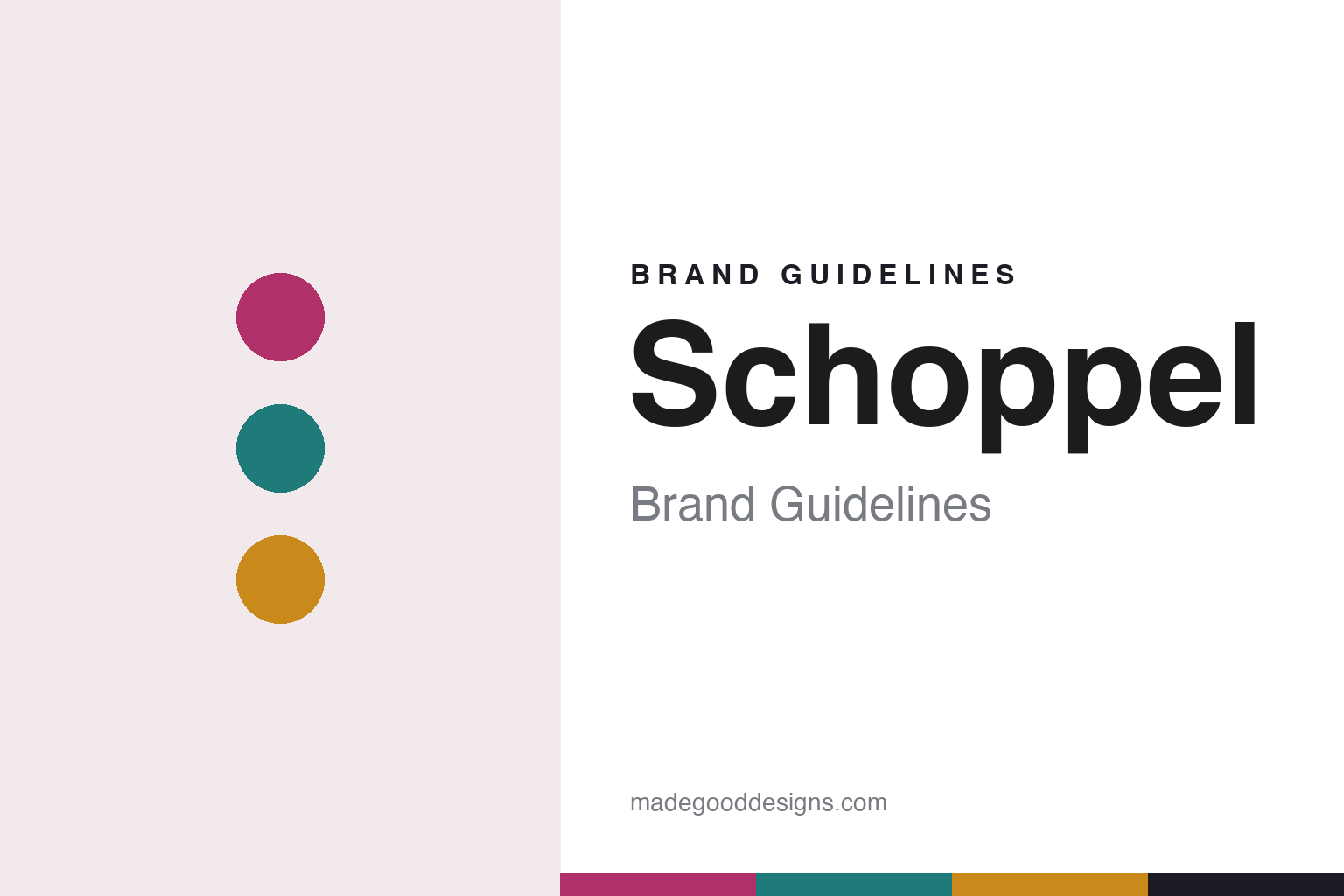
Schoppel Brand Guidelines
The Hohenlohe yarn maker behind the Zauberball.
Aa
Two constants: a Schoppel gradient of magenta, teal and ochre palette and a Rounded geometric sans register. Abstract homage — not a Schoppel product or mark; no yarn, ball band or logo is reproduced.
Wallhausen, 1948
A yarn maker in Hohenlohe.
Schoppel Wolle is a German maker of hand-knitting yarn based in Wallhausen, a small municipality in the Hohenlohe region of north-eastern Baden-Württemberg, in the district of Schwäbisch Hall. Its website carries the line “Made in Germany since 1948” and, in a welcome signed by Gerhard Schoppel, says the company has joined traditional craft to new ideas “for 75 years.” We found no independent source naming who started the business in 1948, so we give that year as the company’s own date.
The legal notice on the website names the operating company as Hohenloher Wolle GmbH of Wallhausen, with Gerhard Schoppel as managing director, registered at the local court in Crailsheim. An archived copy of the website from December 2003, the earliest we found, named its publisher as Schoppel-Wolle GmbH and described the site as a shop “direct from the manufacturer”; we did not find when the company name changed. We found no parent group or outside owner in the sources we checked.
The business is small. The company describes its “Garnmanufaktur in Hohenlohe” — its yarn manufactory — as working with a team of 30, and it runs a shop at its Wallhausen site. Its shop, its magazine and its yarns all carry the family name.
Colour
The Zauberball.
Schoppel’s best-known product is the Zauberball — German for “magic ball.” The company calls it “unsere patentierte Erfindung,” “our patented invention,” and explains the idea: the ball is wound in parallel, “as if wound by hand,” so that every shade of its long colour gradient is visible from the outside before a stitch is knitted. We did not check patent registers and found no dated source for when the Zauberball was introduced, so we give the invention claim as the company’s.
The original Zauberball is a sock yarn, by the company’s description three-quarters wool and one-quarter polyamide, with about 420 metres to 100 grams. It has grown into a family. The company calls Zauberball Crazy “unser Klassiker,” our classic, a robust yarn for everyday things; Edition 3 is a softer variant in fine merino for scarves, and there are cotton and thicker versions of the ball itself; and the newer Wollschwestern, or “wool sisters,” are 50-gram balls of gradients designed to be combined, each with matching “friends” balls for tone-on-tone transitions. The range runs from sock yarns to mohair, linen, hemp, alpaca and cashmere, and a line of undyed yarns for dyeing at home.
Colour is the brand’s theme. Its home page opens with “WE ARE COLOR” and says the colour names themselves tell stories, citing three of them — “Ladies first,” “Frische Fische” (fresh fish) and “Katzengold” (fool’s gold, literally “cat gold”). Product colourways carry similar names, from “Gartenparty” and “Hundeblick” to Greek gods such as Dionysos and Poseidon.
The company also publishes. Its magazine, Knit the Cat, and the website knit-the-cat.com carry knitting and crochet patterns credited to “Schoppel design,” many of them written for its gradient yarns. The magazine and the yarns share the same playful voice.
Typography
Yarn and documentation.
The seven brands in this group all sell yarn for hand knitting and crochet, and they come from seven countries: Purl Soho from the United States, Dale Garn from Norway, Schoppel from Germany, Puppy from Japan, King Cole from the United Kingdom, Mirasol from Peru and Fonty from France. What links them is less a fibre or a price point than the question of who actually stands behind the label on the ball.
Some yarn brands begin as shops, where a retailer’s taste in colour and pattern becomes a house range that others then spin to order. Some are spinners first, mills whose brand name is simply the name over the factory door, and whose shade cards grew out of what their machines and dye houses could make. Others are built around a social purpose, using the sale of yarn to fund work, training or schooling in the places where the fibre is grown and the yarn is made. Many sit somewhere between these models, and some have moved from one to another as owners changed.
Each guide separates what independent sources record from what the company says about itself — who founded it, who owns it now and where its yarn is made — and marks plainly what rests only on the company’s own word.
Aa
A rounded geometric sans — “WE ARE COLOR.” (Specimen set in Outfit, a sans STAND-IN; NOT the Schoppel logo.)
Schoppel
“Made in Germany since 1948.”
On manufacturing, the company is specific about places but not about every step. “Schoppel Garne werden in Süddeutschland und bei bewährten Partnern in Europa hergestellt,” its website says — Schoppel yarns are made in southern Germany and by trusted partners in Europe — and its transparency page speaks of “100 percent production in Europe.” It does not say which stages happen in Wallhausen itself, so we make no claim beyond its words.
It is more detailed about fibre. The company says its wool comes from merino sheep of the Swabian Alb and of Patagonia, where, it says, flocks are traditionally kept without mulesing, and that the animal-welfare group Vier Pfoten (Four Paws) has given it its gold standard for animal-friendly knitting wool. Three yarns, Alb Zauber, ALB Lino and albmerino, are spun, the company says, from wool of the Stotz migratory flock based at Münsingen, whose sheep graze the juniper heaths of the Swabian Alb biosphere area. It names Greek cotton from the Cotton of Greece project, certified to the Global Organic Textile Standard since 2023, linen from northern France and Belgium, and annual GOTS certification for its Bio Merinos yarn.
Since 2020, the company says, all its sock yarns have been reinforced with Amni Soul Eco, a polyamide its maker describes as biodegradable; Schoppel says it breaks down in landfill within five years, and we give that as its claim. A separate “Pro Quality” label marks yarns sold without a superwash finish, which the company says it has dropped on those lines because no felt-proofing process yet satisfies it on sustainability.
For a design guide, Schoppel shows how a small maker can build a brand on one idea about colour. Compare Opal, the Swabian sock-yarn maker in Hechingen, and Lana Grossa, another German yarn house. For this guide we use magenta, teal, ochre and a deep plum with a sans, an unofficial interpretation; no product or logo is reproduced.
Explore & save
Keep Schoppel’s identity on hand — save it to a board in the Made Good inspiration library.
Schoppel identity set
Pin the Schoppel magenta, teal and ochre palette and the Rounded geometric sans register to your own board.