Cardiff Cashmere Brand Guidelines
The Biella cashmere yarn house founded in the 1980s.
Aa
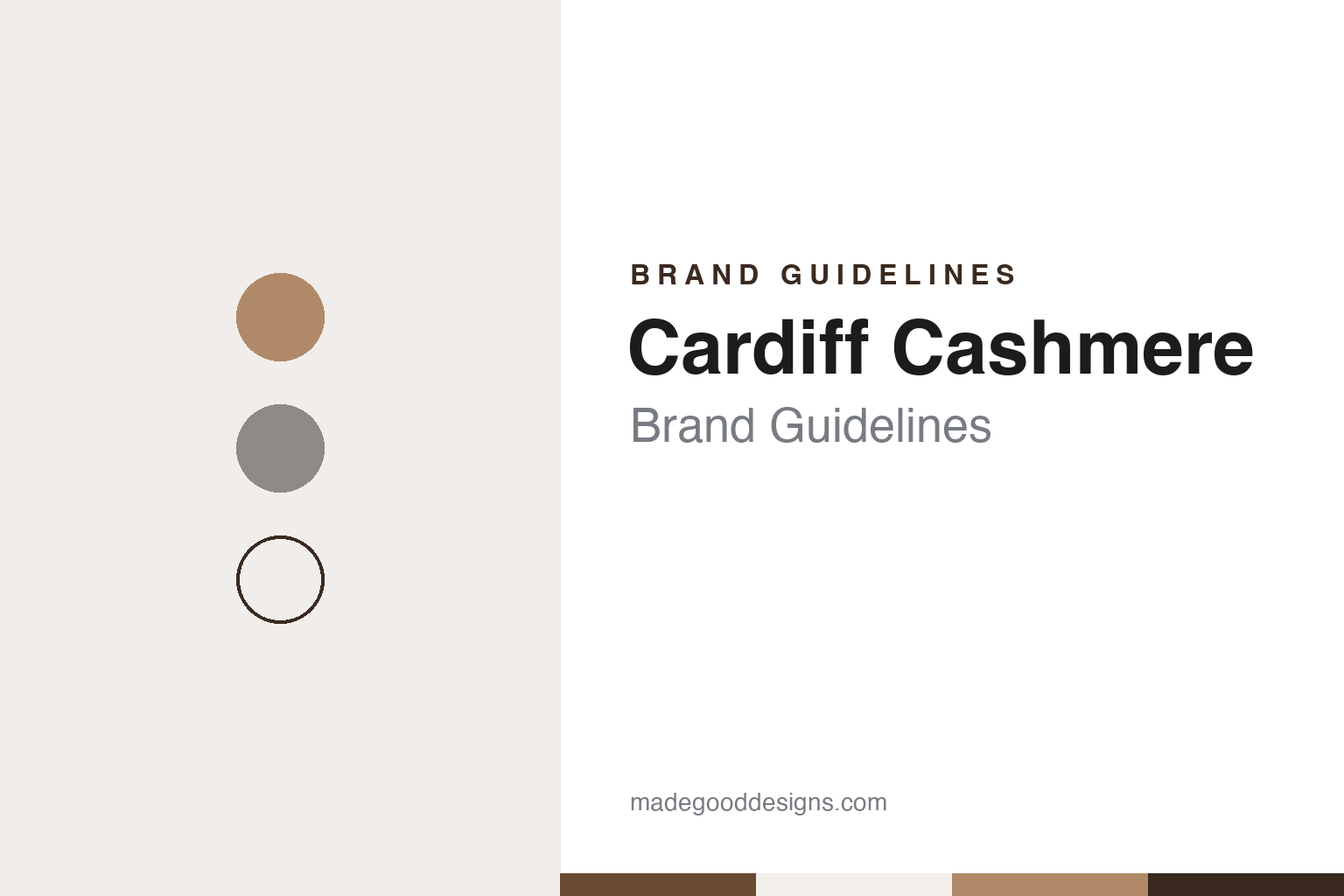
Two constants: a Cardiff camel, smoke grey and snow white palette and an Italian serif register. Abstract homage — not a Cardiff Cashmere product or mark; no yarn, label or logo is reproduced.
A Biella cashmere house
Founded in the 1980s, by its own account.
Cardiff Cashmere is the yarn brand of Cardiff S.r.l., a company based in Biella, the Piedmont town about 80 kilometres north-east of Turin that sits at the centre of one of Italy’s best-known wool districts. The name is the Welsh capital’s, but the company is Italian, registered in Biella’s companies register, and its website does not explain the choice. It has worked in one fibre. “Cashmere inspired the birth and development of Cardiff,” the company says.
Its own account of its origins is brief. Cardiff was founded, its website says, by a family of Biella entrepreneurs who in the 1980s “saw and believed in this fiber as the highest expression of quality and prestige” in textile production. It gives no exact year and does not name the family; we found no independent source that does, so we give the decade as the company’s own and name no founder.
An earlier version of the website, archived in 2018, adds the sequence. Cardiff began, it said, as a company making yarn for knitwear, establishing itself in the luxury clothing market, and only at the beginning of the 1990s launched a line of hand-knitting yarn in balls, “always and strictly in cashmere,” for hand knitters. The same page set out principles the company still repeats: exclusive specialisation in cashmere, care at every stage from choosing the fibre to finishing it, colour following the seasonal trends, and a “stock service” promising prompt delivery of every shade on its colour cards. It credited the quality of its yarns to an approach it called artisanal rather than industrial, and to Biella’s wool-working tradition.
Colour
From Inner Mongolia to Biella.
Cardiff’s raw material comes from Asia. The finest cashmere, its website says, comes from the highlands of Mongolia and Inner Mongolia, where goats grow a fine, soft undercoat beneath a coarser outer coat to survive sharp swings in temperature; the undercoat is combed out at the start of summer. Cardiff says it buys there through a “responsible selection of suppliers.”
It publishes its standards for choosing fibre: fineness, length and colour, with the whitest and cleanest lots preferred. The two language versions of the page differ on the first figure — the Italian page sets the limit at under 16.5 microns, the English page at no more than 15.5 microns — while both give a minimum fibre length of 38 millimetres. Finer, longer fibre, the company says, spins better, feels softer, pills less and lasts longer.
Its manufacturing claim is the core of the brand. “100% Made in Italy,” the company says: “All Cardiff yarns are produced within the Biella textile district.” It lists the stages — carding, spinning, twisting into plies, and dyeing, done before or after spinning depending on the yarn — and says all of them take place in the district. It does not say which steps happen on its own premises and which at partner firms, and it names no mill; we give the statement as the company’s. Its sustainability page adds that keeping every stage in the district supports “dozens of families” working in the area.
Typography
Yarn and where it is made.
The seven brands in this group all sell yarn for hand knitting and crochet, and they come from seven countries: Stylecraft from the United Kingdom, Araucania from Chile, Tukuwool from Finland, Cardiff Cashmere from Italy, Wollmeise from Germany, Blue Sky Fibers from the United States and Biggan Design from Australia. What separates them most is not the shape of a ball or the length of a colour card but the question every knitter eventually asks: where does the fibre come from?
Yarn brands answer that question in very different ways. Some tie their identity to the sheep of one country or even one local breed, and put the farm and the flock at the centre of the story. Some build a name on a single luxury fibre such as cashmere, where sourcing and finishing matter as much as colour. Some are defined by the dye pot, turning bought-in yarn into one-of-a-kind hand-dyed skeins, while others make affordable acrylic in large volumes, for knitters who want bright colour, easy washing and a low price.
Each guide separates what independent sources record from what the company says about itself — who founded it, who owns it now, where its fibre is grown and where its yarn is spun — and marks plainly what rests only on the company’s own word.
Aa
An Italian serif — a cashmere house from Biella. (Specimen set in Cormorant Garamond, a serif STAND-IN; NOT the Cardiff Cashmere logo.)
Cardiff Cashmere
Cones for the trade, balls for hand knitters.
Cardiff still sells to two markets. Its trade side supplies yarn on cones to knitwear makers; in 2018 its archived catalogue listed machine-knitting yarns in pure cashmere and in cashmere blended with silk, several with stock service in dozens of colours. Its hand-knitting side has grown: the 2018 archive listed six ball yarns, among them Classic in 50 colours, and today the company says Classic, its pure cashmere yarn, is available from stock in more than 100. Newer lines include Prime, a brushed cashmere around a core of mulberry silk, and Silka 8, a worsted cashmere-and-silk yarn in 50-gram skeins. It publishes its own patterns and sells through a list of resellers and a trade webshop.
Its colour cards are the most distinctive part of its identity. Shades carry numbers and names, and the names range widely: Neve, Italian for snow, with Nero and Fumo among the neutrals, and others that borrow from culture and design, such as Galileo, Romeo, Memphis, Tadao and Muji. The company describes its palettes as moving from pastels to strong contrasts, earth tones and metallic accents. We found no published brand guidelines, no colour codes and no staff or revenue figures. Its website, in Italian and English, is the main public record of the company; the earliest capture of it in the Internet Archive dates from March 2018, and we found no independent trade-press profile, so most of what is known about Cardiff comes from Cardiff itself. One domain trap: cardiff.it belongs to an unrelated women’s fashion boutique; the yarn maker’s site is cardiffcashmere.it.
For a design guide, Cardiff Cashmere shows how a single-fibre specialist can build an identity from one material and one place. Compare Filatura di Crosa and Lana Gatto, two other yarn names from Biella. For this guide we use a cashmere camel, smoke grey and snow white with a serif, an unofficial interpretation; no product or logo is reproduced.
Explore & save
Keep Cardiff Cashmere’s identity on hand — save it to a board in the Made Good inspiration library.
Cardiff Cashmere identity set
Pin the Cardiff Cashmere camel, smoke grey and snow white palette and the Italian serif register to your own board.