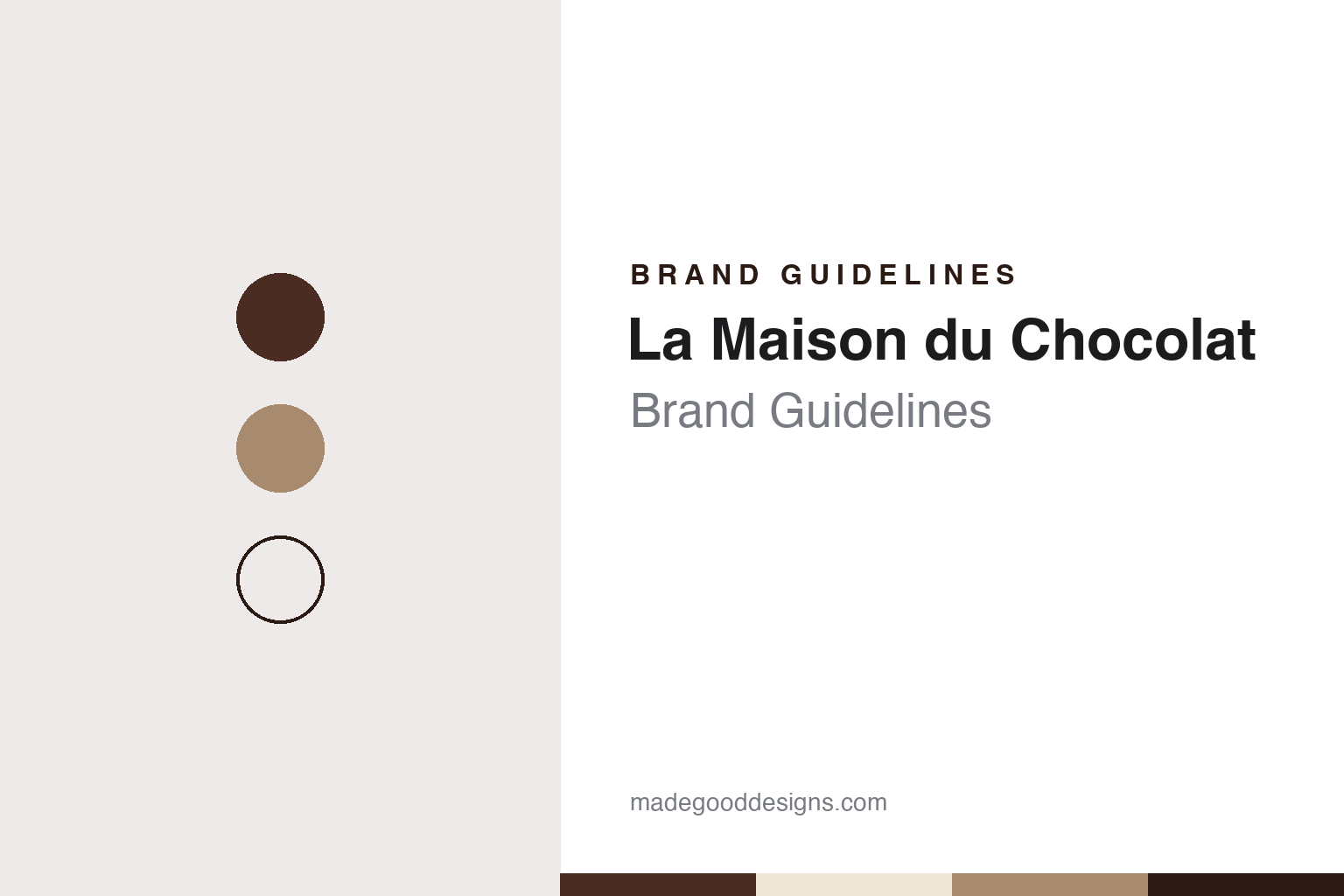
La Maison du Chocolat Brand Guidelines
The Paris house that built a luxury brand on the ganache.
Aa
Two constants: a brown and cream palette and a couture serif register. Abstract homage — not a La Maison du Chocolat product or mark; no box, logo or ribbon is reproduced.
The ganache sorcerer
A Basque pâtissier opens a shop only for chocolate.
La Maison du Chocolat began in Paris in October 1977, when Robert Linxe opened a shop devoted only to chocolate at 225 rue du Faubourg Saint-Honoré, opposite the Salle Pleyel concert hall. The first shop is still trading, according to French Wikipedia and Le Figaro.
Linxe came from Bayonne, in the French Basque Country. French Wikipedia and Le Figaro’s 2014 obituary say he trained as a pâtissier there and in the 1950s at the COBA chocolate school in Basel, Switzerland. He then ran La Marquise de Presles, a pâtisserie and caterer on the avenue de Wagram in Paris, for about twenty years; French Wikipedia says he later sold it to Gaston Lenôtre.
The new shop was built on the ganache, chocolate mixed with cream, which Linxe flavoured with fruit and spices. By the end of the 1970s the writer Jean-Paul Aron had called him “le sorcier de la ganache”, the ganache sorcerer, Le Figaro reported in 2014. An early chocolate cake was named Le Pleyel after the hall across the street. The house’s best-known ganaches, Le Figaro wrote in 2014, include the Salvador (raspberry), the Andalousie (lemon), the Quito (plain dark) and the Guayaquil (vanilla).
The brand went abroad early. Le Figaro dated the first foreign shop, in New York, to 1990 in 2008 and again in 2014, while French Wikipedia gives 1 October 1986; we note both. Tokyo followed in 1998, London in 2003 and Hong Kong in 2008, according to French Wikipedia, and in December 2008 a third New York shop opened on Wall Street, Le Figaro reported. In 2000 the company joined the Comité Colbert, the association of French luxury houses.
Colour
A family food group, a workshop in Nanterre.
La Maison du Chocolat did not stay with its founder. By the mid-1990s it belonged to the Bongrain family’s food group, best known for cheese. In 2008 Le Figaro described it as “a gem of the Bongrain family,” with Armand Bongrain as chairman and shareholder, and said the group had recruited Geoffroy d’Anglejan to run it; in 2017 the paper dated his arrival to 1995. Bongrain renamed itself Savencia Saveurs & Spécialités in 2015. We found no dated source in the material we checked for when the Bongrain family first took control.
The ownership is still visible today. The French company register lists the holding company Eufipar as chairman of La Maison du Chocolat SAS, and the same holding as chairman of Valrhona, the couverture maker in Tain-l’Hermitage, and of Savencia’s cheese businesses. Guillaume Mazarguil, who joined Bongrain in 2003, became managing director in June 2018, succeeding d’Anglejan, Le Figaro reported.
The kitchen changed hands too. Linxe retired in 2007, the house’s thirtieth year, and Gilles Marchal, formerly pastry chef at the Bristol hotel, succeeded him, Le Figaro reported in 2008. Nicolas Cloiseau, who joined in 1996, ran a decoration workshop from 2000, won the title of Meilleur Ouvrier de France chocolatier in 2007 and became the house’s chef in 2012. In 2014 he told Le Figaro that the beans are chosen with the purchasing director of Valrhona and turned into chocolate by the couverture maker — so the chocolate is bought in, then made into ganaches and pralinés by the house.
On where it makes them, the company is specific: it says its chocolates are made by hand by 35 chocolatiers at “our atelier in Nanterre, a short distance from our Parisian boutiques,” and that its cocoa is “100% traceable.” We give those as its claims; Cloiseau’s own account to Le Figaro places the decoration workshop that opened around 2000 in Nanterre. In April 2014 the paper counted 38 shops, 17 in France and 21 abroad, all run by the company.
Typography
Paris chocolate and its houses.
The seven brands in this group are all French chocolatiers: La Maison du Chocolat, Patrick Roger, Jean-Paul Hévin, Debauve & Gallais, Chapon, Richart and Puyricard. Most are names people meet first in a shop window rather than on a supermarket shelf, and their identities are built as much from boutiques, boxes and ribbons as from the chocolate inside.
France’s chocolate trade has a vocabulary of its own. A chocolatier is not always a chocolate maker: many houses buy couverture from specialist producers and put their craft into ganaches, pralinés and moulded or enrobed bonbons, while a growing number roast their own beans and make bars from bean to bar. Paris has long been the trade’s shop window, and the title Meilleur Ouvrier de France, awarded after a national competition, is one of the distinctions a chocolatier can carry on the door. Regional houses, often family-run, sell their own specialities alongside the chocolate.
Each guide separates what independent sources record from what the company says about itself — who founded it, who owns it now, where its chocolate is made and whether it makes that chocolate or shapes it — and marks plainly what rests only on the company’s own word.
Aa
A couture serif — for a house that compared itself to a jeweller. (Specimen set in Cormorant Garamond, a serif STAND-IN; NOT the La Maison du Chocolat logo.)
La Maison du Chocolat
A brown jewel case tied with a ribbon.
The brand’s look was Linxe’s own idea, and he described it in fashion terms. “I always compared my shop to a chocolate jeweller,” he told Le Figaro, with “a brown, felted décor, matching boxes as refined as jewel cases, and cotton ribbons inspired by Hermès.” The paper called the grained boxes “recognisable among all others,” and said the shop design was revised in 2006.
The company tells the same story today. Its website describes “shades of brown and cream” and “a box designed like a jewel case,” a case “inspired by the finest saddler’s boxes,” and quotes Linxe on his love of couture and of Hermès. It says that at Christmas and Easter it hands its gift boxes to illustrators, that its main gift box is made in France and its other boxes in Europe, and that all its boxes are recyclable apart from the ribbons — claims we have not checked.
The house has also stepped outside its browns. For a 2013 pop-up shop at the Printemps department store it used a teal blue with touches of brown, and in 2014 it launched a line of cocktail-inspired chocolates with the Bristol hotel in a bright green box, Le Figaro reported. Brown and cream are still the colours the company describes today.
No typeface or colour code for the brand has been published, so the palette and serif here are our reading of the shops and boxes, not a specification. The useful lesson is structural: a small craft brand, owned since the 1990s by a large food group, has kept the founder’s address, his ganaches and his box as fixed points while chefs, managers and owners have changed around them.
For a design guide, La Maison du Chocolat shows how packaging borrowed from luxury leather goods can carry a food brand across four decades and several continents. Compare Valrhona, its sister company in the Savencia group, and Patrick Roger, a Paris chocolatier who has stayed independent. For this guide we use brown, cream and a ribbon taupe with a serif, an unofficial interpretation; no product or logo is reproduced.
Explore & save
Keep La Maison du Chocolat’s identity on hand — save it to a board in the Made Good inspiration library.
La Maison du Chocolat identity set
Pin the La Maison du Chocolat brown and cream palette and the couture serif register to your own board.