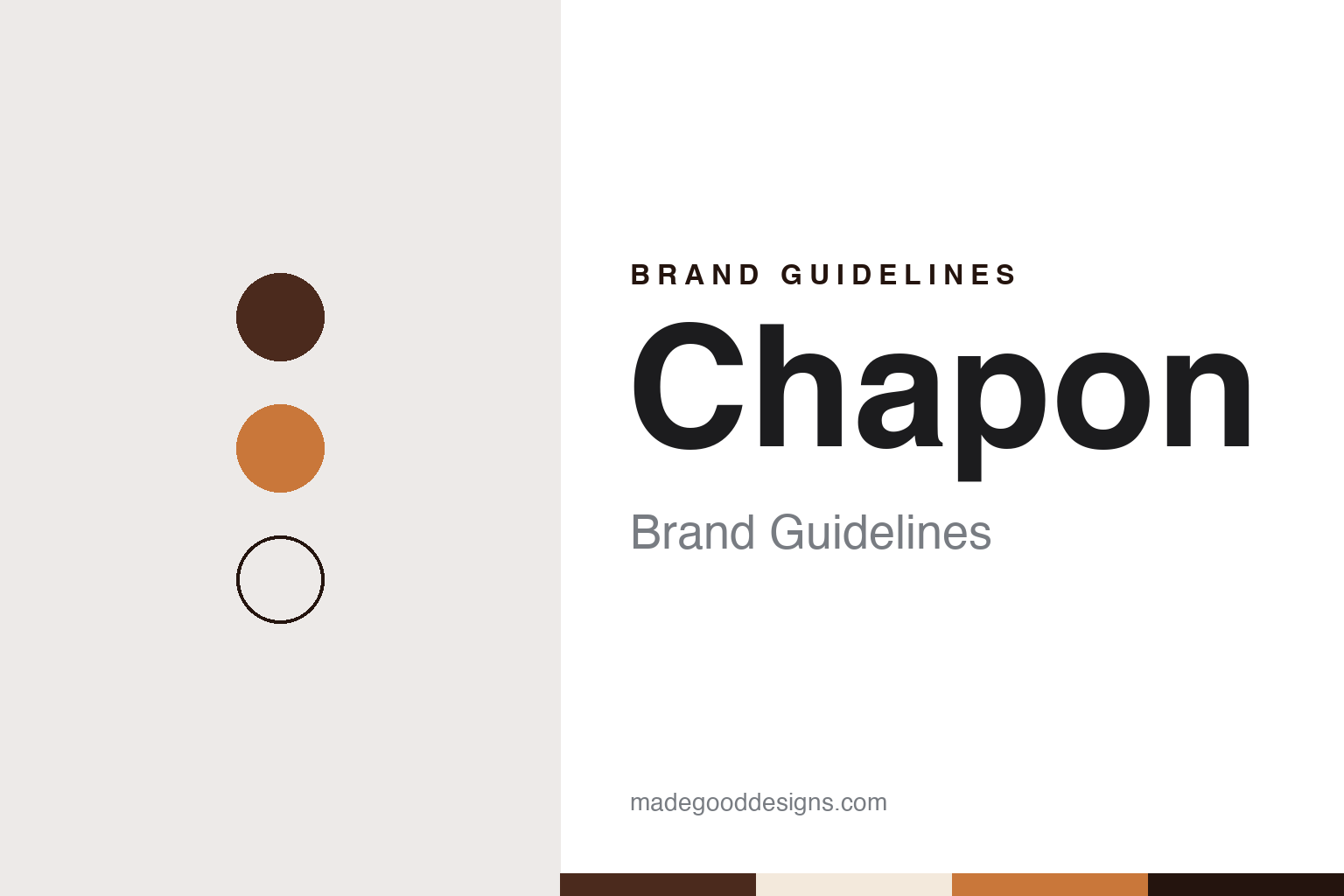
Chapon Brand Guidelines
The bean-to-bar chocolatier behind the Paris mousse bar.
Aa
Two constants: a roasted brown, cream and copper palette and a soft serif register. Abstract homage — not a Chapon product or mark; no wrapper, logo or shop sign is reproduced.
From Chelles
A chocolate maker east of Paris.
Chapon is the chocolate business built by Patrice Chapon. It is a Paris name, but its home is Chelles, a town in the Seine-et-Marne about twenty kilometres east of the capital. French company records date the company, Chapon SAS, to 1995 and place it in Chelles, classed under the manufacture of cocoa, chocolate and confectionery. The company’s legal notice gives the same town for its head office, and its website calls the place where the chocolate is made simply “la Chocolaterie, à Chelles.”
The company tells its own story through Patrice Chapon rather than through dates. A 2023 post on its blog describes the mousse bar as his childhood dream, built on his love of chocolate and his “talents de glacier” — his skill as an ice-cream maker — and says he chose to open his workshop to the public, with chocolate classes for children and adults. Its creations page speaks of the “heritage of Patrice Chapon” and the curiosity that it says still drives the teams. In 2023 the company also posted a television report on its founder from the lunchtime news on the French channel M6, under the title “Patrice Chapon : le Maître du Chocolat.”
Chapon’s range runs from tablets and boxes of filled chocolates, which it calls bonbons, to pralinés, spreads, moulded seasonal figures and ice creams. It sells online with delivery across France and abroad, offers a tablet subscription, and takes corporate gift orders. For pralinés, the company says it selects nuts and grains such as Piedmont hazelnuts, Sicilian pistachios, Sri Lankan coconut and French maize, and turns them into pralinés at its Chelles workshop; we give that as its own description.
Colour
From the bean, and into a cone.
Chapon describes itself as a bean-to-bar maker, working “de la fève à la tablette” — from the cocoa bean to the finished bar — rather than starting from ready-made couverture. Its savoir-faire page says the work starts with a search for rare cocoas “produced in small quantities in agroforestry plantations,” that its teams talk regularly with growers about possible adjustments to drying and fermentation, and that roasting and conching are done at the Chelles workshop, where the cocoa is tasted “at every stage.” It says its rare-cocoa tablets are made without added ingredients, “ni lécithine ni arômes” — neither lecithin nor flavourings. These are the company’s own statements; we found no independent audit of them, and it does not name its growers on the pages we read.
The house’s best-known invention is the bar à mousse, a counter selling chocolate mousse by the scoop. The company says it is the thing that “made Chapon’s name around the world,” and frames it around a single idea: what matters most in a chocolate mousse is the chocolate. Customers choose not between flavours but between cocoa origins — the current page lists Madagascar, Peru, Chuao and Venezuela at 75 and 100 per cent — made with cow’s milk or almond milk, served in an individual cone or a bowl to share. The company says it keeps six permanent recipes and adds seasonal ones, and it now also sells mousse for home delivery through Uber Eats.
Around the tablets and mousse, the company’s filled chocolates are presented as a box of varied shapes and colours, with names such as the canela and the dôme au sel. Its ice creams, it says, are made in collaboration with artisan ice-cream makers who share its standards, so that the range runs through summer as well as winter.
Typography
The French chocolatier tradition.
The seven brands in this group are all French chocolatiers: La Maison du Chocolat, Patrick Roger, Jean-Paul Hévin, Debauve & Gallais, Chapon, Richart and Puyricard. Most are names people meet first in a shop window rather than on a supermarket shelf, and their identities are built as much from boutiques, boxes and ribbons as from the chocolate inside.
France’s chocolate trade has a vocabulary of its own. A chocolatier is not always a chocolate maker: many houses buy couverture from specialist producers and put their craft into ganaches, pralinés and moulded or enrobed bonbons, while a growing number roast their own beans and make bars from bean to bar. Paris has long been the trade’s shop window, and the title Meilleur Ouvrier de France, awarded after a national competition, is one of the distinctions a chocolatier can carry on the door. Regional houses, often family-run, sell their own specialities alongside the chocolate.
Each guide separates what independent sources record from what the company says about itself — who founded it, who owns it now, where its chocolate is made and whether it makes that chocolate or shapes it — and marks plainly what rests only on the company’s own word.
Aa
A soft, warm serif for a gourmand register. (Specimen set in Fraunces, a serif STAND-IN; NOT the Chapon logo.)
Chapon
Nineteen shops and a holding company.
Chapon’s growth has been in shops. Its website now lists 19 chocolateries in Paris and the Île-de-France. In Paris they include shops on the rue du Bac in the 7th arrondissement, the rue Saint-Sulpice in the 6th, the rue Tiquetonne in the 2nd, the Batignolles and the avenue Mozart; outside the city, the list includes Saint-Germain-en-Laye, Versailles, Levallois-Perret and Courbevoie. The newest addition we could date is on the rue de Belleville: French Wikipedia, citing the retail trade weekly LSA in February 2025, says a Chapon shop opened at the Pyrénées end of the street in 2025, under the headline that Chapon was betting on indulgence, with its mousse bar, to win customers.
The ownership structure has also changed. French company records, read in October 2026, list Patrice Chapon among the company’s officers, but show that since 2022 the chair of Chapon SAS has been Fevory Développement, a holding company created that year and also registered in Chelles. Two related companies were registered on the same day, one of them named La Fabrique Chapon. The records do not say who owns the holding company or on what terms it took the chair, and we found no press report of a sale, so we do not describe the change as one. What is documented is that the chocolate is still made, by the company’s account, in Chelles.
Chapon has no published brand book that we could find, and no documented logo designer or typeface; its tablets and shops do the work of identity. The company presents the bean-to-bar process, the origin names and the mousse counter as its signatures, which gives the brand a consistent story: the cocoa first, then the recipe, then the shop.
For a design guide, Chapon shows how a single, easily explained product — chocolate mousse served like ice cream — can carry a whole shop network, while the bean-to-bar claim gives the tablets their seriousness. Compare Michel Cluizel, another French family maker that works from the bean, and Pralus, the Roanne pâtissier who makes his own chocolate. For this guide we use a roasted brown, a mousse cream and a copper accent with a soft serif, an unofficial interpretation; no product or logo is reproduced.
Explore & save
Keep Chapon’s identity on hand — save it to a board in the Made Good inspiration library.
Chapon identity set
Pin the Chapon roasted brown, cream and copper palette and the soft serif register to your own board.