Michel Cluizel Brand Guidelines
The Normandy family that coined “cacaofèvier.”
Aa
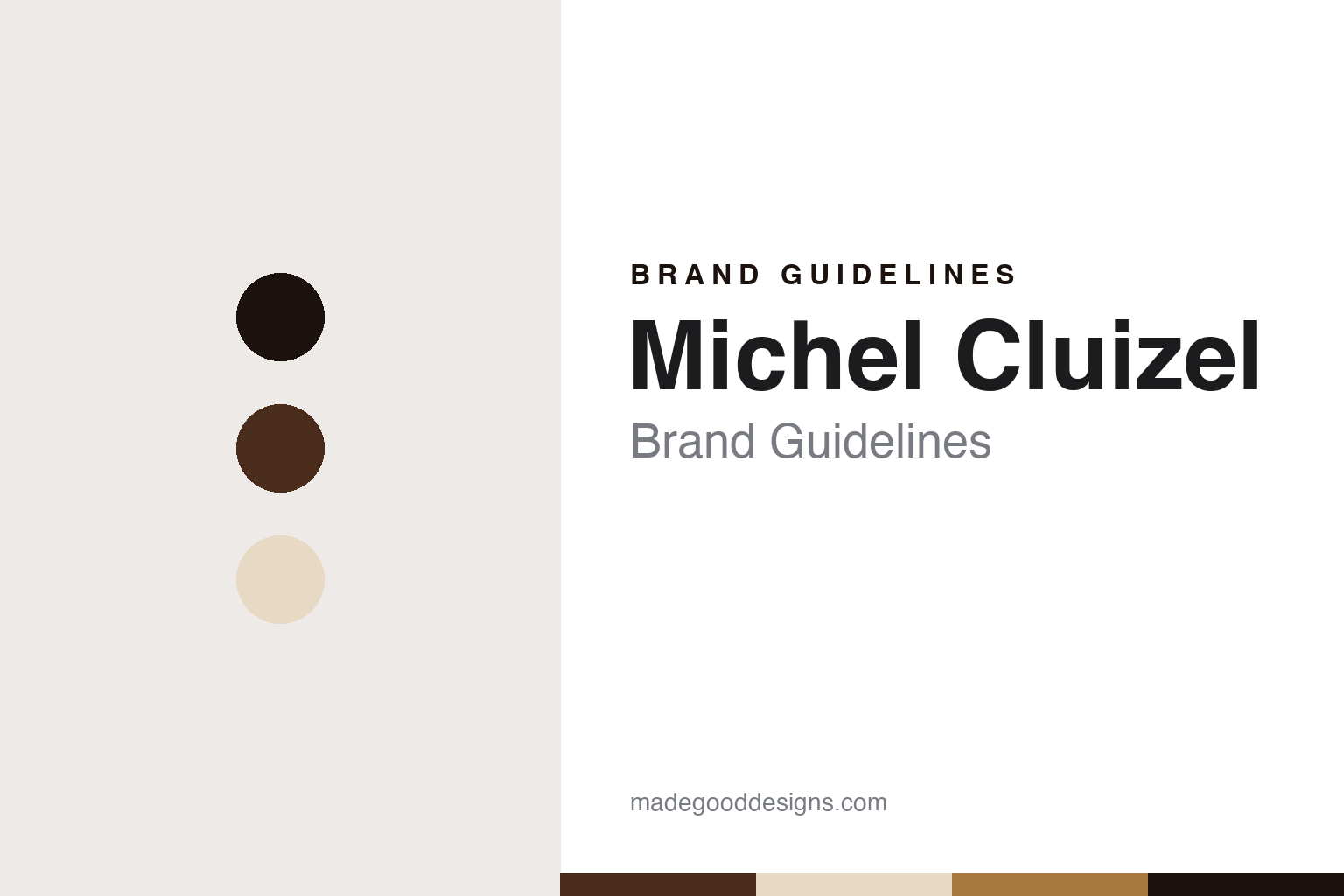
Two constants: a Michel Cluizel brown, cream and amber palette and a high-contrast serif register. Abstract homage — not a Michel Cluizel product or mark; no wrapper, logo or packaging is reproduced.
Damville, 1948
Two pastry cooks and a kitchen in Normandy.
The company that sells chocolate as Michel Cluizel was founded in 1948 not by Michel but by his parents. Marc and Marcelle Cluizel, pastry cooks in Damville, a small town in the Eure département of Normandy, began making chocolate bonbons in their kitchen, the company says; English Wikipedia describes Marc Cluizel expanding his pastry business into chocolate with his wife, and French Wikipedia gives the same founders, place and year. Their son Michel joined as an apprentice in that first year, English Wikipedia says, and later took over the business and gave it his name.
Damville has since been merged into the commune of Mesnils-sur-Iton, and that is where French Wikipedia places the main factory today; it puts the workforce at about 200. In 2002, the company says, it opened the Chocolatrium at Damville, a visitor space where the public can see how chocolate is made.
The family has stayed in charge. The company says Michel Cluizel handed the leadership to his son Marc in 2005, supported by his daughters Catherine and Sylvie, and that the third and fourth generations took on leadership roles in 2023. French Wikipedia says Marc Cluizel runs the company through a family holding company.
Colour
From bonbons to plantation bars.
For its first decades Cluizel was a confectioner, and the company says its confectioners still write their own filling recipes — praliné, almond paste, caramel and nougatine among them — with some fillings ground on a granite wheel. Its move into Paris came in 1987, when it opened its first shop on the rue Saint-Honoré, a date both the company and French Wikipedia give.
The brand’s reputation now rests on dark chocolate. In 1989, the company says, it introduced high-cacao bars, including a 99% cacao chocolate it describes as the first of its kind. In 1999 it launched its first “1er Cru de Plantation,” made with beans from the Hacienda Concepción in Venezuela; the collection was later renamed “Chocolat de Plantation.” The company now names plantations including Mangaro in Madagascar, Mokaya in Mexico, La Laguna in Guatemala and Riachuelo in Brazil, several of which English Wikipedia also lists, as well as El Jardín in Colombia, Los Anconès in the Dominican Republic and Vila Gracinda on São Tomé. It says the beans are fermented on the plantations — for about six days at several of them — under relationships going back around twenty years.
Cluizel makes its chocolate from the bean. The company says its work covers selecting beans, roasting them and grinding the nib into cocoa paste, and English and French Wikipedia both describe it as one of the makers that work directly from cocoa beans. To name that work it coined a word: “cacaofèvier,” from cacao and fève, the bean. The company dates the term to 2006, and French Wikipedia says it created and trademarked it.
A second commitment concerns ingredients. Since 2000, the company says, its “Ingrédients Nobles” charter has limited its chocolate to cocoa, pure cocoa butter, sugar and Bourbon vanilla, without soy lecithin or artificial flavourings.
Typography
From the plantation to the shop.
The seven brands in this group all make chocolate, and they come from four countries: Valrhona, Michel Cluizel and Pralus from France, Amedei from Italy, Felchlin from Switzerland, and Guittard and Askinosie from the United States. They sit at different points in the chocolate trade, from names known mainly to pastry kitchens to small makers known mainly by the bar on the shelf.
At one end are couverture houses, whose chocolate is sold in blocks, pistoles and callets to chefs, chocolatiers and bakers as much as to shoppers, and whose brand often reaches the public second-hand, through a restaurant dessert or a patisserie window. At the other end are bean-to-bar makers, who buy cocoa beans, roast and grind them in their own workshop and sell finished bars, and whose identity rests on the farm, the origin and the maker’s name. Many firms sit somewhere between the two, selling to professionals and to the public at once.
Each guide separates what independent sources record from what the company says about itself — who founded it, who owns it now, where its beans come from and where its chocolate is made — and marks plainly what rests only on the company’s own word.
Aa
A high-contrast serif — a family name signed on the wrapper. (Specimen set in Playfair Display, a serif STAND-IN; NOT the Michel Cluizel logo.)
Michel Cluizel
A family name, a Mucha bar and a coined word.
The brand is built on a person’s name, and Cluizel’s best-documented design episode is a wrapper. In 1984, the company says, it launched a bar illustrated with artwork by Alphonse Mucha, the Art Nouveau poster artist, and the packaging won an “Oscar de l’emballage,” a French packaging award. Beyond that, the company has not published colour values or typefaces, so the palette here is our own interpretation of a dark-chocolate brand.
The house has also tied its name to the French state’s heritage scheme. In 2012 it received the Entreprise du Patrimoine Vivant label, which recognises firms with rare craft skills, according to the company and both Wikipedias.
Cluizel has a presence in the United States. English Wikipedia says that in August 2004 the company opened an American subsidiary, including a manufacturing facility and a museum, in West Berlin, New Jersey; the company’s American website says it established its US headquarters and a chocolate shop there in 2007, after more than twenty years of distributing its chocolate in the country, so the sources differ on the date. The New Jersey site offers guided chocolate tours and an activity for children called “Paint Your Palate,” it says, and sells the French range alongside items such as brownies and cookies. A New York boutique opened in 2005, the company says.
More recent ranges extend the same ideas: an organic collection, “Les Exclusifs,” in 2020 and a tasting experience, “Les Sens du Chocolat,” in 2021, the company says. French Wikipedia puts the company’s revenue at about €23 million in recent years, which makes it a mid-sized family firm beside industrial chocolate groups.
For a design guide, Michel Cluizel shows how a family name and a word of its own invention can carry a brand as far as any logo. Compare Bonnat, another French family maker that sells chocolate by origin, and Valrhona, the Rhône valley couverture maker. For this guide we use dark brown, cream and amber with a serif, an unofficial interpretation; no product or logo is reproduced.
Explore & save
Keep Michel Cluizel’s identity on hand — save it to a board in the Made Good inspiration library.
Michel Cluizel identity set
Pin the Michel Cluizel brown, cream and amber palette and the high-contrast serif register to your own board.