Uist Wool Brand Guidelines
The community spinning mill on an Outer Hebridean island.
Aa
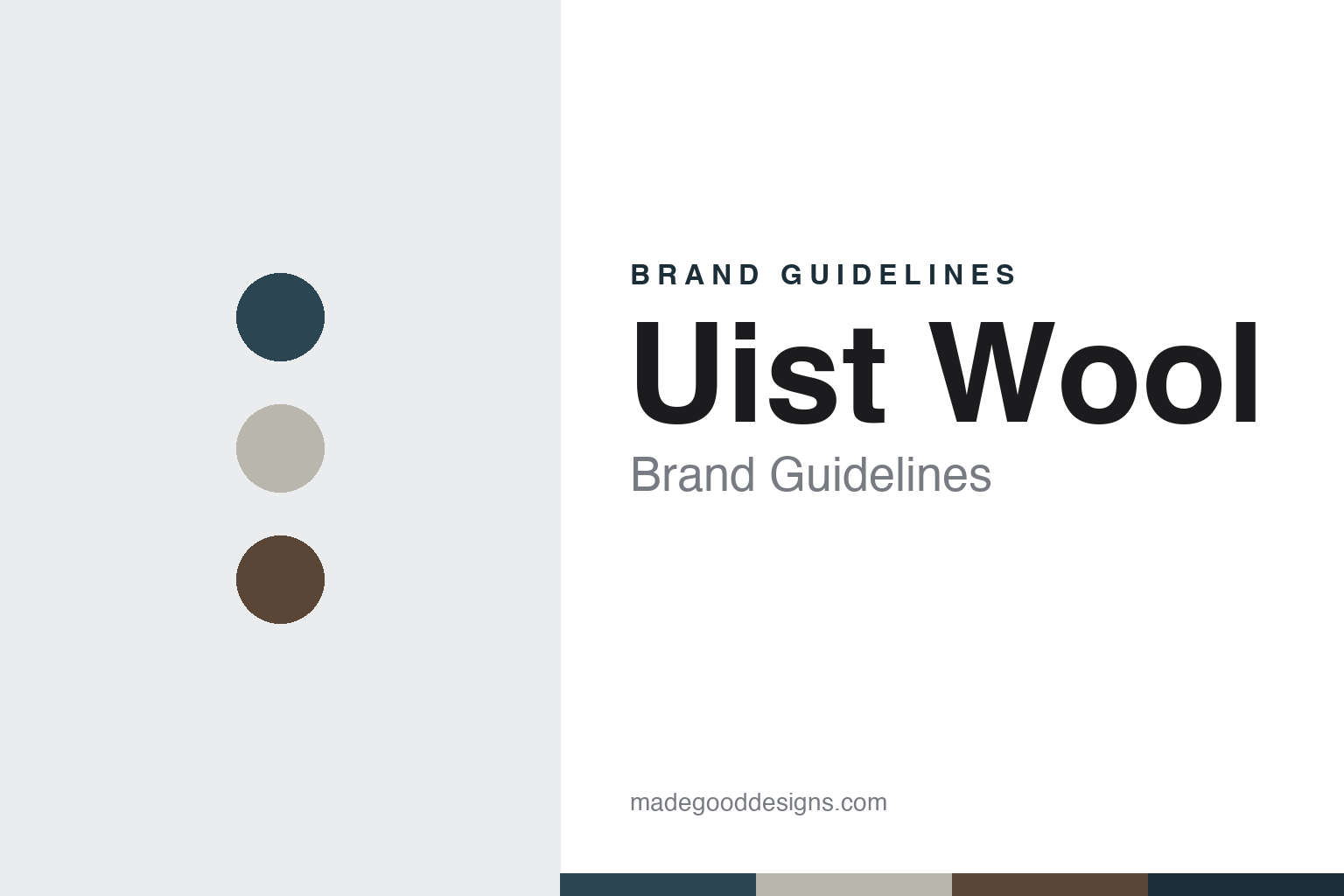
Two constants: a Uist Wool sea blue, Siaban grey and peat brown palette and a plain island sans register. Abstract homage — not a Uist Wool product or mark; no yarn, label or logo is reproduced.
A mill on Grimsay
Island fleece, island jobs.
Uist Wool is a spinning mill on Grimsay, a small tidal island in the Outer Hebrides crossed by the road between North Uist and Benbecula. It was established in 2011 as a community benefit society to revive the traditional wool industry in parts of the Western Isles and to provide training and employment, BBC News reported in January 2017. The company says its story “begins in 2013 when our beloved spinning mill sprung to life,” the result of a long-held ambition to bring yarn and wool production back to the islands.
Its founding aims, the company says, were practical: to find a new use for local wool and to bring new life to the local economy by paying crofters a fairer price for their fleece. Fleece is graded at source, and the mill says it sources as much fibre as it can on Uist and the rest from no further away than Scotland. BBC News said in 2017 that it specialises in the Hebridean, one of the oldest native Scottish sheep breeds.
The machinery is old. The company says the mill uses heritage equipment that came from Argyll and Yorkshire, with the main parts of its carding machine dating back to the nineteenth century, all restored and rebuilt; it says the card alone has more than 100 oiling points that are tended every day. In 2016 it completed a Wool Centre beside the mill, a shop and showroom for its yarns and for commissions from local designers and makers, and in a 2021 blog post it said it had begun selling its yarns “in earnest” when the centre and its website opened five years earlier.
Colour
A not-for-profit with co-operative values.
Uist Wool’s structure is part of its identity. In January 2017 BBC News reported that the community benefit society was to become a trading social enterprise, a structure that would let it put any profits back into the organisation, and that Highlands and Islands Enterprise, the region’s development agency, would provide a £90,000 grant for the change. Today the company describes itself as run “with co-operative values at our heart” and as a not-for-profit, working closely with local crofters, makers and creators.
Its yarns are mostly undyed, sold in the natural colours of the fleece, in 4ply, DK, aran and chunky knitting weights and as weaving yarns. Most have Gaelic names; its “classic light grey yarn” is Siaban, and the company’s brand film follows it from croft to mill. One range, Canach, is spun from Scottish Merino, also called Bowmont, a breed the company says was developed in the 1990s by the Macaulay Institute, now the James Hutton Institute, by crossing Shetland and Saxon Merino sheep. Because Hebridean winters are too harsh for that fine fleece, Uist Wool says it buys it from a single flock in Aberdeenshire, and it notes that changes to its machinery after the first batches made the yarn smoother.
The mill also works with other Scottish textile makers. In 2021 it named its collaborators: the weaver Sam Goates of Woven in the Bone, who weaves its Canach scarves and wraps; Ardalanish Weavers on the Isle of Mull, who weave its blankets and some of its scarves; Rebecca Hutton of Taobh Tuath Tweeds in Northton, on Harris, who weaves its Harris Tweed; and Schofield Dyers & Finishers in Galashiels, who finish its cloth.
Typography
Island mills and native wool.
The seven brands in this group all sell British yarn for hand knitting and crochet: West Yorkshire Spinners, John Arbon, Baa Ram Ewe, Blacker Yarns, Laxtons, Uist Wool and Fyberspates. They share a country, but not a way of making yarn, and the difference between them says a good deal about what is left of Britain’s wool industry.
Britain once spun yarn on an industrial scale, and the mills that remain are a small fraction of what there was. Some brands still own the machinery that turns fleece into yarn. Others design yarns and colours and pay a mill — at home or abroad — to spin them, which is how much of the modern yarn trade works. Between the two sit firms that do part of the work themselves, such as dyeing or blending, and buy in the rest. A brand’s label rarely makes clear which kind of company it is.
Each guide separates what independent sources record from what the company says about itself — who founded it, who owns it now and where its yarn is spun and dyed — and marks plainly what rests only on the company’s own word.
Aa
A plain sans for a brand its makers call “bold, clear and simple.” (Specimen set in Work Sans, a sans STAND-IN; NOT the Uist Wool logo.)
Uist Wool
From a star and crooks to a bold, plain mark.
Uist Wool’s identity was redrawn in 2021. In a blog post that May it announced a new website and brand by the agency Jamhot, made with financial support from Highlands and Islands Enterprise, and a move of its online shop from WordPress to Shopify. It said the decision had been hard, because it was attached to its earlier “delicate star and crooks logo” by Kristina Low, but that the old mark had not always kept up with new media and formats; the new brand was, in its words, “bold, clear and simple.” The company has not published its colours or typefaces.
The result is a brand built on place and language rather than on a founder or a founding date. Gaelic product names, undyed colours and the story of a restored mill on a tidal island do the work that a heritage crest might do for an older firm, and the company presents itself less as a manufacturer than as part of its community, with crofters, weavers and designers named alongside the yarn.
For a design guide, Uist Wool shows how a small community mill can make its island, its sheep and its language into a brand. Compare Jamieson’s of Shetland, another island spinner of native wool, and Blacker Yarns, which also spins British breed wool. For this guide we use sea blue, Siaban grey and a peat brown with a sans, an unofficial interpretation; no product or logo is reproduced.
Explore & save
Keep Uist Wool’s identity on hand — save it to a board in the Made Good inspiration library.
Uist Wool identity set
Pin the Uist Wool sea blue, Siaban grey and peat brown palette and the plain island sans register to your own board.