Blacker Yarns Brand Guidelines
The Cornish mill brand spinning breed-specific British wool.
Aa
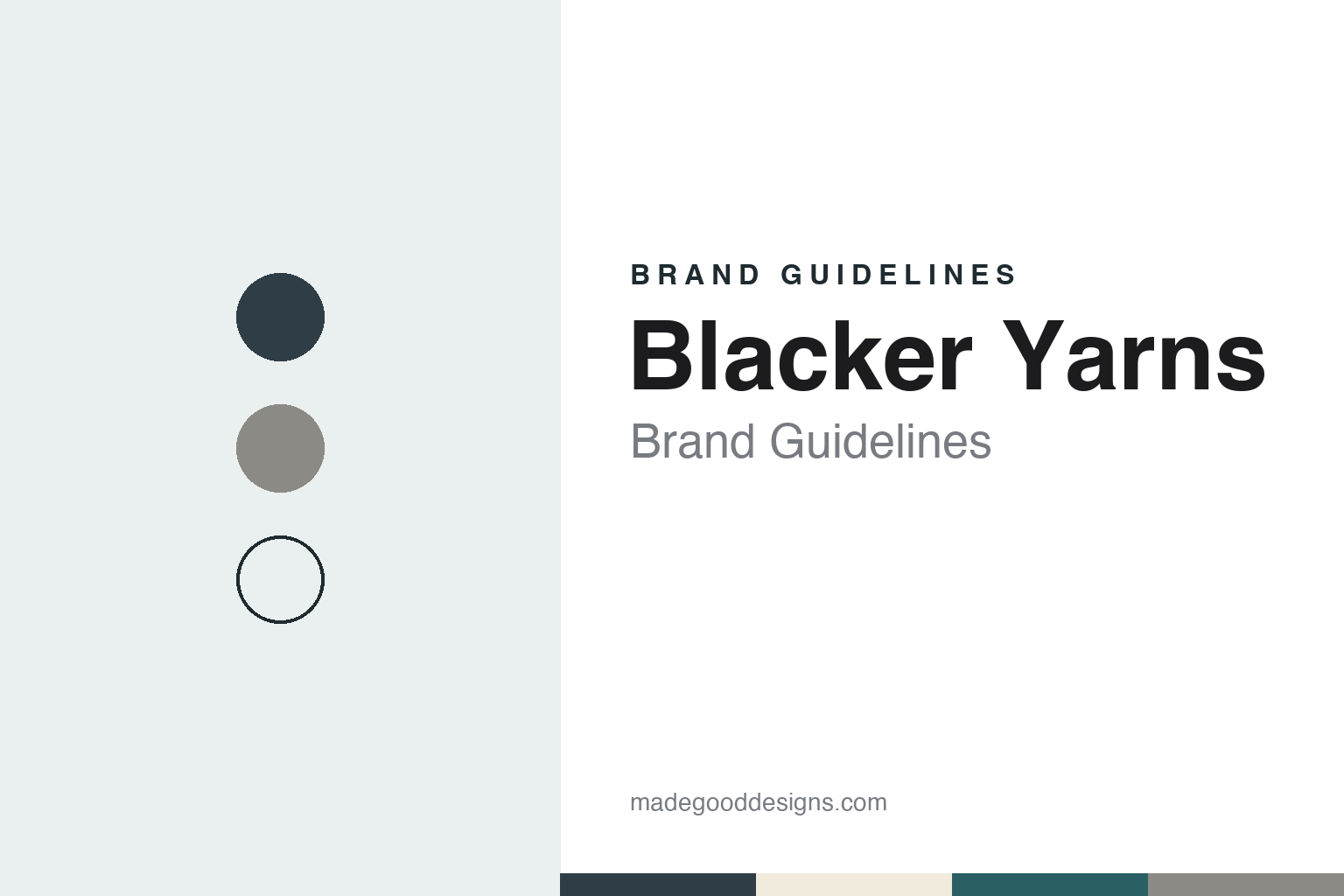
Two constants: a slate, teal and undyed fleece palette and a plain grotesque sans register. Abstract homage — not a Blacker Yarns product or mark; no yarn band, logo or label is reproduced.
The Natural Fibre Company
A Welsh mini-mill that moved to Cornwall.
Blacker Yarns is the knitting brand of a small spinning mill in Launceston, in east Cornwall, close to the Devon border. The mill is older than the brand. According to the company’s own history, it began in the mid-1980s, when Rose Elworthy started a small natural-fibre business in South Wales. By the 1990s the mill, by then called The Natural Fibre Company, was spinning wool for smallholders, specialising in natural, undyed yarns, under the management of Myra Mortlock, the company says.
The turning point came in 2005. The company says Sue Blacker, a breeder of Gotland sheep, took over that year and moved the mill to Launceston. Companies House records fit that account: Blacker Sheep Limited was incorporated in April 2005 with Susan Mary Blacker among its first directors, and The Natural Fibre Company Limited was incorporated in June 2005, with her as a director from that August. In Cornwall, the company says, the operation grew into a fully equipped mill of about 10,000 square feet, adding organic production, scouring, blending and the ability to spin a wider range of fibres, including mohair and alpaca.
That history matters to the brand because the mill’s first trade was not selling yarn to knitters but spinning other people’s wool. A mini-mill of this kind takes fleece from farms, smallholdings and flocks too small for the big processors, and turns it into yarn the owners can sell under their own names — which is how the company describes its early work for smallholders.
Colour
A yarn brand named after its owner.
The knitting brand came three years after the move. The company says Blacker Yarns was “created as a sister company to The Natural Fibre Company” in 2008, to sell the mill’s breed-specific yarns directly to knitters and crocheters through an online shop. It explains the name simply: “We’re named after the founder and previous owner of the business,” meaning Sue Blacker.
The idea behind the range is the sheep breed. Instead of blending anonymous wool to a standard, Blacker Yarns sells yarns labelled by breed — Gotland, Jacob, Shetland, Romney, Merino and rarer breeds in limited editions — and the company says its team has worked with more than 50 of Britain’s 60-plus recognised sheep breeds. Its named ranges include Blacker Swan, made with wool from Falkland Islands growers, according to the company; Tamar Lustre, which shares its name with the river that divides Cornwall from Devon; and Westcountry Tweed.
The company makes strong claims about how the yarn is made, and we give them as its claims. It says all its yarns are made in its own mill in Cornwall, “where we scour, spin and finish,” using heritage machinery and traditional processes to produce both woollen-spun and worsted-spun yarns, with fibre sourced “whenever possible” from local and other UK farms. It says it uses only organic dyes and makes no superwash or nylon yarns, and it runs a separate online shop selling repurposed and recycled mill waste. It also asks customers for donations to support its heritage machinery.
Blacker Yarns stresses traceability, publishing a “farm to yarn” page and information about the breeds it spins. It works with independent pattern designers and sells their patterns alongside its own, which is how most small British yarn brands reach knitters today.
Typography
Design and documentation.
The seven brands in this group all sell British yarn for hand knitting and crochet: West Yorkshire Spinners, John Arbon, Baa Ram Ewe, Blacker Yarns, Laxtons, Uist Wool and Fyberspates. They share a country, but not a way of making yarn, and the difference between them says a good deal about what is left of Britain’s wool industry.
Britain once spun yarn on an industrial scale, and the mills that remain are a small fraction of what there was. Some brands still own the machinery that turns fleece into yarn. Others design yarns and colours and pay a mill — at home or abroad — to spin them, which is how much of the modern yarn trade works. Between the two sit firms that do part of the work themselves, such as dyeing or blending, and buy in the rest. A brand’s label rarely makes clear which kind of company it is.
Each guide separates what independent sources record from what the company says about itself — who founded it, who owns it now and where its yarn is spun and dyed — and marks plainly what rests only on the company’s own word.
Aa
A plain grotesque sans — workmanlike and legible. (Specimen set in Work Sans, a sans STAND-IN; NOT the Blacker Yarns logo.)
Blacker Yarns
A change of owner in 2019.
The mill changed hands in 2019. The company says that since that year it has been “under the ownership of Colin Spencer Halsey,” and that it now trades as “Blacker Sheep Limited: The Natural Fibre Company.” Companies House records match: on 13 December 2019 Susan Mary Blacker and her fellow long-serving director Douglas Bence stepped down from the board of Blacker Sheep Limited and Colin Spencer Halsey was appointed; from 19 December 2019 the company’s controlling shareholder has been a holding company, The Natural Fibre Company Holdings Limited, incorporated that October. Sue Blacker remained a director of The Natural Fibre Company Limited until August 2020, when Halsey joined that board too. The terms of the sale have not been published.
Under the new owner, the company says, it has added a research and development strand, exploring new products and blends, and launched the mill-waste shop. It says Blacker Yarns now exports to 26 countries and supplies a growing number of UK and international stockists, and elsewhere that it has welcomed customers from more than 100 countries; we give both figures as the company’s claims.
The brand’s position is unusual among British yarn names. Many brands design yarn and have it spun by others; Blacker Yarns is the retail face of the mill that spins it. That lets it make the claim — “all spun under one roof” — that most of its competitors cannot.
For a design guide, Blacker Yarns shows how a brand can be built on the sheep rather than the shade card: breed names, place names and a mill’s own history. Compare John Arbon, another West Country mill brand, and Jamieson’s of Shetland, a mill spinning a single native breed. For this guide we use slate, teal and undyed fleece tones with a sans, an unofficial interpretation; no product or logo is reproduced.
Explore & save
Keep Blacker Yarns’s identity on hand — save it to a board in the Made Good inspiration library.
Blacker Yarns identity set
Pin the Blacker Yarns slate, teal and undyed fleece palette and the plain sans register to your own board.