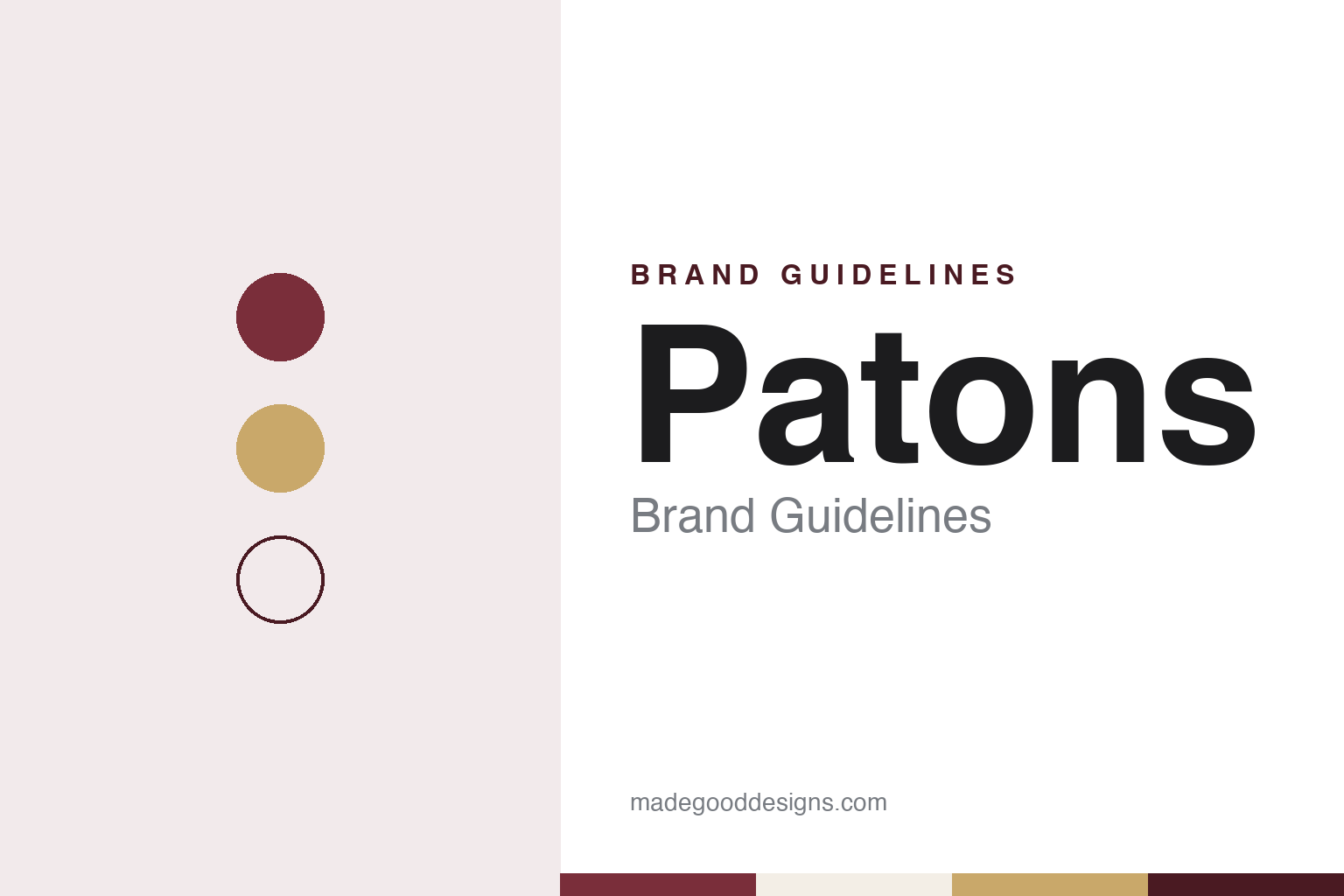
Patons Brand Guidelines
The Alloa yarn name now split between two owners.
Aa
Two constants: a Patons rose, heather and gold palette and a heritage serif register. Abstract homage — not a Patons product or mark; no yarn, logo or ball band is reproduced.
Two Mills, One Name
A Scottish spinner and a Yorkshire one.
Patons began as two separate businesses, one in Scotland and one in England. English Wikipedia records that John Paton Son and Co. was founded in 1814 by John Paton of Alloa, on the Forth, and that J & J Baldwin and Partners was founded in the late 1770s by James Baldwin of Halifax, in West Yorkshire. Both built their businesses on Samuel Crompton’s spinning mule, and both mainly made yarn for commercial knitting machines. The Paton family became generous benefactors to Alloa, paying for its town hall, public libraries, a school, a swimming pool and a gymnasium, Wikipedia says.
The two companies merged in 1920 as Patons & Baldwins and turned towards wool for knitting at home, publishing patterns under the “Patons Rose” and “Baldwins Beehive” trademarks. By the mid-1930s the group had works across Scotland and northern England, including Billingham and Jarrow, and further afield in Canada, New Zealand and at Launceston in Tasmania; it briefly ran an angora rabbit farm in Staffordshire and experimented with nylon and Terylene. In 1951 it moved its headquarters from Spring Hall in Halifax to a 140-acre site at Darlington, County Durham, where a single-storey factory built for £7.5 million employed some 4,000 people and turned out 113 tons of yarn a week, Wikipedia says. The company was an original member of the FT 30 index of leading London shares.
Colour
From Coats to two new homes.
In 1961 Patons & Baldwins merged with J & P Coats, the Paisley thread group, and for most of the next half-century the Patons name sat inside Coats. Production at Alloa ended in 1999; most of the surviving business records from the town’s mills are now held by Clackmannanshire Archives. The Launceston factory in Tasmania, which employed more than 2,000 people in the 1960s, was sold in the late 1980s, spun its last yarn in 1995 and closed in July 1997, according to English Wikipedia.
Coats sold its European handicrafts arm, trading as MEZ, to the German investor AURELIUS in the summer of 2015. On 30 April 2020 AURELIUS announced that MEZ had sold “the hand-knitting yarn business of the Rowan and Patons brands” to the DMC Group, which it described as a subsidiary of the private-equity firm Lion Capital. The same press release noted that “Patons is currently sold only in the United Kingdom.” In Britain the old knitpatons.com address now forwards to the website of Sirdar, the Wakefield spinner that DMC also owns.
That sentence explains why Patons today has two owners. In North America the brand belongs to Spinrite, the yarn company of Listowel, Ontario, and is sold through its Yarnspirations website, where patonsyarns.com now forwards. Spinrite’s own pages do not give a date for when it took on Patons, but an archived Spinrite brand page from 2017 already listed Patons beside Bernat, Caron and Lily Sugar’n Cream. Australia is separate again: English Wikipedia says Patons there is made by Wangaratta Woollen Mills in Victoria and has been an Australian brand since 1923, and the Australian Patons web address now forwards to the website of another Australian yarn business.
Typography
Yarn, mills and marketing.
The seven brands in this group all make yarn for hand knitting and crochet, but they sit at opposite ends of the trade. Patons, Bernat, Caron and Lily Sugar’n Cream are the kind of names found on the shelves of big craft chains, while Sublime, Louisa Harding and Woolfolk present themselves as designer and premium labels, built around a name, a house style or a single fibre.
Craft-store yarn is a volume business, and its best-known names have often passed between larger groups. A brand can change owner, factory and even country of manufacture while the name on the ball band stays the same, so the label a knitter recognises says little about who makes the yarn today. Designer labels work the other way round: the name of a person, a fibre or a house style is the product, and the yarn is often spun by mills the brand does not own and may not name.
Each guide separates what independent sources record from what the company says about itself — who founded it, who owns it now and where its yarn is made — and marks plainly what rests only on the company’s own word.
Aa
A heritage serif — a register for a name in use since 1814. (Specimen set in Libre Baskerville, a serif STAND-IN; NOT the Patons logo.)
Patons
Heritage yarns, North American lines.
The North American range is the larger and better documented today. Yarnspirations presents Patons under the line “Timeless Yarns For Every Project” and says the brand “offers the finest heritage yarns for garments and home decor, as well as timeless patterns that will become beautiful heirlooms.” Its featured lines include Classic Wool Worsted, which the company sells as a 100 per cent wool family, Canadiana and Kroy Socks, alongside acrylic yarns for accessories. The range runs from natural fibres to acrylics, in the company’s words. Spinrite’s 2017 brand page put it more simply: “From natural fibres, to beautiful acrylics, Patons is a classic choice for your most treasured projects.” Spinrite runs its brands from Ontario: its 2017 history page placed its head office in Listowel and its design, digital and marketing teams in Liberty Village, Toronto, and its website today names Walmart, Amazon and Michaels among the retailers that sell its yarns.
Where the yarn is made is not stated. The Patons brand page and the product pages we checked for Classic Wool and Canadiana give no country of origin, and we found no independent source naming the mill that spins Patons for North America today. Spinrite says it has “several locations across North America,” and in 2017 it described its Listowel mill as among “the best equipped and most versatile” in the world, with “a robust sourcing program” alongside; we give both as the company’s own claims. The British range, sold through DMC’s Sirdar website, is a separate line of yarns.
For a design guide, Patons shows how one heritage name can survive the break-up of the group that held it, living on under different owners on different continents. Compare Rowan, sold to DMC in the same 2020 deal, and Sirdar, its British sister brand today. For this guide we use a rose madder, a heather ink and a beehive gold with a serif, an unofficial interpretation; no product or logo is reproduced.
Explore & save
Keep Patons’s identity on hand — save it to a board in the Made Good inspiration library.
Patons identity set
Pin the Patons rose, heather and gold palette and the heritage serif register to your own board.