Jamieson’s of Shetland Brand Guidelines
The family mill spinning native Shetland wool at the far west of the islands.
Aa
Two constants: a moorit, heather and fleece-cream palette and an island serif register. Abstract homage — not a Jamieson’s of Shetland product or mark; no yarn, garment, label or logo is reproduced.
Sandness
Five generations, one family, the far west of Shetland.
Jamieson’s of Shetland is a family business in Sandness, on the far west coast of Shetland’s Mainland, and it spins yarn from the wool of the islands’ own native sheep. The company says its story began in the early 1890s, when Robert Jamieson ran a shop in Sandness that bought or bartered hand-spun knitwear from local crofters and sold it on, as Shetland hosiery, to buyers beyond the islands. It does not give an exact year, and we have not found one in independent sources.
The next steps, as the company tells them, followed the wool rather than the knitwear. Robert’s son Andrew became one of the islands’ first wool brokers, buying the raw clip from crofters and shipping it to mainland Scotland to be processed. Shetland wool was then thought too fine and fragile for industrial machinery, the company says, so it was blended with coarser breeds, and even the best yarn sold as “Shetland” was only about 60 per cent pure.
In 1952 the third generation, Bertie Jamieson, opened a retail outlet in Lerwick, the islands’ main town, which the company treats as the start of its knitwear brand. Sweaters were knitted by hand by home workers, using blended yarn spun on the mainland. Bertie and his son Peter then set out to make a pure yarn, and the company says it produced its first 100 per cent Shetland yarn in 1978.
The family describes itself as now in its fifth generation, with Peter and Elaine Jamieson and their children, and it still sells from a shop on Commercial Street in Lerwick. The name causes some confusion: Jamieson’s is not connected, in any source we checked, with Jamieson & Smith, a separate Lerwick wool broker whose own website says it was incorporated in 1951 and became part of the Yorkshire firm Curtis Wool Direct in 2004.
Colour
A woollen mill on the islands.
The decisive move came in 1981, when the family opened Jamieson’s Spinning at Sandness. The company says every stage happens under one roof — grading, scouring, dyeing the fleece, blending colours, carding, spinning, twisting and balling — and calls it Shetland’s only commercial wool mill. That is not only a self-description: the local paper Shetland News has repeatedly called it the islands’ only commercial woollen mill, in 2017 and 2020, and in September 2025 described it as “the mill, established in 1981.” The operating company, Jamieson’s Spinning (Shetland) Limited, was incorporated in 1983, according to Companies House.
Because the fleece is dyed before it is spun and the colours are blended at the carding stage, the company’s shades are mixtures of several tones, which gives them a heathered look. Shetland News reported in 2017 that the mill made yarn in five weights and more than 400 colours, plus Shetland tweeds, rugs and blankets woven on its own looms; it repeated the 400-colour figure in 2025. The company’s own product notes describe Spindrift, a two-ply yarn roughly equal to a traditional 4-ply and meant for Fair Isle knitting, in 225 shades, with a double-knitting version in the same colours; Shetland Heather, an Aran weight in 40 heathered colours; and a chunky Shetland Marl. Its Ultra and Cobweb lace yarns are, it says, its only blends, half Shetland wool and half lambswool, spun for fine lace shawls.
The mill has grown with the craft. Shetland News reported 15 employees in 2017 and more than 30 in 2023, and has charted a run of investments supported by Highlands and Islands Enterprise: a yarn-balling machine in 2020, after the pandemic lifted demand for hand-knitting yarn; whole-garment knitting machines from the Japanese maker Shima Seiki in January and September 2023, joining eight older computerised machines; and new equipment for its carding machines in 2025. “Sales of both our knitwear and hand knitting yarns have been growing steadily for the past 20 years,” the manager, Garry Jamieson, told the paper in 2023.
The wool itself carries a regional name. In 2011 Shetland News reported that the European Union had granted “Native Shetland Wool” protected designation of origin status, on an application by a crofters’ co-operative, and called it the first non-food product in Europe to receive one.
Typography
Wool, colour and craft.
The seven brands in this group all sell yarn for hand knitting and crochet, but they work at very different scales and come from seven countries. Between them they cover most of the ways a ball or skein of yarn reaches a maker: from a mill on an island, from a small hand-dyeing studio, from a family distributor, and from names sold widely on the high street and in craft chains.
Four come from continental Europe. Phildar is French, Scheepjes is Dutch, Katia is Spanish and Isager is Danish, and each guide sets out who founded the brand, who owns it now and what it says about where its yarn is spun. Two are smaller and rooted in place: Jamieson’s of Shetland, from the islands north of mainland Scotland, and Hedgehog Fibres, an Irish hand-dyer. The last, Cascade Yarns, is an American family firm in Seattle that sources its yarn from partner mills abroad.
Each guide separates what independent sources record from what the company says about itself, and marks plainly what rests only on the company’s own word.
Aa
An island serif — warm, bookish and unhurried. (Specimen set in Libre Caslon Text, a serif STAND-IN; NOT the Jamieson’s of Shetland logo.)
Jamieson’s of Shetland
Hand-knitting yarn and machine knitwear from one family.
Jamieson’s runs two businesses under one name: the mill, which spins hand-knitting and weaving yarn, and the knitwear, sold from the Lerwick shop and online. The company says the islands’ oil boom cut the number of hand-knitters, and that the family were among the first in Shetland to adopt computerised knitting machines. Shetland News reported in 2023 that the newest machines make plain garments so that its linkers can concentrate on finishing Fair Isle pieces, and that its staff also work at the Lerwick shop.
Its range is built on colour, not on new fibres. Apart from the Ultra lace blends, the company says its yarns are pure Shetland wool, and its catalogue stays close to the traditional island weights — fine two-ply for Fair Isle, lace and cobweb yarns for shawls, and heavier Aran and chunky yarns. In 2017 the firm told Shetland News it wanted to grow internationally, and in 2020 the paper reported a new market opportunity in China.
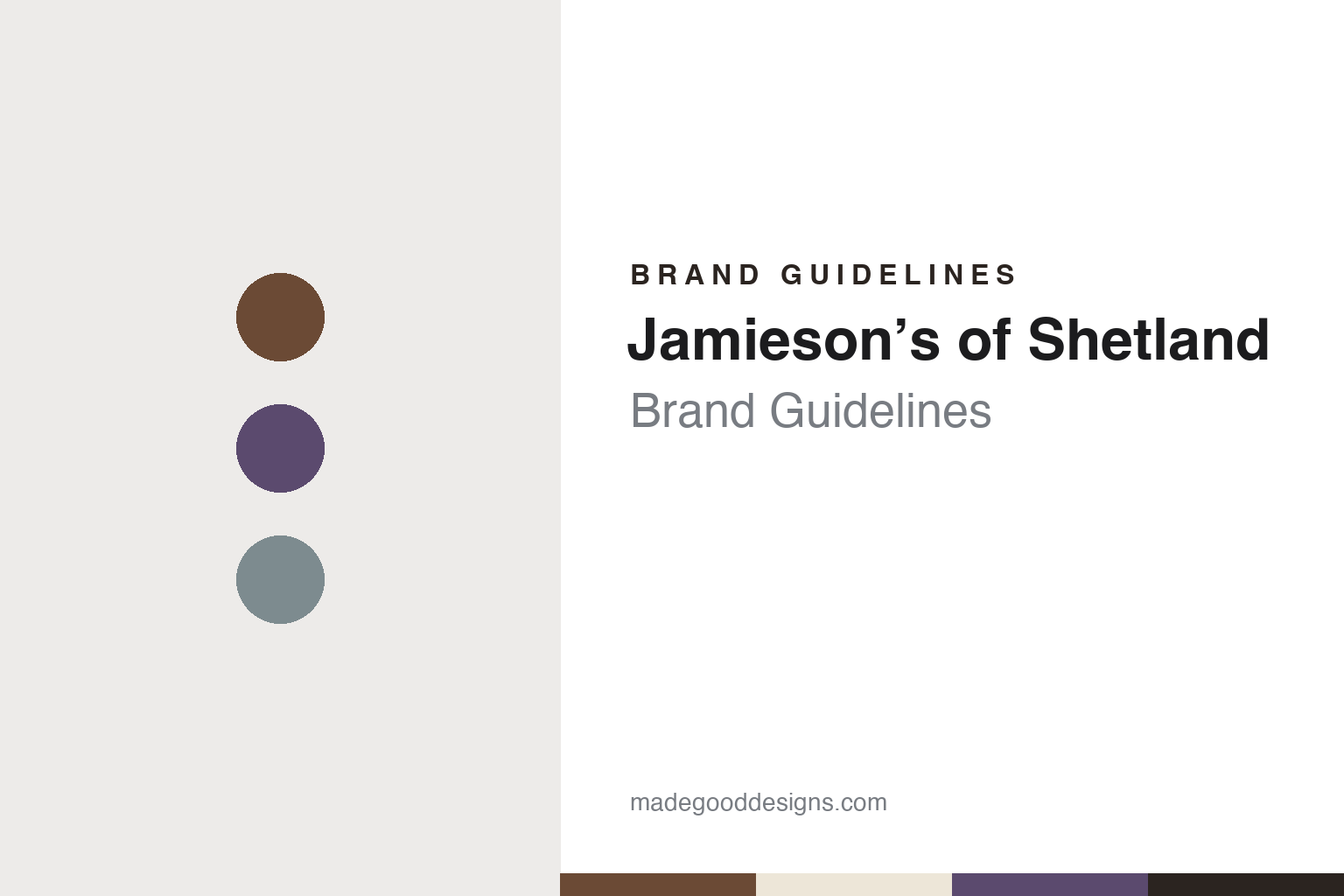
For a design guide, Jamieson’s of Shetland shows how a heritage brand can rest on a place and a process rather than a logo: the name, the islands and hundreds of blended shades do the work. Compare Isager, a Danish yarn house with its own strong colour sense, and Hedgehog Fibres, an Irish hand-dyer at the opposite end of the palette. For this guide we use moorit brown, heather and fleece cream with a serif, an unofficial interpretation; no product or logo is reproduced.
Explore & save
Keep Jamieson’s of Shetland’s identity on hand — save it to a board in the Made Good inspiration library.
Jamieson’s of Shetland identity set
Pin the Jamieson’s of Shetland moorit, heather and fleece-cream palette and the island serif register to your own board.