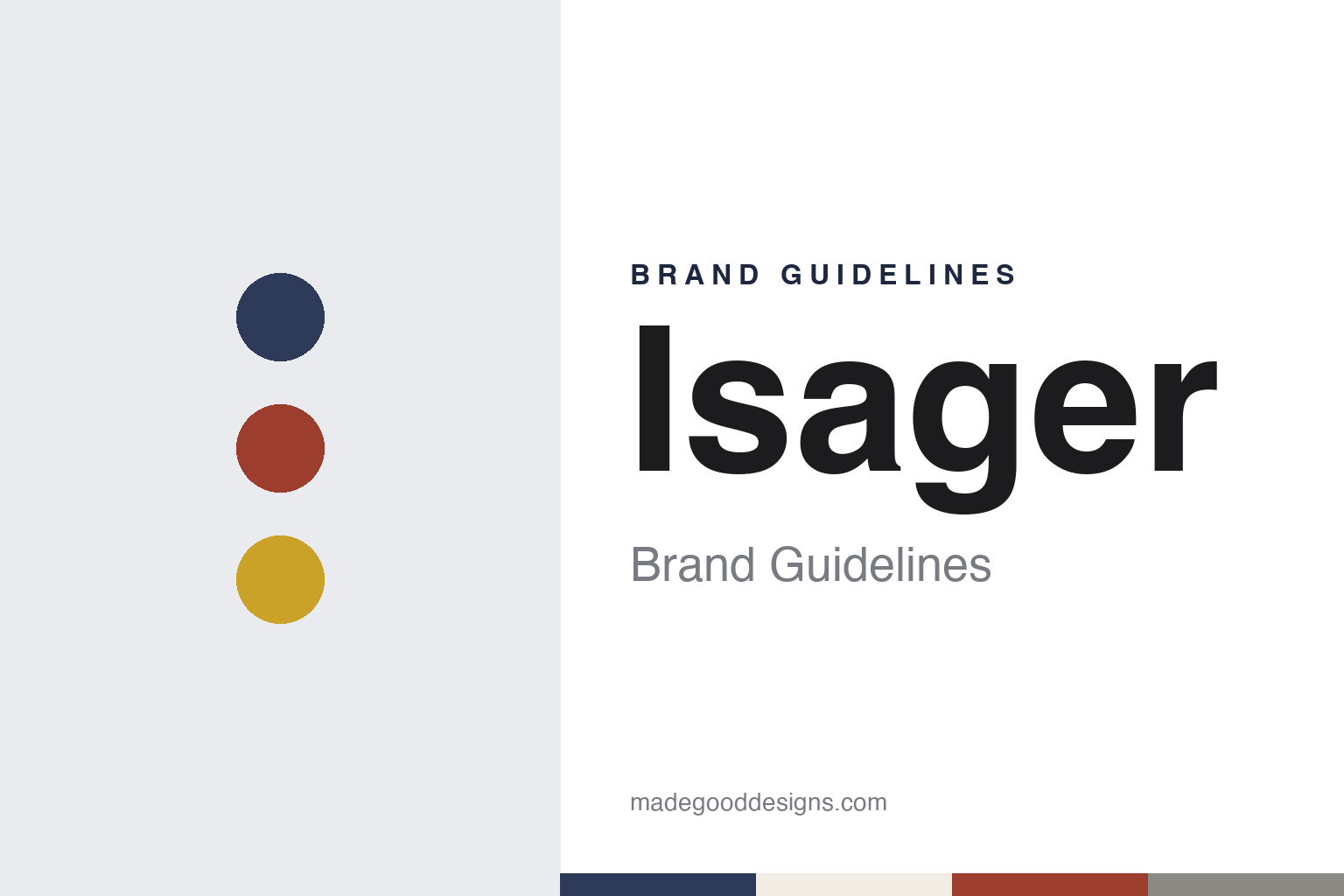
Isager Brand Guidelines
A Danish colour card kept for half a century.
Aa
Two constants: an indigo, madder and weld palette and an old-style serif register. Abstract homage — not an Isager product or mark; no yarn band, pattern or logo is reproduced.
Åse Lund Jensen
A knitting workshop that wanted better colours.
Isager’s story starts with another designer. Åse Lund Jensen (1920–1977), according to the Dansk Kvindebiografisk Leksikon, trained in haute-couture sewing at the Copenhagen department store Illum in 1940–42, graduated from the School of Arts and Crafts as an advertising artist in 1950, and went with her husband to Greenland, where she became interested in the region’s bead and skin patterns. Later travels in Iceland led her to measure and reconstruct old knitted shawls.
In 1959 she and Karen Lind Petersen published a small book of modern knitting based on Danish folk patterns, and in 1960 she set up her own workshop focused on knitted collections. The lexicon says her key inspiration was Faroese knitting, and that she developed multicolour “Jacquard” knitting into a style of her own, building the shaping of a garment into its pattern. A text by Kirsten Toftegaard, a curator at Designmuseum Danmark, published on Isager’s website, says she had about sixty knitters working for her at one point, and quotes her in 1972: “I strive for knitted clothes to fit as well as clothes that are cut, fitted and sewn.”
She designed for Illum’s handicraft department from 1968 to 1970, exhibited at Nordens Hus in Reykjavik in 1971 and at the Kunstindustrimuseet, now Designmuseum Danmark, in 1974, and published Strikning (“Knitting”) in 1974, which the lexicon describes as a new, professional approach to the craft. In 1975 she received the Dansk Kunsthåndværk annual prize, the lexicon says. She taught at the Skals handicraft school in 1973 — and it was there, the lexicon says, that she met Marianne Isager.
Colour
Plant colours, three shades each.
The yarn came out of a rejection. When Åse Lund Jensen applied to join Den Permanente, the crafts sales co-operative founded in 1931, she was first turned down because her yarn colours were considered too garish, the lexicon says. That led her to work with Henrichsens Uldspinderi, a wool spinner in Skive, Jutland, on yarns of her own, with a colour scale developed from plant-dyed yarns that, the lexicon notes, is still sold.
She had her own complaint about the knitting yarn of the day. “Cheerful colours are always garish, it seems,” she said in 1970, in Toftegaard’s account; “I also use red and blue, but I have just taken the bite out of them.” With Henrichsens, Toftegaard writes, she developed the single-ply Spinni, a three-ply yarn called ÅLJ and a heavier four-ply, and began with twelve cool tones — greyish, green, earth brown and indigo. By 1972 the card had grown to thirty colours, and she had been admitted to Den Permanente.
Isager tells its own version of why she wanted her own yarn. The yarn she had been using was too heavy, the company says: a sweater ordered from the United States weighed just over a kilo and cost too much to post. Working with a friend, she found her colours in plant dyes — indigo, madder, cochineal and the yellows and greens of Danish plants — and made each one in three shades, light, medium and dark. The company says the colour numbers in use today are still the same.
Åse Lund Jensen died in 1977. Before her death, the lexicon says, she arranged for Isager to take over her business. Isager says Marianne Isager was 23 and a textile student at the School of Applied Arts in Copenhagen when the business passed to her, and that her daughter Helga was then three months old. Toftegaard writes that Marianne Isager took over the rights to use Lund Jensen’s patterns and continued the firm. Marianne later doubled the colour card, the company says, by dyeing the same colours on a melange of wool from black and white sheep — the “s” colours still listed today.
Typography
Yarn, colour and the craft trade.
The seven brands in this group all sell yarn for hand knitting and crochet, but they work at very different scales and come from seven countries. Between them they cover most of the ways a ball or skein of yarn reaches a maker: from a mill on an island, from a small hand-dyeing studio, from a family distributor, and from names sold widely on the high street and in craft chains.
Four come from continental Europe. Phildar is French, Scheepjes is Dutch, Katia is Spanish and Isager is Danish, and each guide sets out who founded the brand, who owns it now and what it says about where its yarn is spun. Two are smaller and rooted in place: Jamieson’s of Shetland, from the islands north of mainland Scotland, and Hedgehog Fibres, an Irish hand-dyer. The last, Cascade Yarns, is an American family firm in Seattle that sources its yarn from partner mills abroad.
Each guide separates what independent sources record from what the company says about itself, and marks plainly what rests only on the company’s own word.
Aa
An old-style serif for a house built on pattern books. (Specimen set in EB Garamond, a serif STAND-IN; NOT the Isager logo.)
Isager
A village company with spinners in four countries.
Isager dates itself to 1977. Marianne Isager’s designer biography on the company website says she set up the firm after finishing her weaving studies and moved it in 1980 to Tversted, a village in North Jutland near the North Sea, where it has been ever since. In 2015, Isager says, the company took over the former Tversted School, which now houses its shop, offices, wholesale business and course centre. Her daughter Helga Isager is co-owner and creative director, and mother and daughter run the business together; both have published many knitting books, several also in English, German or Japanese.
Isager is unusually specific about where its yarns are made. On its own product pages, the company says that Spinni, Tvinni and Jensen Yarn — named for Lund Jensen — are spun and dyed in Denmark; that Isager Tweed is spun and dyed in Ireland; that Alpaca 1 and Highland are spun and dyed in Peru; and that its Silk Mohair, which it says is certified to the Responsible Mohair Standard, is spun and dyed in Italy. It says all the fibres in its yarns are mulesing-free and that its yarns are not moth-proofed. These are the company’s statements; we have not seen them independently confirmed.
It has also started spinning at home. At Uldens Hus (“the house of wool”) in Tversted, Isager runs a small spinning mill using machines from Belfast Mini Mills, a Canadian maker, spinning undyed yarn from Vendsyssel wool and from its own alpacas. The company says the aim is to learn enough about Danish wool and how to collect it that larger spinners could use it, and that it might one day go into Isager’s main wool yarns.
For a design guide, Isager shows how a fixed colour system can carry a brand for half a century: the same numbered shades, light to dark, reused across new yarns and new designers. Compare Jamieson’s of Shetland, another North Sea wool house built on a deep shade card, and Scheepjes, the Dutch brand that grew from a wool-combing business. For this guide we use indigo, madder, weld yellow and sheep grey with a serif, an unofficial interpretation; no product or logo is reproduced.
Explore & save
Keep Isager’s identity on hand — save it to a board in the Made Good inspiration library.
Isager identity set
Pin the Isager indigo, madder and weld palette and the old-style serif register to your own board.