Schachenmayr Brand Guidelines
The Salach spinning mill that became a yarn brand.
Aa
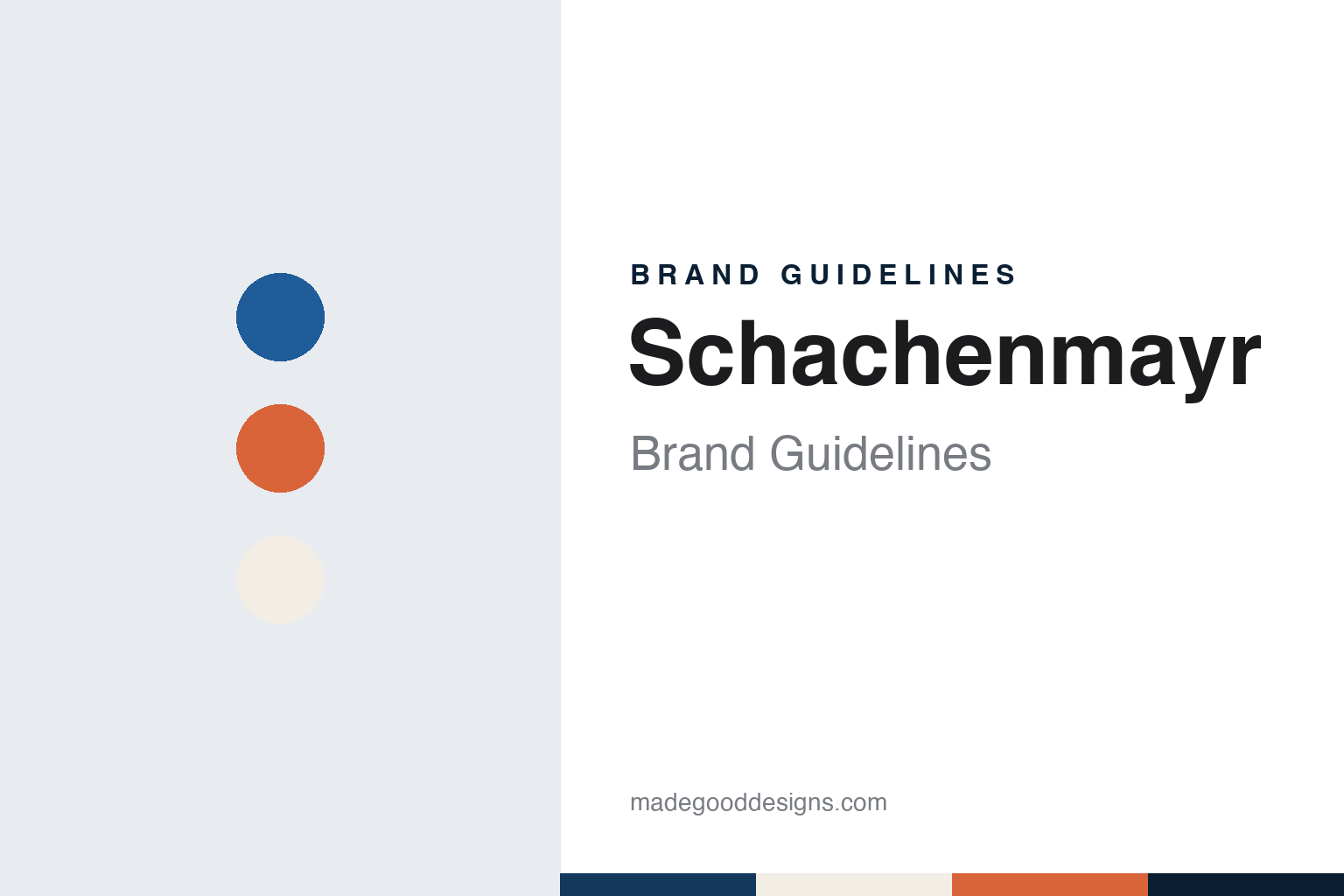
Two constants: a Schachenmayr blue, coral and cotton palette and a Friendly sans register. Abstract homage — not a Schachenmayr product or mark; no yarn band, logo or pattern is reproduced.
Salach
A worsted mill and two families.
Schachenmayr takes its name from a family, and its origins from a mill. According to MEZ, the company that owns the brand, it grew out of a small worsted-spinning mill — a Kammgarnspinnerei — founded early in the 19th century in Salach, near Göppingen in Württemberg. MEZ says the mill was bought in 1822 by a businessman from Aachen; in 1824 Leonhardt Schachenmayr joined as his son-in-law and partner, and in 1835 he took the firm over and made it a commercial success.
After Schachenmayr’s death in 1871, MEZ says, his own son-in-law, Friedrich Bareiß, ran the business, followed by his sons, and by the early 20th century it employed about 1,000 people. German Wikipedia’s article on the industrialist Conrad Bareiß (1880–1958) names the firm as Schachenmayr, Mann & Co., a worsted mill at Salach, which he owned after the death of his adoptive father, Otto Bareiß; the article adds that Conrad studied at the technical universities of Berlin and Zürich and chaired the supervisory board of the worsted mill at Bietigheim; both men were made honorary citizens of Salach, in 1923 and 1927. The village still has a Schachenmayr open-air pool and a Schachenmayr housing estate, German Wikipedia records.
The family kept the business until the early 1980s, when, in MEZ’s words, the general decline of the Württemberg textile industry led to its sale to the British thread group Coats, which acquired the hand-knitting yarn maker in 1984.
Colour
Inside the MEZ family.
Under Coats, Schachenmayr joined MEZ, an even older German thread business. MEZ says “Carl Mez & Söhne” was founded in Freiburg in 1785, that a grandson of the founder built a twisting machine in 1828 that could twist a continuous thread, that the firm became a public company in 1922, and that J. & P. Coats of Glasgow took a majority of it in 1932.
In 2020 AURELIUS described Schachenmayr and Regia, which MEZ presents separately as its sock-yarn brand, as traditional hand-knitting brands sold especially in German-speaking countries. Schachenmayr’s website, archived in September 2025, organised its range into families including Catania, Bravo, Merino and Baby Smiles, and sold printed pattern magazines and individual patterns in German and English; that season it was promoting a new mouliné yarn, Color Breeze. In 2023 the MEZ website also advertised a spring–summer collection made with the German women’s magazine freundin. Catania, a cotton yarn, is the line most prominently featured on that website; the company says it has been tested to the European toy-safety standard EN 71-3 and is suitable for crocheted toys.
MEZ says many Schachenmayr and Regia yarns are certified to class 1 of the OEKO-TEX Standard 100, the textile-safety label’s strictest product class, and describes its production principles as modern, resource-conscious and regional. Its own disclosures on manufacturing are more specific about one place than any other: AURELIUS, which owned MEZ from 2015 to 2020, said the business had its own production site in Hungary, serving sewing, embroidery and crochet products. We found no statement in the sources checked on where each Schachenmayr knitting yarn is spun.
Typography
Yarn, owners and documentation.
The seven brands in this group all sell the same basic thing — yarn for knitting and crochet — and come from seven countries: Rowan from the UK, DROPS from Norway, Malabrigo from Uruguay, Lang Yarns from Switzerland, Schachenmayr from Germany, Lion Brand from the United States and Noro from Japan. A ball of wool looks simple, but the businesses behind these names are not alike.
Among yarn makers in general there are family firms still carrying a founder’s name, brands that sit inside larger corporate groups, dye houses that colour fibre by hand in small batches, and companies that sell as much through free patterns as through the yarn itself. Some spin their own fibre; others design and dye, and buy in the spinning. Some sell direct, and some reach most of the world through distributors, so the company that makes a yarn and the company whose name appears in a shop are not always the same.
This guide sets out what can be checked about each brand — who founded it, who owns it, and what it says about where its yarns are spun and dyed — and marks clearly what rests only on the company’s own word.
Aa
A friendly sans — for a brand that sells to everyday knitters and crocheters. (Specimen set in Work Sans, a sans STAND-IN; NOT the Schachenmayr logo.)
Schachenmayr
From Coats to a Swiss owner.
MEZ says Coats decided in 2015 to separate its handicrafts business. In February 2015 the German investor AURELIUS agreed to buy Coats’ European handicrafts division, including the headquarters and warehouse in Germany and the plant in Hungary, and completed the purchase with effect from 31 July 2015, according to its press releases. The business, about 900 people strong, kept trading as MEZ — and included the British brand Rowan, which, by Rowan’s own account, Coats had acquired in 1996.
AURELIUS then split the group. On 30 April 2020 it announced that MEZ, then based in Herbolzheim, had sold the Rowan and Patons hand-knitting business to the DMC group, so that MEZ could concentrate on continental Europe with Schachenmayr and Regia. On 7 July 2020 it announced the sale of MEZ itself to “a Swiss entrepreneur,” with the existing management staying on. MEZ’s own history page names the owner since 2020 as the Swiss investment company Levito AG, and says the group has about 500 employees and annual sales of more than €50 million. In 2023 MEZ sold the Anchor embroidery-thread brand, with Domino and Puppets, to DMC, saying it wanted to focus on knitting, crochet and sewing threads.
In January 2026 the MEZ website gave the company as MEZ Crafts Germany GmbH, at Ettenheim in Baden, with a brand portfolio of just two names: Schachenmayr, “your traditional brand for hand knitting yarns,” and Regia. When we checked in October 2026, both the MEZ and Schachenmayr websites were not loading, so the most recent company statements cited here date from 2025 and January 2026.
For a design guide, Schachenmayr shows how a family mill’s name can outlive the mill and become a mass-market craft brand. Compare Rowan, its former sister brand under Coats and AURELIUS, and Pfaff, another German craft name. For this guide we use a mid blue, coral and raw-cotton cream with a sans, an unofficial interpretation; no product or logo is reproduced.
Explore & save
Keep Schachenmayr’s identity on hand — save it to a board in the Made Good inspiration library.
Schachenmayr identity set
Pin the Schachenmayr blue, coral and cotton palette and the Friendly sans register to your own board.