Lion Brand Brand Guidelines
The family yarn company that dates itself to New York, 1878.
Aa
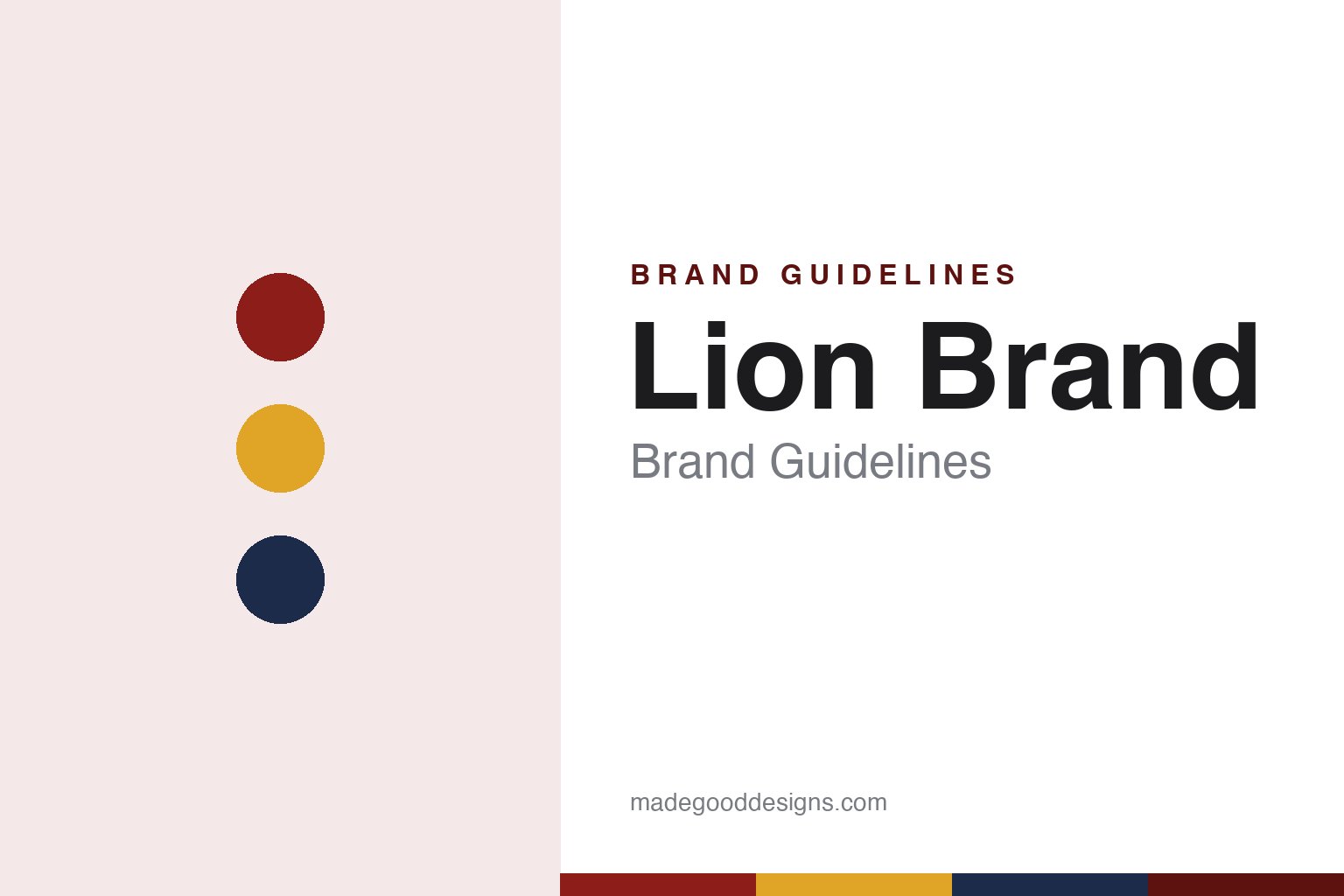
Two constants: a Lion Brand red, gold and navy palette and a Sturdy sans register. Abstract homage — not a Lion Brand product or mark; no skein, label or lion logo is reproduced.
Since 1878
A New York family business.
Lion Brand dates itself to 1878. “Our story began in 1878 with a small family business in New York City,” the company says, and it calls itself a fifth-generation, family-owned business that has sold yarn for “nearly 150 years.” We found no independent record of the founding itself, so the year is the company’s own; English Wikipedia, which repeats it, describes Lion Brand as the oldest producer of knitting and craft yarn in the United States, a claim we give as the encyclopedia’s.
The family is the Blumenthals. English Wikipedia says the company was founded by a group of notions and dry-goods salesmen that included a man named Reuben, great-great-grandfather of a later chief executive, Adam Blumenthal; that Reuben’s son-in-law Joseph Blumenthal had three sons — Isidor, George and Bernard — who ran the business from the 1930s to the early 1990s, with Isidor Blumenthal as president from 1958 until his death in 2003; and that a fourth generation, led by Isidor’s son David Blumenthal, joined from 1969. Those passages are largely uncited, so we give them as Wikipedia’s account.
The company has left Manhattan. It now speaks of moving “from our beginnings in New York City to today’s base in New Jersey and Georgia,” and its press releases carry a Carlstadt, New Jersey, dateline. Wikipedia adds that in the 1930s Lion Brand imported yarns from Europe rather than making them in the United States.
Colour
Yarn for the mass market.
Lion Brand is a mass-market name. The company says its yarns are sold “online, at craft chains, discount chains and independent shops” across the United States, and describes itself as “one of the leading distributors of craft yarn in the United States and other countries.” It sells acrylics, blends and natural fibres across the standard weights, and its best-known lines include Wool-Ease, Homespun, Vanna’s Choice and Fun Fur, according to English Wikipedia.
The Vanna’s Choice name points to its most famous association. Wikipedia says that in 1992 the television host Vanna White told Johnny Carson on The Tonight Show that crocheting was her favourite hobby; a Blumenthal cousin heard the interview, the company sent her yarn, and she became Lion Brand’s spokesperson, later lending her name to a yarn line. Lion Brand’s own press archive records her hosting a company fashion show at the Craft & Hobby Association trade show in 2012. Wikipedia says part of the proceeds from her yarns has gone to St. Jude Children’s Research Hospital.
Lion Brand was also early to the web. Its press archive lists a Forrester “Groundswell Award” for its blog and podcast and a 2009 Platinum PR Award for its blog, and announces that all the knitting and crochet patterns on its website had been made free; Wikipedia says it won a Webby Award in 2006. It also ran a shop: the Lion Brand Yarn Studio on West 15th Street in Manhattan, which Wikipedia says opened in 2008 and closed in March 2020, and whose window displays and classes appear in the company’s press releases. The same archive records a yarn partnership with Martha Stewart Living Omnimedia, under the Martha Stewart Crafts name, and Lion Brand’s support for the yarnbombing of the Philadelphia Museum of Art to mark its “Craft Spoken Here” exhibition.
Typography
Design and documentation.
The seven brands in this group all sell the same basic thing — yarn for knitting and crochet — and come from seven countries: Rowan from the UK, DROPS from Norway, Malabrigo from Uruguay, Lang Yarns from Switzerland, Schachenmayr from Germany, Lion Brand from the United States and Noro from Japan. A ball of wool looks simple, but the businesses behind these names are not alike.
Among yarn makers in general there are family firms still carrying a founder’s name, brands that sit inside larger corporate groups, dye houses that colour fibre by hand in small batches, and companies that sell as much through free patterns as through the yarn itself. Some spin their own fibre; others design and dye, and buy in the spinning. Some sell direct, and some reach most of the world through distributors, so the company that makes a yarn and the company whose name appears in a shop are not always the same.
This guide sets out what can be checked about each brand — who founded it, who owns it, and what it says about where its yarns are spun and dyed — and marks clearly what rests only on the company’s own word.
Aa
A sturdy sans — a brand name with a lion in it. (Specimen set in Archivo, a sans STAND-IN; NOT the Lion Brand logo.)
Lion Brand
A family firm with an outside chief executive.
The family still owns the company, but not every chief executive has been a Blumenthal. In July 2020 a release from Carlstadt announced Chris Mills, formerly president of BIC’s North American consumer-products division, as president and chief executive, succeeding David Blumenthal, who became chairman. In 2013, the company says, David Blumenthal and Dean Blumenthal received an Ernst & Young Entrepreneur Of The Year award in New Jersey.
Lion Brand has also bought a smaller, more upmarket brand. Quince & Co, founded in Maine in 2010 by the knitwear designer Pam Allen, says that in 2023 it joined “the Lion Brand Yarn family”; Wikipedia dates the deal to June 2023. Quince names its yarns after birds native to the north-eastern United States. Lion Brand’s website also lists Silk City Fibers among its brands.
Where its yarns are made is harder to pin down. On the pages we checked, Lion Brand does not say where its yarns are spun, and the product pages we read gave no country of origin; the company calls itself a distributor, and we make no claim about manufacturing. It does say that many of its yarns are certified to OEKO-TEX Standard 100, that some use fibres verified to the Global Recycled Standard and that selected wool yarns meet the Responsible Wool Standard; we give those as its statements.
We found no published brand guidelines, colour codes or typeface, though the name itself — a lion, for a yarn — has carried the brand for well over a century.
For a design guide, Lion Brand shows how a family name can hold a mass-market brand together across generations. Compare Schachenmayr, the German yarn brand, and malabrigo, a much younger family yarn company. For this guide we use a red, a gold and a navy with a sans, an unofficial interpretation; no product or logo is reproduced.
Explore & save
Keep Lion Brand’s identity on hand — save it to a board in the Made Good inspiration library.
Lion Brand identity set
Pin the Lion Brand red, gold and navy palette and the Sturdy sans register to your own board.