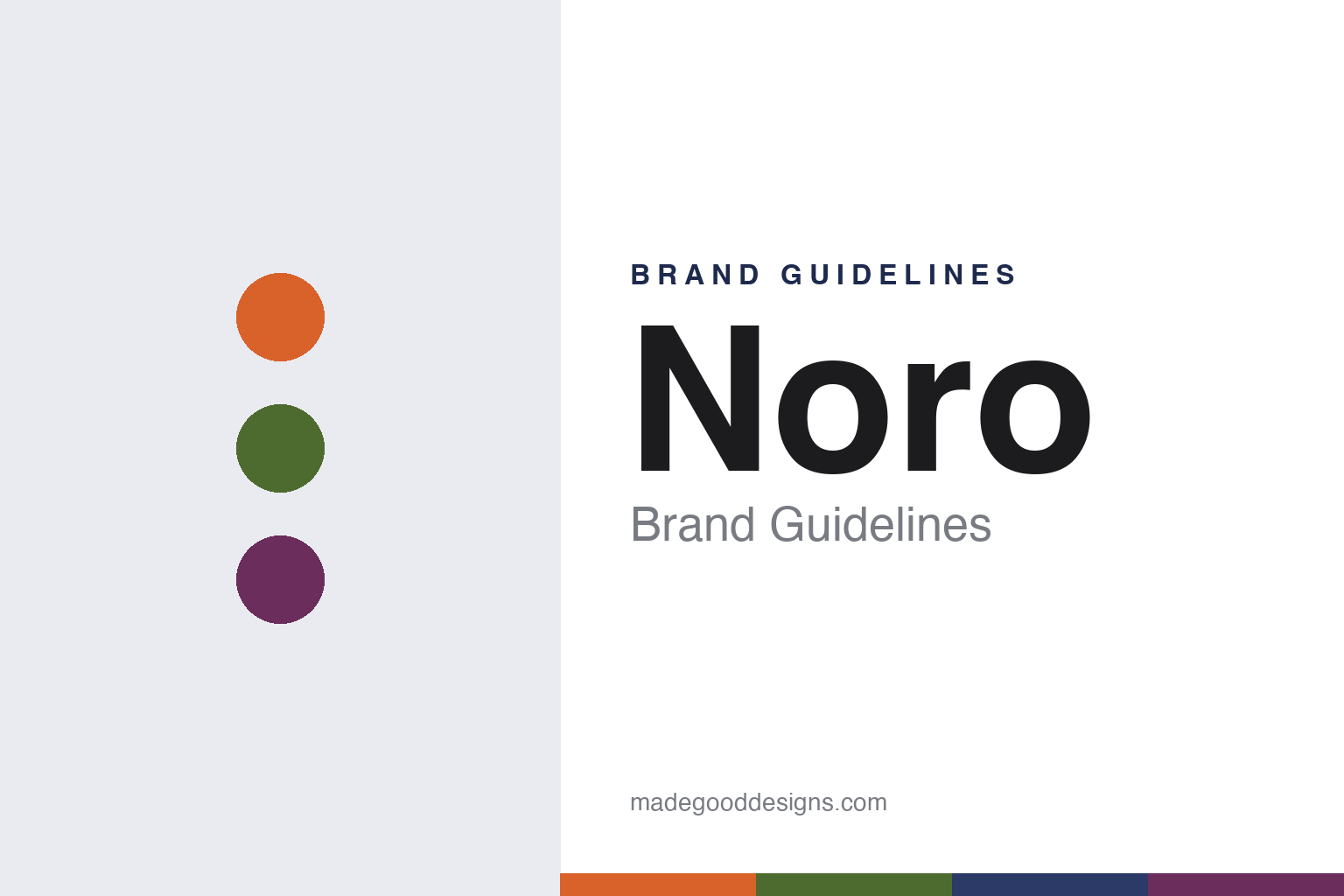
Noro Brand Guidelines
The Ichinomiya yarn maker whose colours change slowly along the strand.
Aa
Two constants: a Noro persimmon, moss, indigo and plum palette and a Japanese gothic sans register. Abstract homage — not a Noro product or mark; no yarn, label or logo is reproduced.
A yarn with his name on it
A spinner from Mie sets up on his own in Aichi.
Noro is the hand-knitting brand of Eisaku Noro Co., Ltd. — in Japanese, 株式会社 野呂英作 — a yarn maker in Ichinomiya, in Aichi Prefecture, west of Nagoya. The company sells its hand-knitting yarns as Noro and its yarns for the textile trade under the Eisaku Noro name, English Wikipedia says.
Its founder, Eisaku Noro, grew up in southern Mie Prefecture, near the Yoshino-Kumano National Park, and won a gold prize in a school sketching contest at 13, the company says. The Knitter, in a 2017 profile cited by English Wikipedia, says he went to Matsusaka Technical High School and then spent eighteen years at two wool-spinning companies making specialty yarns. The company says he began learning spinning, weaving and dyeing at 15, and went independent at 35, setting up a small company in Aichi to make yarn of his own design. According to a 2007 report in the Asahi Shimbun cited by Japanese Wikipedia, he named the business after himself because, as he put it, a healthy body and the name Eisaku were all he had — and he could not knit.
Dates differ slightly. The company dates its founding to 1973; Japanese Wikipedia, citing the credit agency Tokyo Shoko Research, gives 1 August 1975 as the date he became head of the incorporated company. The company says it chose Aichi for its textile trades — twisting, dyeing and weaving — as well as its steady climate, clean water for dyeing and the port of Nagoya. Ichinomiya lies in Bishu, a wool-textile district; a 2003 headline in the trade paper Senken Shimbun called the firm “Bishu’s Eisaku Noro.”
The start was slow. The company says its sales visits to Tokyo, Yokohama and Osaka in 1972 were turned down by shops that thought the yarn too odd to sell. Japanese Wikipedia, citing the Nikkan Kogyo Shimbun in 2010, says the firm took subcontract work for three years until a shop in Yokohama’s Diamond underground mall agreed to stock it; the yarn sold well there, and other shops followed.
Colour
Dyed as fibre, laid out by hand, spun slowly.
Noro yarns are known for long colour changes: one strand moves gradually through many shades, so a plain knitted piece forms broad stripes on its own. The Senken Shimbun reported in 2005 that a single yarn can carry 20 to 30 colours. English Wikipedia attributes the striping to colour runs that are longer than in most commercial yarns.
The colour goes in before the spinning. According to Japanese Wikipedia, citing the Senken Shimbun in 2005 and 2010, the company owns all its manufacturing equipment except for dyeing — blending machines, mule spinning frames, twisting machines and finishing machines, some modified in-house — while the fibre is dyed under contract at an outside dye works, using dyes Noro specifies. In a 2011 letter to customers, published by its then British distributor Designer Yarns, Takuo Noro wrote that one of the company’s partners, a dye house, was about 80 kilometres away. The dyed fibre is then teased out and arranged by hand, colour by colour, before being spun, the Asahi Shimbun and the company say.
The company describes its method in one line: spin by hand, and use machines only for what hands cannot do. It says it deliberately does not blend fibres evenly, so that wool, silk and mohair each show their own colour and lustre along the yarn, and that the fibre content on a label is an average. It also says that, because the yarn is wound off in short lengths of about 80 to 90 grams, a ball or skein may contain one or two joins. Noro Knitting Magazine, a US-published title that began in 2012, described a single roller on the carding machine instead of the usual three, and Jane Ellison’s 2008 book Knitting Noro says the yarns are 30 to 40 per cent lighter than others of the same thickness.
The wool came from the Falkland Islands and Argentine Patagonia, kid mohair from South Africa’s Eastern Cape and alpaca from Peru, the Senken Shimbun reported in 2010, when it also called Noro the largest buyer of mohair in Japan. Long-running yarns include Kureyon and Silk Garden, a silk and mohair blend that The Knitter says took a new spinning approach because neither fibre clings easily.
Typography
Seven makers, one product.
The seven brands in this group all sell the same basic thing — yarn for knitting and crochet — and come from seven countries: Rowan from the UK, DROPS from Norway, Malabrigo from Uruguay, Lang Yarns from Switzerland, Schachenmayr from Germany, Lion Brand from the United States and Noro from Japan. A ball of wool looks simple, but the businesses behind these names are not alike.
Among yarn makers in general there are family firms still carrying a founder’s name, brands that sit inside larger corporate groups, dye houses that colour fibre by hand in small batches, and companies that sell as much through free patterns as through the yarn itself. Some spin their own fibre; others design and dye, and buy in the spinning. Some sell direct, and some reach most of the world through distributors, so the company that makes a yarn and the company whose name appears in a shop are not always the same.
This guide sets out what can be checked about each brand — who founded it, who owns it, and what it says about where its yarns are spun and dyed — and marks clearly what rests only on the company’s own word.
Aa
A clean Japanese gothic sans. (Specimen set in Zen Kaku Gothic New, a sans STAND-IN; NOT the Noro logo or label.)
Noro
A Japanese maker sold abroad through a distributor.
Noro is better known abroad than at home, the Asahi Shimbun reported in 2007. The turning point came around 1981, when the US yarn distributor Sion Elalouf of Knitting Fever Inc. saw the yarn — at a trade show in Osaka, according to the Nikkan Kogyo Shimbun, and through an introduction from a Japanese yarn retailer, according to the company. Within two years it was in about 100 American shops, that paper said. A sales subsidiary in Paris, selling door to door from a van, was abandoned in favour of local agents. The company says it has shown at Pitti Filati in Florence, Expofil in Paris and the German handicraft trade fair, and that Noro yarn was voted one of the most memorable yarns by visitors to Expofil in 2003.
The maker and the sellers are different companies. Today the company’s website lists Knitting Fever, of Amityville, New York, as its distributor for the United States, Canada, the UK, Europe, Australia and New Zealand, with other distributors for Korea and China; it sells in Japan itself. The English-language Noro websites and much of the brand copy seen abroad come from the distributor side, and some of it — such as wording about certified organic farms — does not appear on the Japanese maker’s own site, so we have not repeated it as fact. The company says Noro is now sold in more than 2,500 shops in 30 countries. In 2007 it was chosen as one of Japan’s 300 vibrant small manufacturers by the Small and Medium Enterprise Agency, and it is a certified Aichi Brand company.
The business remains private and carries the family name. English Wikipedia says it is now run by the founder’s son, Takuo Noro, who signed the 2011 letter to customers; we found no record of a sale in the sources checked. Its motto, printed on its site, is “The World of Nature.”
For a design guide, Noro shows how a maker’s process can become the brand: the stripes are the signature, not a logo. Compare Janome, another Japanese maker for home crafts, and Rowan. For this guide we use persimmon, moss, indigo and plum with a sans, an unofficial interpretation; no product or logo is reproduced.
Explore & save
Keep Noro’s identity on hand — save it to a board in the Made Good inspiration library.
Noro identity set
Pin the Noro persimmon, moss, indigo and plum palette and the Japanese gothic sans register to your own board.