Bergère de France Brand Guidelines
The Lorraine spinning mill its own workers saved.
Aa
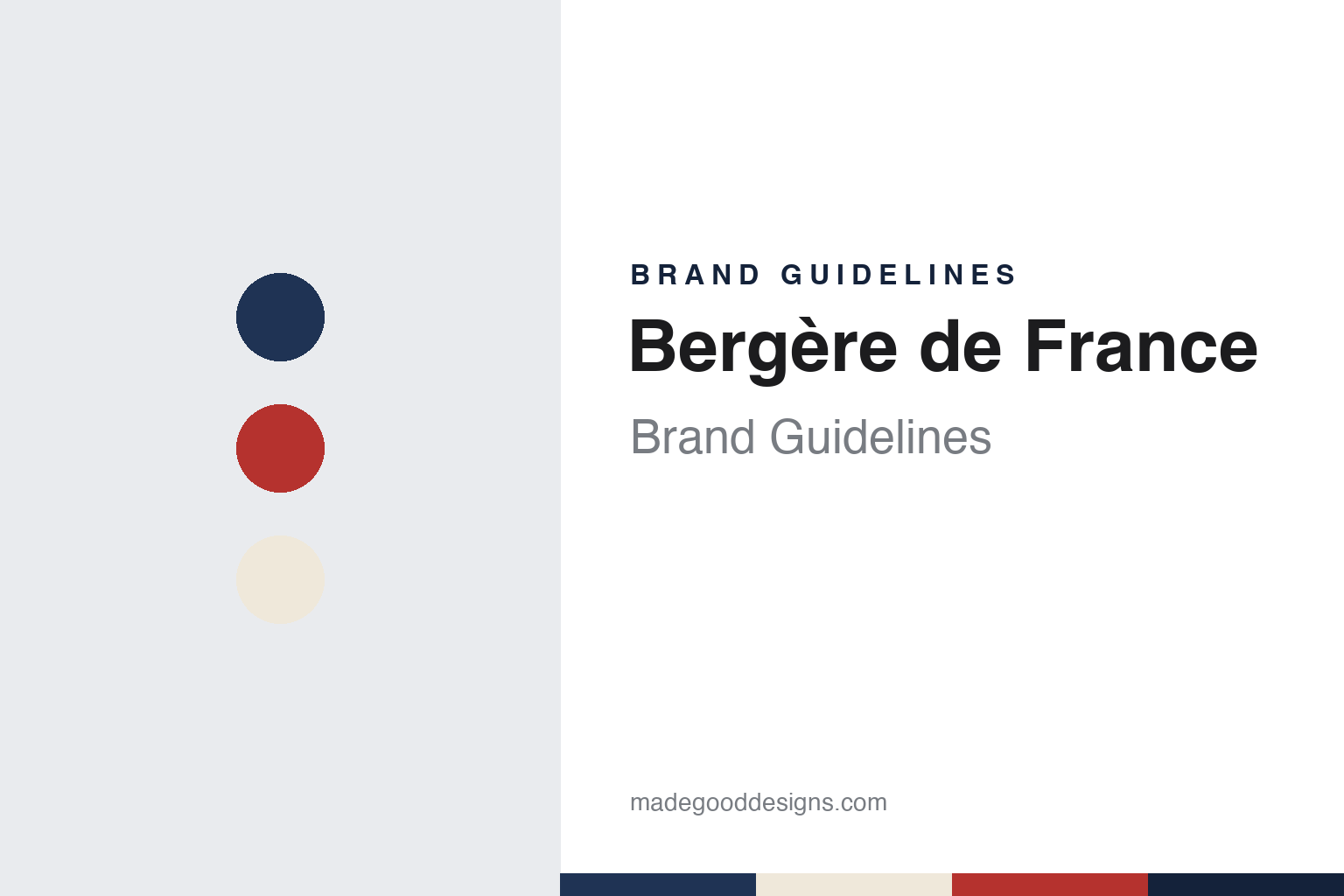
Two constants: a navy, raw-wool and madder-red palette and a heritage serif register. Abstract homage — not a Bergère de France product or mark; no ball band, logo or label is reproduced.
Bergère Lorraine
A wool trader in the Meuse.
Bergère de France began in 1946 in Bar-le-Duc, the main town of the Meuse département in Lorraine, in northeastern France. French Wikipedia, citing the business paper Le Journal des Entreprises, names the founder as Robert Petit and says the business first traded in wool under the name Bergère Lorraine — bergère is French for shepherdess — before adopting the name Bergère de France in 1948. franceinfo, reporting in November 2024, also dates the brand’s start to 1946 in Bar-le-Duc.
The firm became a manufacturer in 1962, when, according to French Wikipedia, it bought the Buirette-Gaulard spinning mill and its site in Bar-le-Duc. From then on it made knitting yarn rather than only selling it. The Petit family ran the company for three generations: Robert Petit, then his sons Jean-Louis and Daniel, then his grandson Geoffroy, the same source says, again citing Le Journal des Entreprises.
What made the name familiar to knitters was the way it sold. French Wikipedia describes a catalogue containing a sample of each yarn as the company’s trademark, and says its market spread to Belgium, the Netherlands and Canada. In 1990, it says, Bergère de France built a network of independent haberdashery shops, launched its first knitting magazines and began supplying industrial yarns to textile companies. An online shop and discussion forums followed in 2000, and in 2013 separate websites for the United States, the United Kingdom and Canada.
Colour
One mill, from fleece to ball.
Bergère de France’s central claim is that it still makes its yarn itself. French Wikipedia, citing franceinfo, describes an integrated production site in France that takes wool through every stage, from raw fibre to balls ready to knit, and the regional broadcaster France 3 Grand Est has called it the last French spinning mill making knitting yarn. The company offers guided tours of the mill through the local tourist office, keeps a factory shop next to it and holds an annual clearance sale, the braderie, which L’Est Républicain covered in June 2024.
The business was under strain long before its recent rescue. France 3 Grand Est reported a net loss of €1.9 million on revenue of €32 million for 2014. In February 2015, with about 300 employees, the company declared that it could no longer pay its debts and was placed in redressement judiciaire, France’s court-supervised reorganisation procedure, as L’Usine Nouvelle reported at the time; France 3 later said that crisis cost 68 jobs. French Wikipedia lists the causes of the longer decline as international competition, higher energy costs, a slowing market for hand-knitting yarn and the lasting effects of the Covid-19 pandemic.
In April 2024 the company entered insolvency proceedings again; French Wikipedia says it was placed in liquidation. In July the court allowed it to keep trading for three more months, pushing the closure date to 26 October 2024 while takeover offers were examined, France 3 Grand Est reported. By then the workforce had already shrunk: French Wikipedia gives 165 employees in 2023.
Typography
Yarn makers of seven countries.
The seven brands in this group all sell yarn for hand knitting and crochet, and they come from seven countries: Bergère de France from France, Debbie Bliss from the United Kingdom, Rico Design from Germany, Hobbii from Denmark, Sandnes Garn from Norway, madelinetosh from the United States and We Are Knitters from Spain. What sets them apart is less the fibre than the route a ball or skein takes to reach a maker.
Yarn still travels by many roads. Some of it comes from old mills with long regional histories; some is sold under a designer’s own name; some sits in ranges stocked by craft shops and department stores; some is bought from online retailers that ship across borders; some arrives in a box as a kit, with needles and a pattern; and some is dyed in small batches by hand. Each guide shows which of those roads a brand travels, and how its name, colours and tone of voice change to suit it.
Each guide also separates what independent sources record from what the company says about itself — who founded it, who owns it now and where its yarn is made — and marks plainly what rests only on the company’s own word.
Aa
A heritage serif for a mill brand from 1946. (Specimen set in Fraunces, a serif STAND-IN; NOT the Bergère de France logo.)
Bergère de France
A cooperative since October 2024.
The rescue came from inside the company. On 21 October 2024 the commercial court in Bar-le-Duc approved a takeover by employees organised as a SCOP (société coopérative et participative), a worker-owned cooperative, France 3 Grand Est reported. French Wikipedia, citing the news site Reporterre, says the court preferred it to a rival offer from Phildar that did not include continuing production at the mill. The cooperative took over the business on 25 October 2024 with 57 employee-members and 70 jobs kept. The former sales director, Jean-Michel Nicolas, became managing director, and the former production manager became chair, France 3 reported.
The plan, as French Wikipedia summarises reports in Le Journal des Entreprises, is to narrow the range back to historic yarns such as la Barisienne, modernise sales and reduce stock, with financing from Crédit Coopératif, Crédit Agricole, the cooperative-movement fund Socoden and local public bodies including the Grand Est region. In February 2025 the same paper reported a new commercial strategy built on small “kiosks” in partner shops, to reach knitters as haberdasheries close. In May 2025 L’Est Républicain reported Bergère de France baby-knitting kits on sale in post offices in Bar-le-Duc and Verdun through a partnership with La Poste.
Recognition followed in its first full year as a cooperative. French Wikipedia lists Bergère de France as the Meuse laureate of the 2025 Grande Exposition du Fabriqué en France, the made-in-France showcase held at the Élysée Palace in November, and as a winner of regional business awards that year, including the Ailes de Cristal in Lorraine. In the most recent reports we read, the company was still trading as a cooperative from its mill in Bar-le-Duc.
For a design guide, Bergère de France shows how a heritage name tied to one town and one mill can be carried by the people who work there. Compare Phildar, the northern French yarn brand that bid for the business, and Scheepjes, another old yarn name that changed hands. For this guide we use navy, raw wool and a madder red with a serif, an unofficial interpretation; no product or logo is reproduced.
Explore & save
Keep Bergère de France’s identity on hand — save it to a board in the Made Good inspiration library.
Bergère de France identity set
Pin the Bergère de France navy, raw-wool and madder-red palette and the heritage serif register to your own board.