Holst Garn Brand Guidelines
The North Jutland yarn shop that sells colour by the small ball.
Aa
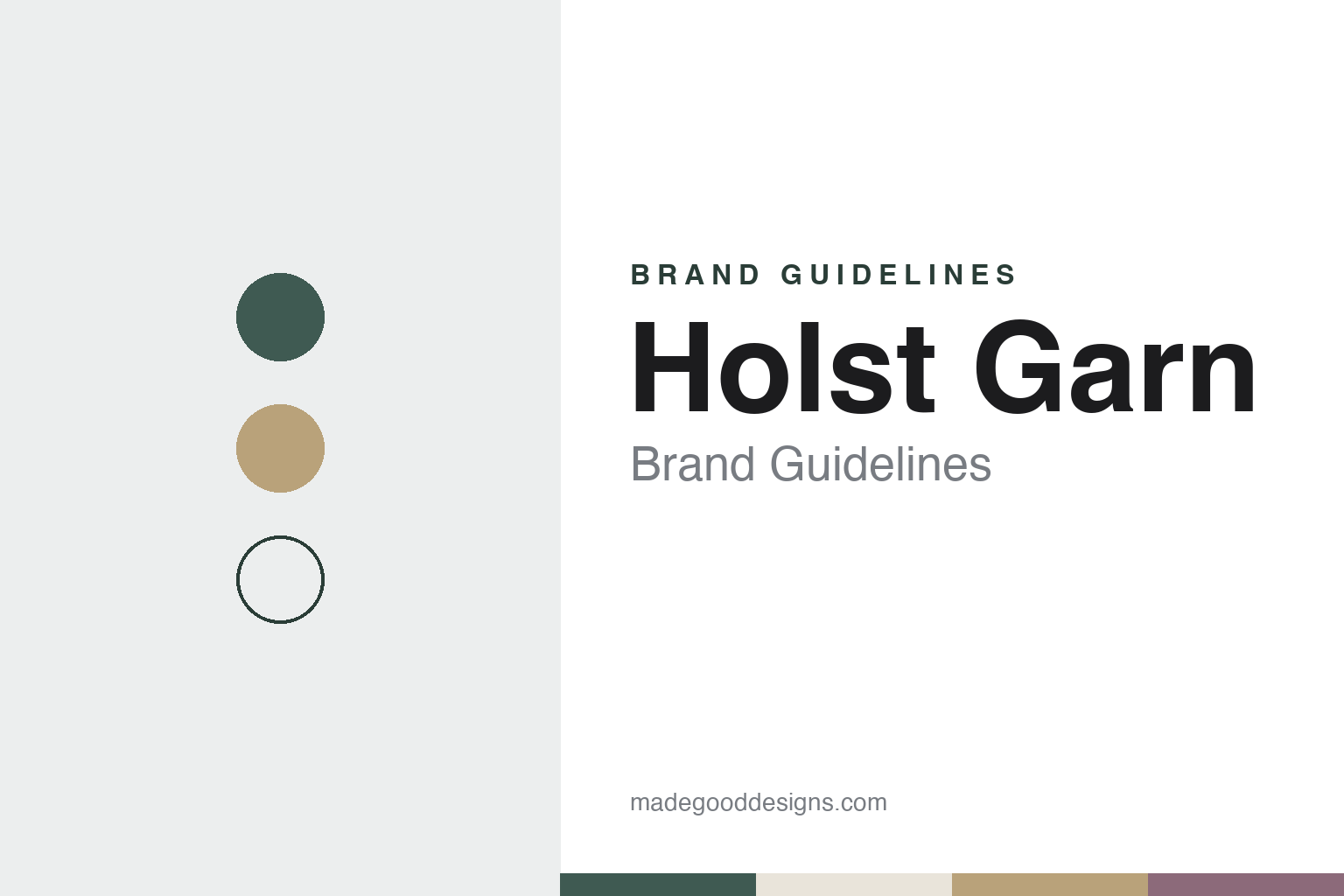
Two constants: a Holst Garn fjord green, oat and heather palette and a Plain sans register. Abstract homage — not a Holst Garn product or mark; no ball band, logo or label is reproduced.
Helle Holst
A yarn shop built around colour.
Holst Garn — garn is Danish for yarn — is a small Danish yarn brand based in Aabybro, a town in North Jutland a short drive north-west of Aalborg. It sells its own yarns online from holstgarn.dk, ships worldwide by post, and keeps a shop in Aabybro that it says is open on weekday mornings and early afternoons.
The business is closely tied to one person. On its company profile, Helle Holst says she created Holst Garn as a shop where knitters could put together their own knitting kit in the colours they wanted, find the whole palette of a yarn in one place, and buy many colours without a large outlay. The company’s terms state that Holst is personally owned by Helle Holst; we give that as its own description and have not checked it against the Danish business register.
The website does not give a founding year. The earliest capture of holstgarn.dk in the Internet Archive dates from 16 April 2009, so the brand was online by then; it may be older. That first archived homepage shows how narrow the offer was at the start: a single yarn, called simply “100% uld” — 100 percent wool — in 96 colours, sold in 25 g and 50 g balls, and described as “a classic 2-ply yarn in pure new wool” and “a really good alternative to the expensive designer yarn.” By January 2010 the archived site lists the same yarn under the name Supersoft, which it has carried since.
The small ball is the idea behind the brand. A 25-gram ball lets a knitter buy a dozen shades for a colourwork yoke or a striped scarf without buying a dozen full skeins, which is the point Helle Holst makes in her own description of the shop.
Colour
Supersoft, and a candid name.
Supersoft remains the core of the range, and the company is unusually frank about it. It describes the yarn as 100 percent wool, blended half Merino and half Shetland, from farms in New Zealand and Australia that it says do not practise mulesing. The yarn was developed, it says, as an alternative to traditional Shetland yarns, with Merino added for softness — “hence the name” — and it concedes that other yarns are softer and that the name is “somewhat misleading.” It gives the fibre as 25.5 microns.
The technical notes read like a spinner’s brief. The company says Supersoft is woollen-spun, with its S and Z plies balanced; that the fibre is dyed before spinning, which gives the heathered, melange shades; that it is not washed after spinning; that the colours meet the OEKO-TEX Standard 100; and that a vegetable spinning oil is used. It also says the yarn was developed with the furniture industry in mind and is supplied on cones for machine knitting.
Around it the range has grown. The site lists Coast, a 2-ply of 55 percent Merino lambswool and 45 percent cotton; Titicaca, a pure alpaca; and Cielo, an alpaca and Merino yarn that the company says is spun thin and then knitted into a tube, “like a shoelace.” It also sells finer blends of alpaca, silk and yak, kits, and needles from the German maker Addi, and publishes a “Perfect Matches” guide pairing Titicaca shades with its other qualities. Two yarns, Tides and the Highland sock yarn, are marked as being discontinued.
Typography
Design and documentation.
The seven brands in this group all sell yarn for hand knitting and crochet, and they come from seven countries: Plassard from France, Opal from Germany, Holst Garn from Denmark, Rauma from Norway, Daruma from Japan, Lana Gatto from Italy and Red Heart from the United States. They sit at very different points on the map of the yarn trade, from small regional names to brands sold by the million.
At one end are regional spinners and family firms, whose names are tied to a town, a valley or a national wool tradition, and whose colour cards often grew out of what local mills could make. At the other end are mass-market brands, built for craft chains and online shops, where a yarn name can pass from one corporate owner to another while the label on the ball stays the same. Between them sit companies that design yarn and its colours but rely on others to spin it.
Each guide separates what independent sources record from what the company says about itself — who founded it, who owns it now and where its yarn is made — and marks plainly what rests only on the company’s own word.
Aa
A plain sans — one wool in many colours. (Specimen set in Work Sans, a sans STAND-IN; NOT the Holst Garn logo.)
Holst Garn
Danish brand, wool from abroad.
Holst Garn is a Danish brand, but its fibre comes from elsewhere, and the company says so. Its FAQ gives the wool origin for each yarn: South Africa for Noble, Australia and New Zealand for Supersoft and Tides, New Zealand and Argentina for Coast, and Peru for Highland and Titicaca, and says all of it is from non-mulesed sheep.
Where the yarn is spun is a separate question. The only yarn whose place of production the company names is Cielo, which it says is made in Peru at a large and reputable spinnery that holds OEKO-TEX certification. The pages we read do not say where Supersoft, Coast or Titicaca are spun, and the company does not claim a Danish mill; we do not assign them to a country.
We found no published brand guidelines, logo history or official colours. The palette here — a fjord green, an oat melange and a heather mauve on undyed cream — is our own interpretation of a brand whose catalogue is a long run of heathered, dyed-in-the-fibre shades.
For a design guide, Holst Garn shows how a very small brand can be organised around a single idea — many colours, sold in small amounts — and let the colour card stand in for an identity. Compare Hjertegarn, the Danish yarn house that began in Odense and is now based in Jutland, and Isager, the Danish yarn house built on a plant-inspired palette. For this guide we use fjord green, oat and heather with a sans, an unofficial interpretation; no product or logo is reproduced.
Explore & save
Keep Holst Garn’s identity on hand — save it to a board in the Made Good inspiration library.
Holst Garn identity set
Pin the Holst Garn fjord green, oat and heather palette and the Plain sans register to your own board.