Hamanaka Brand Guidelines
The Kyoto craft-yarn maker behind Eco Andaria.
Aa
Two constants: an unofficial indigo-and-straw palette and a Japanese gothic sans register. Abstract homage — not a Hamanaka product or mark; no ball band, logo or label is reproduced.
From bag handles to yarn
A Kyoto accessories business that became a craft company.
Hamanaka is a Kyoto company that makes yarn and craft supplies. Its own history page dates it to 1940, when its founder set up on his own as a maker and wholesaler of dress accessories and ornaments. The business was incorporated in 1956, and Japanese Wikipedia gives the same two dates. The company says its first product was bag handles, and its Chinese site also dates the company to 1940.
The link that shaped the company came soon after. Its history records a joint business with the chemical and fibre group Asahi Kasei from 1957, and says Hamanaka began handling Asahi Kasei’s Andaria in 1959 and its Cashmilon acrylic in 1961. The founder’s page tells the story from his side: it says he developed Andaria himself, testing it in his own bathroom, and that it set off a large craft boom in Japan. Japanese Wikipedia says Hamanaka was once part of the Asahi Kasei group, though that article is marked as needing citations, so we treat it with care.
The company kept growing through the 1960s and 1970s. Its Kyoto head office on the present site in Ukyō ward was finished in 1964, and it took the name Hamanaka Co., Ltd. in 1966. In 1975 the old company was renamed and a new Hamanaka Co., Ltd. took over the business. The company says a rival yarn firm once dismissed it as “a craft shop, not a yarn shop,” and that the founder took it as praise. Japanese Wikipedia describes the company as unlisted.
Colour
Factories in Miyazaki and Shiga, and a range that goes beyond yarn.
Hamanaka makes a point of producing in Japan. The company says its yarn comes from its own bases in Miyazaki and Shiga prefectures. Its group company Hamanaka Hobiil runs a factory in Shintomi, Miyazaki, completed in 1976, which the company says spins acrylic and raw wool and then twists and finishes the yarn. Another group company runs a factory in Maibara, Shiga, completed in 1977, which the company says handles brushing, balling, labelling and inspection. The company describes itself as handling everything from product development to production and sales. These are the company’s own statements; we found no independent audit.
Its history also lists public awards. The Shintomi factory received a Minister of International Trade and Industry award as a model green factory in 1990 and a Prime Minister’s award for greening in 1992. In 2006 an organic-cotton yarn won a Minister of Economy, Trade and Industry award at the Hobby Industry Grand Prize, and the company lists further awards from the Japan Hobby Association in 2012 and 2013.
The range is wider than yarn. The company’s product site lists Eco Andaria kits, the paper-band craft line Eco Craft, amigurumi, felting wool, pompom tools, knitting needles, looms, bag handles and pattern books. Rich More, which the company calls its fine hand-knitting yarn brand, has its own site. Hamanaka opened the website hamanaka.jp in 2000 and the craft-lesson site amuuse in 2010, set up a trading company in Guangzhou in 2012, and opened a concept shop, Itokobako, in a Kyoto townhouse in 2013.
The group today is made up of several companies. Alongside the two factory companies, the company’s site lists a logistics company in Nagahama, Shiga, a Tokyo branch, an office in Hong Kong and the trading company in Guangzhou. It names no outside owner, and nothing in its own pages points to a sale or a merger since the 1970s reorganisation. Japanese Wikipedia adds that Hamanaka’s yarn adverts once ran on the long-running television quiz show Naruhodo! The World, a sign of how widely the brand was known at home.
Typography
Design and documentation.
The seven brands in this group all sell yarn for hand knitting and crochet, and they come from seven countries: Novita from Finland, Järbo from Sweden, Alize from Turkey, Hamanaka from Japan, Adriafil from Italy, Wool and the Gang from the United Kingdom and Knit Picks from the United States. Set side by side, they show two quite different ways of putting a ball of yarn in front of a knitter.
One is the national yarn maker: a name that grew up in a single country, sold through that country’s department stores, craft shops and yarn shops, and often found in homes for generations. The other is the brand built around the buyer rather than the shop — one that sells online or by catalogue, or packs yarn, needles and a pattern together as a kit, and talks to knitters directly. The first kind tends to lean on heritage and place; the second on convenience, price or a sense of belonging to a community. Each route shapes a brand’s name, its labels and the voice it uses.
Each guide also separates what independent sources record from what the company says about itself — who founded it, who owns it now and where its yarn is made — and marks plainly what rests only on the company’s own word.
Aa
A clean Japanese gothic sans for a Kyoto craft company. (Specimen set in Zen Kaku Gothic New, a sans STAND-IN; NOT the Hamanaka logo.)
Hamanaka
A craft shop, not a yarn shop.
Hamanaka’s identity is that of a craft company more than a yarn mill. Its products run from raffia-like Eco Andaria to paper-band craft, felting and amigurumi parts, so the brand has to work on kits, books and small packets of parts as well as on balls of yarn. The joke the founder liked, “a craft shop, not a yarn shop,” is a fair description of the range today.
The second thread is made in Japan. The company gives its own production bases a page of their own, naming the factories and the work done in each, and that story sits close to the centre of how it presents itself. For a designer, that is a reminder that a manufacturing claim is only useful when it is specific: which factory, which stage of the work.
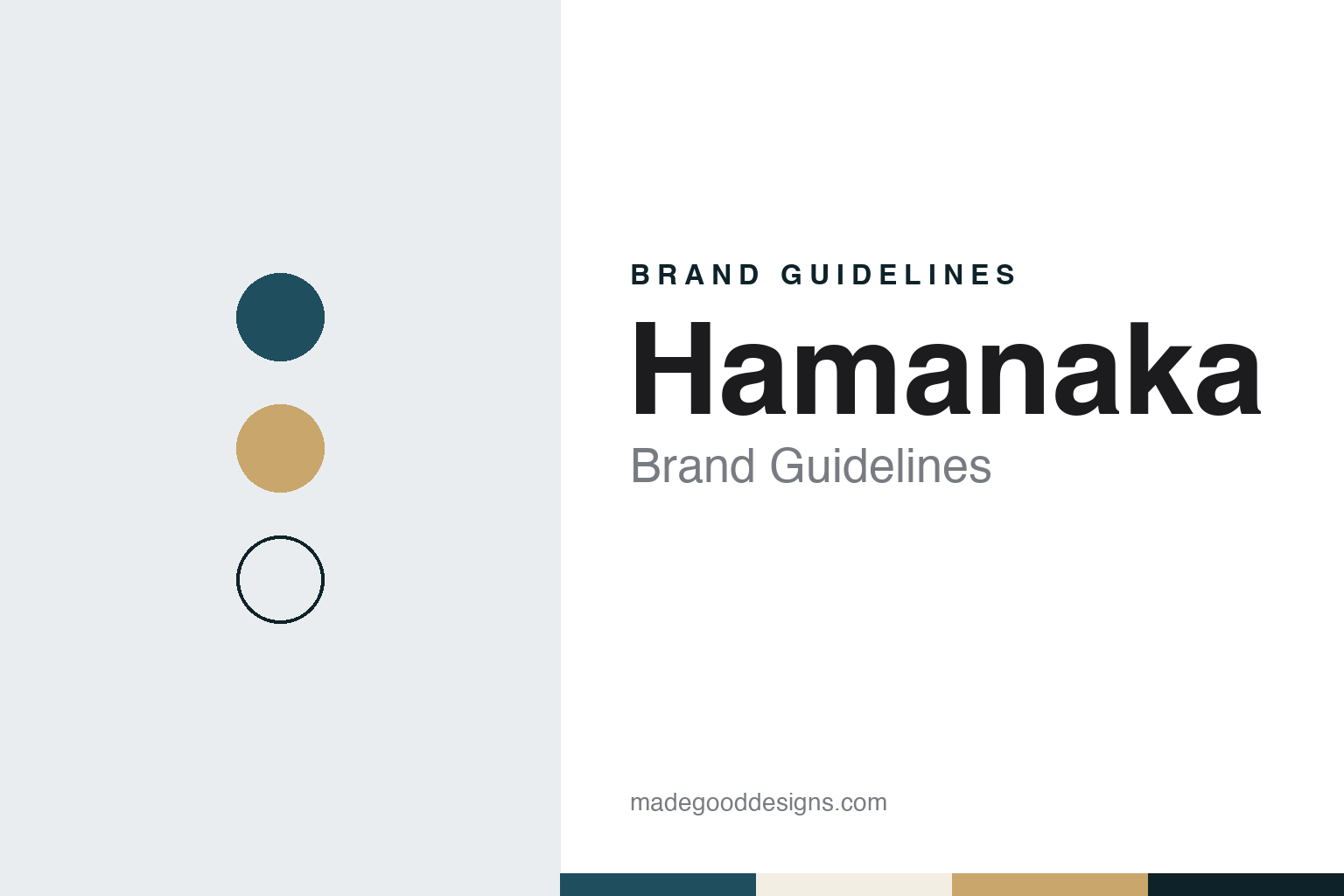
No official brand colour, typeface or style guide is published, so our palette is an interpretation: a deep indigo for headings and small text, a straw tone for accents and a warm paper white for backgrounds, chosen to suggest dyed thread and woven raffia rather than copy any label.
For a design guide, Hamanaka shows how a craft-supply company can hold many product types together under one name and a clear made-in-Japan story. Compare Noro, another Japanese yarn maker, and Rico Design, a family craft brand with a similarly wide range. For this guide we use indigo, straw and washi white with a gothic sans, an unofficial interpretation; no product or logo is reproduced.
Explore & save
Keep Hamanaka’s identity on hand — save it to a board in the Made Good inspiration library.
Hamanaka identity set
Pin the Hamanaka indigo, straw and washi palette and the Japanese gothic sans register to your own board.