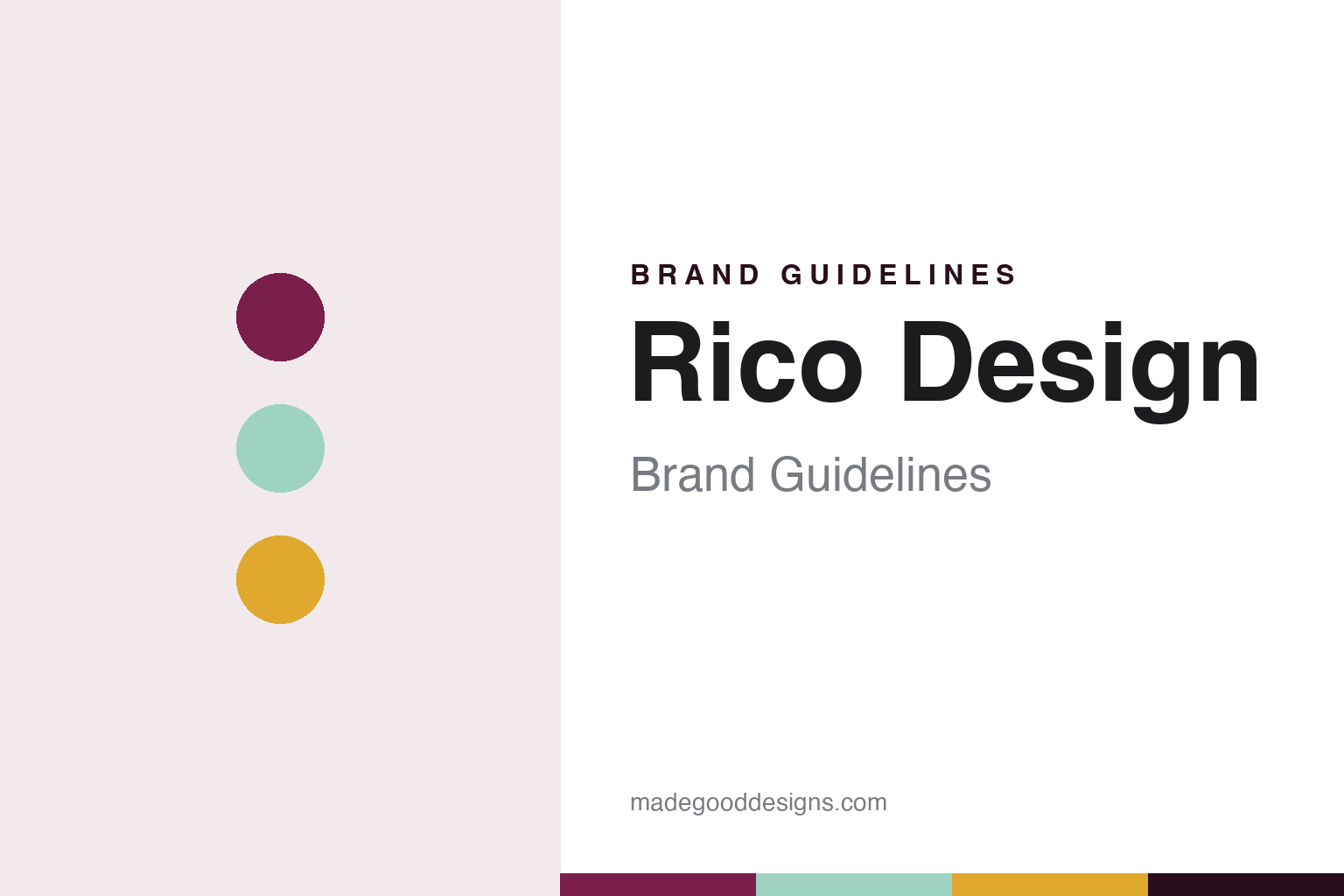
Rico Design Brand Guidelines
A Brakel framing workshop that grew into a European craft brand.
Aa
Two constants: a berry, mint and mustard palette and a rounded sans register. Abstract homage — not a Rico Design product or mark; no yarn label, logo or packaging is reproduced.
Tap Tapisserie Service
A framing workshop that bought a Hamburg name.
Rico Design is a brand from Brakel, a small town in East Westphalia, about 30 kilometres from Paderborn, but the name did not start there. The company’s own history page, archived in 2014, begins in 1974, when Franz Jacoby founded Tap Tapisserie Service in Brakel. Its first trade, the page says, was framing embroidered pictures and mounting textiles: wall hangings, table runners and bell-pulls.
Over the next two decades the Brakel firm widened its range. In 1983 and 1984, according to the same timeline, it became a full-range supplier of embroidery materials and bought the brand AMC and Bärengarne. In 1994 it bought Rico Design GmbH & Co. KG, a company based in Hamburg, and with it, the company says, became the market leader in embroidery; the purchase also took it into home textiles. When Rico Design was first set up in Hamburg, and by whom, is not stated in the sources we checked.
The Hamburg name became the main brand. By June 2001 the Rico Design website, preserved by the Internet Archive, carried a holding page that sent visitors to Tap GmbH & Co. KG in Brakel. Today the company trades as Rico Design GmbH & Co. KG from the same industrial street in Brakel, and the family’s group, TAP Holding, still describes itself as having been founded in 1974.
Knitting yarn came late. The company’s timeline dates its move into hand-knitting yarn to 1998 and onwards, more than twenty years after the framing workshop opened. That order matters for reading the brand: Rico Design began as an embroidery and needlecraft supplier and grew outward, rather than starting as a spinner or a wool shop.
Colour
Yarn, paper, paint and party goods.
Yarn is now one part of a much wider craft range. The company’s timeline says it moved into craft ideas and jewellery-making around 2000, and its current website describes Rico Design as one of Europe’s leading brands for hand-knitting yarn, embroidery, fabric, stationery, party goods, art materials, crafts and jewellery. It sells under several sub-brands, including Ricorumi for small amigurumi-style crochet yarns, Paper Poetry for stationery, Made by Me for crafts and ART for artists’ materials.
Its knitting range, the company says, is organised around fashion, home and baby, with patterns written to match. The shop groups its yarns by season, by thickness and by fibre, and its product information lists the fibre blend, weight, length, needle size and whether wool is mulesing-free. Rico Design also publishes its own pattern books and magazines, and its parent group says it runs workshops and appears at trade fairs.
The company has sold abroad for two decades. From 2004, its timeline says, it set up its own sales organisations in Austria, France, Belgium, the Netherlands, the United Kingdom and Ireland; its current pages add Spain. Its products are also sold through other retailers, including online yarn shops elsewhere in Europe.
Where the yarn is made is less clear. Rico Design describes itself as a designer and wholesaler, with an in-house design studio; an archived company page from 2014 says its team works “with our suppliers” to turn ideas into products, and its parent group lists logistics centres in Brakel and Bärenstein rather than spinning mills. The shop does not give a country of origin in the product details for most of its yarns. For a few, including a sock yarn and an alpaca blend, the image descriptions on its own shop say they are made in Italy; we give that as the company’s statement and found no independent source on where the rest are spun.
Typography
Design and documentation.
The seven brands in this group all sell yarn for hand knitting and crochet, and they come from seven countries: Bergère de France from France, Debbie Bliss from the United Kingdom, Rico Design from Germany, Hobbii from Denmark, Sandnes Garn from Norway, madelinetosh from the United States and We Are Knitters from Spain. What sets them apart is less the fibre than the route a ball or skein takes to reach a maker.
Yarn still travels by many roads. Some of it comes from old mills with long regional histories; some is sold under a designer’s own name; some sits in ranges stocked by craft shops and department stores; some is bought from online retailers that ship across borders; some arrives in a box as a kit, with needles and a pattern; and some is dyed in small batches by hand. Each guide shows which of those roads a brand travels, and how its name, colours and tone of voice change to suit it.
Each guide also separates what independent sources record from what the company says about itself — who founded it, who owns it now and where its yarn is made — and marks plainly what rests only on the company’s own word.
Aa
A rounded sans — a friendly, craft-shop register. (Specimen set in Nunito, a sans STAND-IN; NOT the Rico Design logo.)
Rico Design
A family group with a Chipperfield headquarters.
Rico Design has stayed in the founding family. In 2008, according to the company’s archived profile, Franz Jacoby handed the business to his daughters Ellen and Yvonne Jacoby; the same 2013 page put the workforce at about 150 people in Brakel. The company’s current legal notice names Yvonne Jacoby and Franz Jacoby as managing directors.
Rico Design now sits inside TAP Holding, which describes itself as a family-run group with three brands: Rico Design, the craft-store chain idee. Creativmarkt, which it says has more than 40 branches in Germany, and the yarn retailer Wolle Rödel, which it says has sold hand-knitting yarn since 1964 and has more than 65 shops and shop-in-shops. The group says it employs more than 1,000 people in Europe. When the two retail chains joined the group is not stated in the sources we checked.
The group’s headquarters is the most documented part of the story. Jacoby Studios in Paderborn was designed by David Chipperfield Architects in Berlin, which lists the project as 2014–20, for a client named as Jacoby GbR, represented by Ellen, Franz and Yvonne Jacoby. The architects describe a former St. Vincenz hospital built on a seventeenth-century Capuchin monastery, whose post-war additions were removed and whose chapel facade, cloister and cellar were restored alongside new office wings, in a garden by Wirtz International. TAP Holding dates completion to 2019; the architects give 2020. The building was shortlisted for the Mies van der Rohe Award in 2020 and for the RIBA International Prize in 2024, and won the BDA architecture prize for North Rhine-Westphalia in 2021, according to the architects.
For a design guide, Rico Design shows how a brand name can outlast the company that started it: a Hamburg mark, bought by a Westphalian family firm, now carries a whole craft range. Compare Katia, another family yarn brand, and Scheepjes, a yarn name that changed hands. For this guide we use berry, mint and mustard with a rounded sans, an unofficial interpretation; no product or logo is reproduced.
Explore & save
Keep Rico Design’s identity on hand — save it to a board in the Made Good inspiration library.
Rico Design identity set
Pin the Rico Design berry, mint and mustard palette and the rounded sans register to your own board.