Sandnes Garn Brand Guidelines
The 1888 Norwegian wool mill still spinning in Rogaland.
Aa
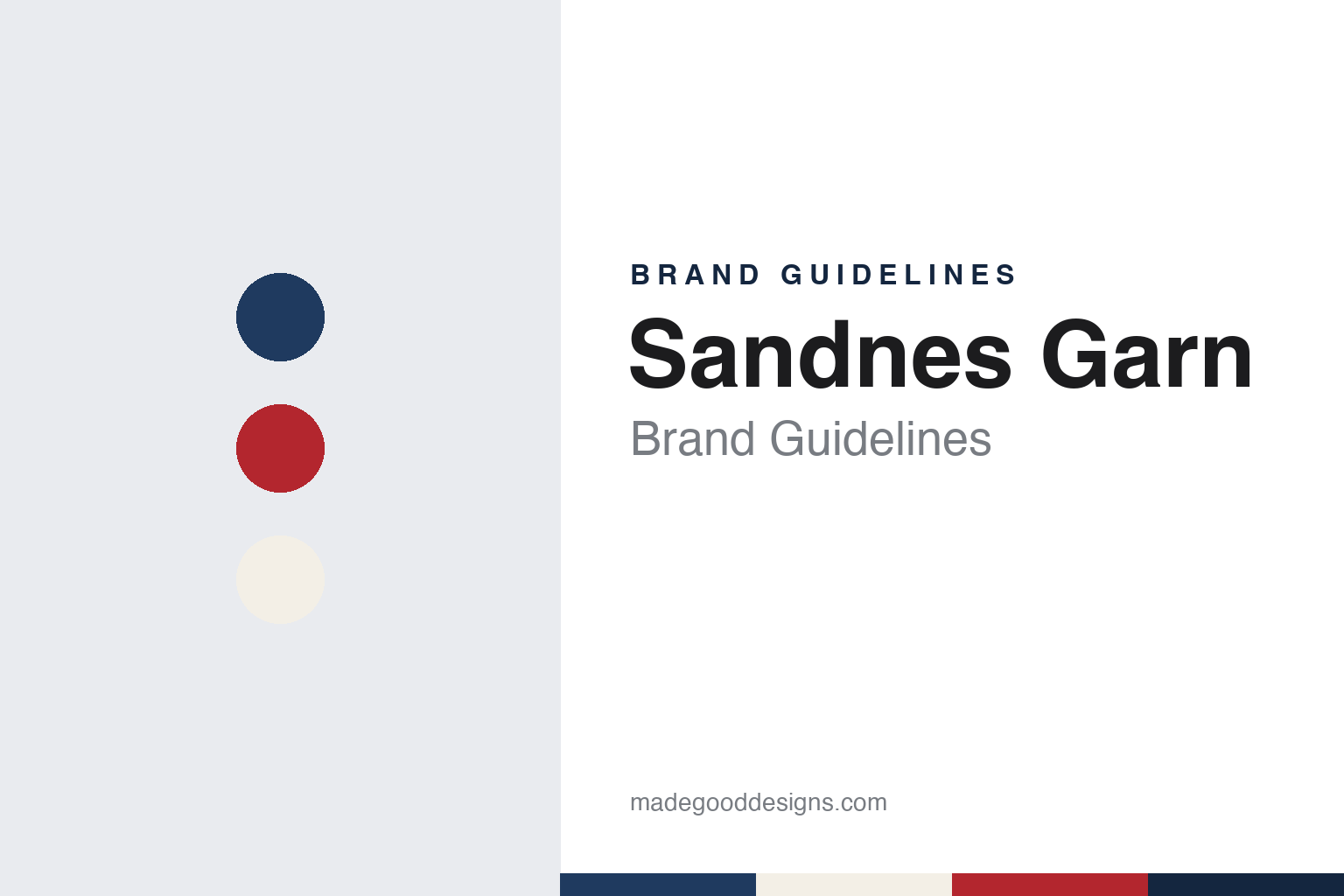
Two constants: a Sandnes Garn blue, wool white and red palette and a Nordic serif register. Abstract homage — not a Sandnes Garn product or mark; no yarn band, logo or pattern is reproduced.
Sandnes Uldvarefabrik
A wool mill by the harbour in Sandnes.
Sandnes Garn began as Sandnes Uldvarefabrik, a wool mill founded in 1888 in Sandnes, the town south of Stavanger in Rogaland, on Norway’s south-west coast. Norwegian Wikipedia says the first buildings went up at Vågen, the harbour in the town centre, and that production started in 1889. The company’s own history, published in 2011, says a group of Sandnes business leaders planned the factory early in 1888 and that local people owned it from the start; no single founder is named in the sources we checked. The company says the mill was a red-brick building and that more than 500 people worked there at its peak. Its history also names the first head of dyeing, Johan Ludvigsen, who it says worked at the mill from 1888 to 1915 and kept his book of dye recipes so secret that not even colleagues were allowed to read it.
The mill grew from 1905, was enlarged in 1910 and bought its first combing machines in 1932, Norwegian Wikipedia says. In 1954 it started a knitting club, Strikk Ess, to sell more yarn: members paid a one-off fee and received a booklet of patterns every quarter. A local history of Sandnes business published in 1996 says more than 50,000 people joined before the club closed in 1975.
A second mill stood nearby. Sandnes Kamgarn Spinneri, a worsted spinner, was founded at Vågen by Walter Roff in 1906. When wool prices rose sharply in the mid-1970s the two companies merged, in 1975, and kept both brand names; the merged business became one of the leaders in Norway’s hand-knitting yarn market, and the company says it exported to Denmark, Sweden, Finland, Germany and Japan. The worsted mill’s name was retired in 1986, and its old building on the harbour reopened in 2000 as Sandnes’s cultural centre.
Colour
The Marius pattern and the fire of 1978.
The best-known design in the company’s history is the Marius sweater, the star-patterned jumper in red, white and blue named after the alpine skier Marius Eriksen. Norwegian Wikipedia’s article on the company dates its launch by Sandnes Uldvarefabrik to 1952; its article on the sweater says the designer Unn Søiland Dale sold the hand-knitting pattern to the mill in 1954, the year a version of the sweater was shown in the film Troll i ord. The design’s origin is disputed, and in 2008 Dagens Næringsliv called the quarrel “the bitterest authorship dispute in Norwegian design history”; the rights to the Marius pattern are today managed by a separate company, MARIUS of Norway. In 2011 a Sandnes Garn employee told Dagbladet that around five million copies of the pattern had been sold.
On 21 August 1978 the mill at Vågen burned to the ground. The old harbour site was unsuited to a modern spinning mill, the company says, so it rebuilt outside the town at Foss-Eikeland, where it has worked since; Norwegian Wikipedia dates the completion of the new building to 1987. Production from the former worsted mill and from a factory at Hermansverk, in western Norway, taken over in 1972, was moved there by 1986.
The company says the mill handles almost every stage itself. Wool from Norwegian sheep is washed, carded and spun; for its worsted yarns it buys in tops, wool that has already been washed and combed; then the yarn is twisted, skeined, dyed and wound into balls. It says some 14 to 15 million balls leave the factory a year, that 90 per cent of sales go straight to shops, and that its best-known yarns include Peer Gynt and Fritidsgarn. It calls itself the largest maker of hand-knitting yarn in northern Europe; we give that as its claim.
Typography
Design and documentation.
The seven brands in this group all sell yarn for hand knitting and crochet, and they come from seven countries: Bergère de France from France, Debbie Bliss from the United Kingdom, Rico Design from Germany, Hobbii from Denmark, Sandnes Garn from Norway, madelinetosh from the United States and We Are Knitters from Spain. What sets them apart is less the fibre than the route a ball or skein takes to reach a maker.
Yarn still travels by many roads. Some of it comes from old mills with long regional histories; some is sold under a designer’s own name; some sits in ranges stocked by craft shops and department stores; some is bought from online retailers that ship across borders; some arrives in a box as a kit, with needles and a pattern; and some is dyed in small batches by hand. Each guide shows which of those roads a brand travels, and how its name, colours and tone of voice change to suit it.
Each guide also separates what independent sources record from what the company says about itself — who founded it, who owns it now and where its yarn is made — and marks plainly what rests only on the company’s own word.
Aa
A Nordic serif — for a mill that has been spinning since 1889. (Specimen set in Fraunces, a serif STAND-IN; NOT the Sandnes Garn logo.)
Sandnes Garn
Sold, bought back and renamed.
The mill has changed hands. Norwegian Wikipedia says it was bought by Sagatex in 1995 and bought back by local owners in 2000, who invested 15 million kroner in new machinery. The company’s 2011 history named its managing director, Harald Mjølne, as owner, and said the business was committed to producing in Norway. The name changed to SandnesGarn in 2006; the company now writes it as Sandnes Garn, and says the new name reflects that wool is no longer the only fibre going through the mill.
Today the operating company, Sandnes Garn AS, is part of a group headed by Sandnes Uldvarefabrik AS, a holding company that keeps the old name; the group lists sister companies in Sweden and Denmark and a head office at Foss-Eikeland. Norway’s company register listed Harald Mjølne as managing director in October 2026 and Sandnes Garn AS with 129 employees. The company says it deals directly with shops in Norway, Sweden, Denmark and Finland and sells through distributors in Iceland, Germany, the United States, Canada and South Korea.
For a design guide, Sandnes Garn shows how an old local mill can keep its identity by keeping its spinning, dyeing and pattern-writing under one roof. Compare Jamieson’s of Shetland, another mill that spins its own wool, and Isager, a Scandinavian yarn house. For this guide we use a fjord blue, undyed-wool white and a Marius-style red with a serif, an unofficial interpretation; no product or logo is reproduced.
Explore & save
Keep Sandnes Garn’s identity on hand — save it to a board in the Made Good inspiration library.
Sandnes Garn identity set
Pin the Sandnes Garn blue, wool white and red palette and the Nordic serif register to your own board.