We Are Knitters Brand Guidelines
The Madrid start-up that sold knitting kits to the world.
Aa
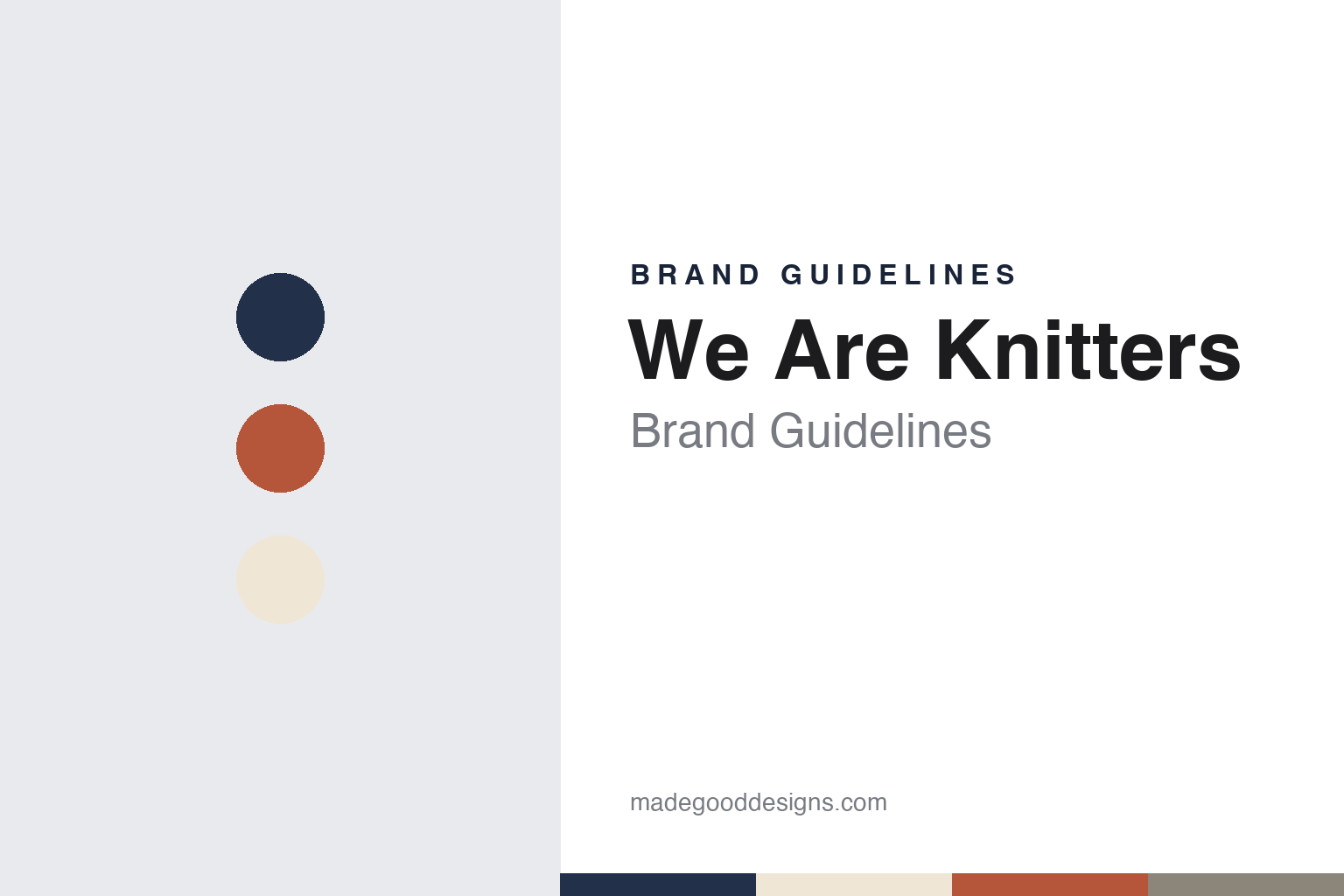
Two constants: a We Are Knitters navy, wool and terracotta palette and a Friendly sans register. Abstract homage — not a We Are Knitters product or mark; no kit, logo or label is reproduced.
Making knitting cool
Two consultants, a subway ride and €10,000 of wool.
We Are Knitters is a Madrid knitting-kit brand founded in 2011 by Pepita Marín and Alberto Bravo. On its website the company says the two met around 2009 and came up with the idea after a trip to New York the following year. El País, interviewing Marín in 2020, reported that both had worked at the consultancy PwC and that the spark was a young woman knitting on the New York subway; Hipertextual added in 2019 that the pair had also visited Manhattan yarn shops and taught themselves to knit from YouTube videos.
The aim, Marín told El País, was to make knitting cool. Bravo put it in similar terms to Hipertextual: “Nuestro objetivo era renovar la imagen de la gente que teje” — our goal was to renew the image of people who knit. According to El País, the start-up money came from a prize in an entrepreneurs’ competition at ICADE, the Madrid business school: €10,000, all of it spent on wool.
The business was online from the start. It sold kits — yarn, wooden needles and a pattern — for blankets, jumpers, scarves and cardigans, and it used Instagram from its first days, sharing photographs of what customers had made, Hipertextual reported. Within months, Hipertextual said, the company was selling abroad.
Marín became the company’s public face. In 2020 she won the business award of the Princess of Girona Foundation, which Spanish Wikipedia records as given for turning the ancestral tradition of knitting into a modern hobby. Business reports in 2025 described her as an independent director of the Spanish media group Prisa.
Colour
Sold abroad, spun in Peru.
Most of its sales were made outside Spain. Hipertextual put Spain at about 5% of revenue in 2019; El País reported in 2020 that 95% of sales came from abroad, led by the United States, Germany, France and the United Kingdom, then Italy and Spain, all handled from an office in Madrid. FashionUnited reported in 2025 that the company had set up a US subsidiary and sold in more than 15 countries, and Marketing4eCommerce put its customer base at more than 60,000. Its website today offers storefronts for around thirty regions, from North America and Europe to Australia, Japan and South Korea.
Its funding was modest. In 2019 Hipertextual reported a loan from ENISA, the Spanish state lender for young companies, and a small round from private investors, with revenue of about €10 million in 2018 and a positive operating result. El País described a board backed by business angels and investment funds. The pandemic brought a peak, including days with €100,000 in sales in 2020. FashionUnited put the high point at €14.9 million in revenue and €1.61 million in profit in 2021; El Confidencial gave about €15 million for 2020. In October 2022 the brand opened its first permanent shop, on Calle Fuencarral in Madrid’s Malasaña district, with free knitting sessions.
Where the yarn comes from rests mainly on the company’s word. Its “Our Yarn” page says part of its team visited the Peruvian highlands, “where we source and process our fibers,” and describes its yarn as sheep’s wool, baby alpaca, merino and pima cotton — “100% natural fibers made in Peru.” It says the fibre is cleaned, washed, spun and dyed there, with speckled colours sprinkled by hand and solid colours dyed by machine. El País reported in 2020 that Peru was the main supplier but that the company also bought from Spain and Portugal, and its current shop lists yarns in other fibres such as linen and mohair. We found no named mill. The company says its needles and hooks are made from FSC-certified beechwood.
Typography
Seven ways yarn reaches a knitter.
The seven brands in this group all sell yarn for hand knitting and crochet, and they come from seven countries: Bergère de France from France, Debbie Bliss from the United Kingdom, Rico Design from Germany, Hobbii from Denmark, Sandnes Garn from Norway, madelinetosh from the United States and We Are Knitters from Spain. What sets them apart is less the fibre than the route a ball or skein takes to reach a maker.
Yarn still travels by many roads. Some of it comes from old mills with long regional histories; some is sold under a designer’s own name; some sits in ranges stocked by craft shops and department stores; some is bought from online retailers that ship across borders; some arrives in a box as a kit, with needles and a pattern; and some is dyed in small batches by hand. Each guide shows which of those roads a brand travels, and how its name, colours and tone of voice change to suit it.
Each guide also separates what independent sources record from what the company says about itself — who founded it, who owns it now and where its yarn is made — and marks plainly what rests only on the company’s own word.
Aa
A friendly sans — a start-up’s voice for an old craft. (Specimen set in DM Sans, a sans STAND-IN; NOT the We Are Knitters logo.)
We Are Knitters
Boom, insolvency and new owners.
The growth did not last. El Confidencial reported in June 2024 that sales had fallen to about €6.8 million in 2023, after the company had bought too much wool following the pandemic; it had made losses in consecutive years, its auditor had raised doubts about it as a going concern, and it had closed operations in several countries as well as its Madrid shop. Shareholders put in more capital, and in November 2024 the paper reported a debt-restructuring agreement with banks submitted for court approval. The founders then controlled about 43% of the company, according to FashionUnited.
In May 2025, after losses of €1.65 million, the company filed for insolvency — a concurso de acreedores — in Madrid, FashionUnited and Marketing4eCommerce reported. In June 2025 its business unit was sold to the technology company Caracas Lab for about €914,000, with supplier debts assumed and 11 of its 14 employees kept on; in October 2025 the original company, We Are Knitters S.L., went into liquidation. FashionUnited said the sale was meant to keep part of the business going under new management. The brand’s website was still selling kits in October 2026.
We found no published brand guidelines. As shown on its website, the identity leans on photographs of finished pieces and of people knitting, which fits the community approach Hipertextual described in 2019.
For a design guide, We Are Knitters shows how a kit, a social feed and a story about where the yarn comes from can turn an old craft into a lifestyle brand — and how quickly such a brand can grow and contract. Compare Katia, the Castelló family’s yarn house in Barcelona, and Isager, a Danish yarn house built on colour. For this guide we use a navy, an undyed-wool cream and a terracotta with a sans, an unofficial interpretation; no product or logo is reproduced.
Explore & save
Keep We Are Knitters’s identity on hand — save it to a board in the Made Good inspiration library.
We Are Knitters identity set
Pin the We Are Knitters navy, wool and terracotta palette and the Friendly sans register to your own board.