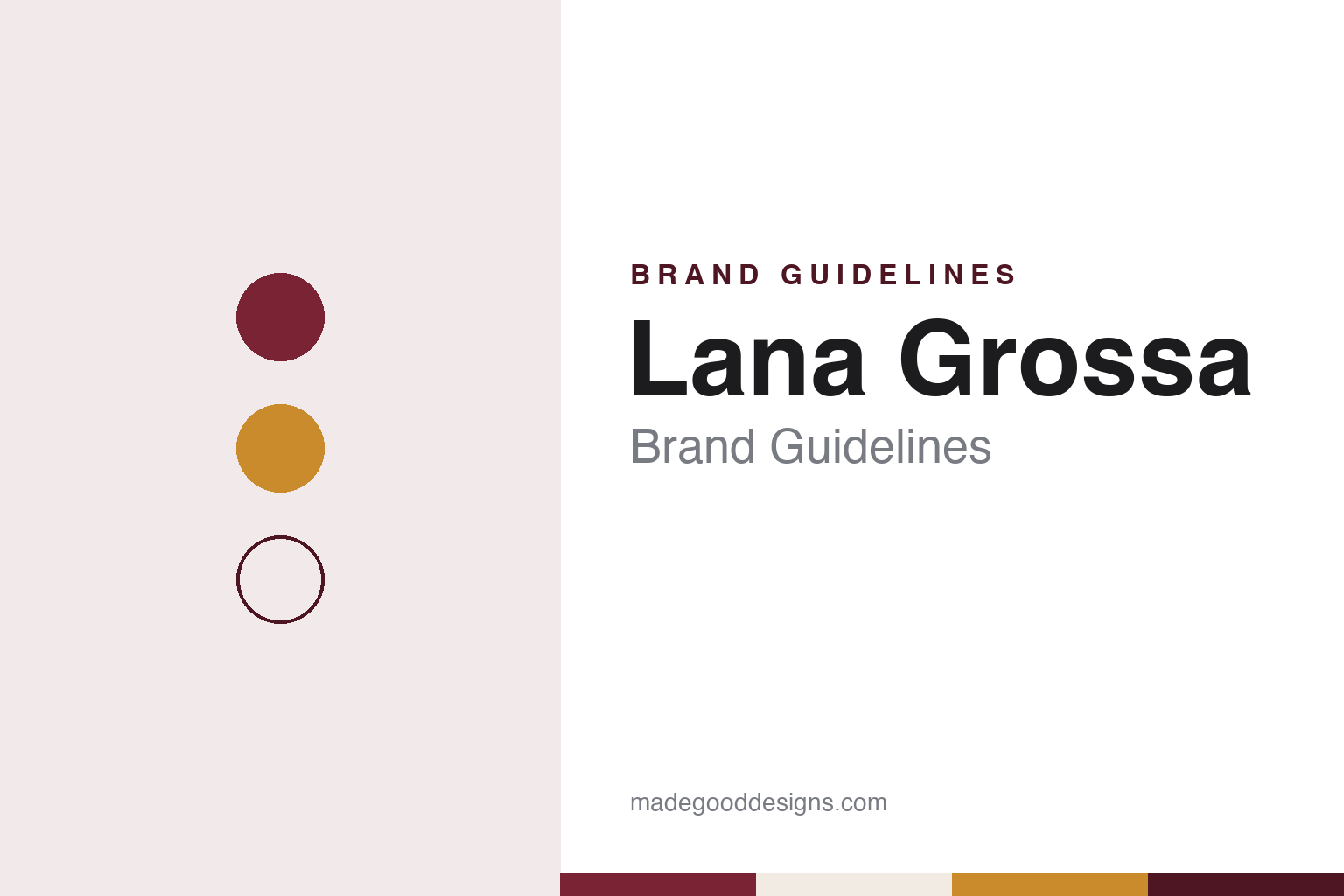
Lana Grossa Brand Guidelines
The Bavarian yarn house that spins in Italy.
Aa
Two constants: a bordeaux, cream and saffron palette and an Italianate didone register. Abstract homage — not a Lana Grossa product or mark; no ball band, logo or magazine cover is reproduced.
Gaimersheim
A German yarn house with an Italian name.
Lana Grossa is a German company with an Italian name. Its head office, and its logistics and sales centre, is in Gaimersheim, a market town just outside Ingolstadt in Upper Bavaria, and its legal name is Lana Grossa Mode mit Wolle Handels- und Vertriebs GmbH — a trading and distribution company, registered at the Ingolstadt local court, rather than a spinner. “Lana” is the Italian word for wool.
The company’s own account of its age has shifted. Its website today says Lana Grossa was founded in 1972, and its homepage advertises “54 years of experience.” A company press release issued in Munich in August 2013, however, said the business had been founded 35 years earlier — which would put the start in the late 1970s — so we give the company’s current date and note the earlier one. The same release names the founder as Ernst Groß and says that at the start the business had 20 employees.
Neither English nor German Wikipedia has an article on the company, and we have not found an independent dated history, so most of what follows is the company’s own account.
Colour
A family business with Italian mills.
Lana Grossa presents itself as a family firm. The 2013 press release described it as a family company headed by the founder’s son, Hans-Peter Groß-Leinfelder, who was quoted as managing director, and the company’s imprint in 2026 still names him as its representative. We have not checked a shareholder list, so we describe the company as family-run on its own word rather than setting out who owns it.
The 2013 release gave a snapshot of the business at the time: some 60 permanent staff and about 30 freelancers, and output of about 1.2 million kilograms of yarn a year, with demand having nearly doubled over the previous four years. It also claimed a place among the most important makers in the hand-knitting market alongside the Coats group and Lang Yarns. Those are the company’s figures and comparisons, not independent ones.
Its range today is built around four groups, the company says: classic merino and pure-wool yarns kept in the range for years; the self-patterning sock yarn Meilenweit; “fashionable classics” carried over from season to season; and new fashion yarns each season. As with most yarn brands, the patterns matter as much as the fibre. Lana Grossa publishes its own magazines — a main Journal, with themed titles such as Classici, Infanti and Home, twice-yearly Lookbook issues and, more recently, a series called Nera, subtitled “una storia italiana.” It says it sells only through specialist shops, about 1,200 of them, with core markets in Germany, Austria and Switzerland and long-established sales in the United States, the Benelux countries and Scandinavia, and it is a member of the German trade body Initiative Handarbeit.
Its marketing has leaned on fashion and familiar faces. In the 2013 release the company said the Berlin label Lala Berlin used its yarns for the knitted pieces in its collections, and that the biathletes Magdalena Neuner and Miriam Gössner and the cook Sarah Wiener were working with it as testimonials for knitting. The release also described a push towards younger and beginner knitters, with chunky, quick-to-knit lines, an entry-price range and an organic-wool line called Linea Pura, alongside how-to videos on its website. Its domain has changed too: the 2013 releases pointed to lanagrossa.de, while the company’s site is now lana-grossa.de.
Typography
Yarn brands and where they are made.
The seven brands in this group all sell yarn for hand knitting and crochet, and they come from seven countries: Sirdar from the United Kingdom, Lana Grossa from Germany, Ístex from Iceland, Manos del Uruguay from Uruguay, Brooklyn Tweed from the United States, Filatura di Crosa from Italy and Hjertegarn from Denmark. What sets them apart is less the colour card than the question behind every ball: where the wool comes from, and who spins it.
The answers differ widely. Some yarn is washed and spun by a national wool processor that takes in a country’s own fleece; some is made by artisan cooperatives, where the people who dye and twist the fibre share in the business; some comes out of an old spinning district, where generations of mills grew up beside the same rivers; and some is sold by brands that design the yarn and its colours but commission mills to make it. Each route leaves its mark on a brand’s name, its labels and the way it talks about wool.
Each guide also separates what independent sources record from what the company says about itself — who founded it, who owns it now and where its yarn is made — and marks plainly what rests only on the company’s own word.
Aa
An Italianate didone — the register of a fashion magazine. (Specimen set in Bodoni Moda, a serif STAND-IN; NOT the Lana Grossa logo.)
Lana Grossa
Designed in Bavaria, spun in Italy — on its own word.
The Italian connection is the core of the brand, and it rests on the company’s word. Lana Grossa says its range is made almost entirely by leading spinning mills in Italy, and its sustainability page goes further: apart from a few exceptions, it says, all production takes place at spinners in northern Italy, especially in Biella and Prato, two old wool-textile districts. The 2013 release put it slightly differently, saying fashion yarns were made in Prato and classic qualities in Piedmont, the region that contains Biella. The company does not name the mills on the pages we checked, and we have not found an independent source that does, so we report the claim as the company’s.
It makes other claims about its fibres, which we also give as its own: that the company holds GOTS certification for organic textiles; that its merino wool, from Australia, New Zealand and South America, is mulesing-free; that its newer alpaca qualities carry AIA certification; and that its mohair comes from South Africa. In Gaimersheim, the company describes its site as a logistics and sales centre, not a spinning mill.
For a design guide, Lana Grossa shows how a yarn brand can borrow a country’s reputation openly: a Bavarian distributor with an Italian name, Italian-titled magazines and a stated Italian supply chain. Compare Schachenmayr, the German brand that grew from its own spinning mill, and Lang Yarns, the Swiss family firm the company once named as a peer. For this guide we use bordeaux, merino cream and saffron with a serif, an unofficial interpretation; no product or logo is reproduced.
Explore & save
Keep Lana Grossa’s identity on hand — save it to a board in the Made Good inspiration library.
Lana Grossa identity set
Pin the Lana Grossa bordeaux, cream and saffron palette and the Italianate didone register to your own board.