De Rerum Natura Brand Guidelines
The French yarn brand built on Arles merino.
Aa
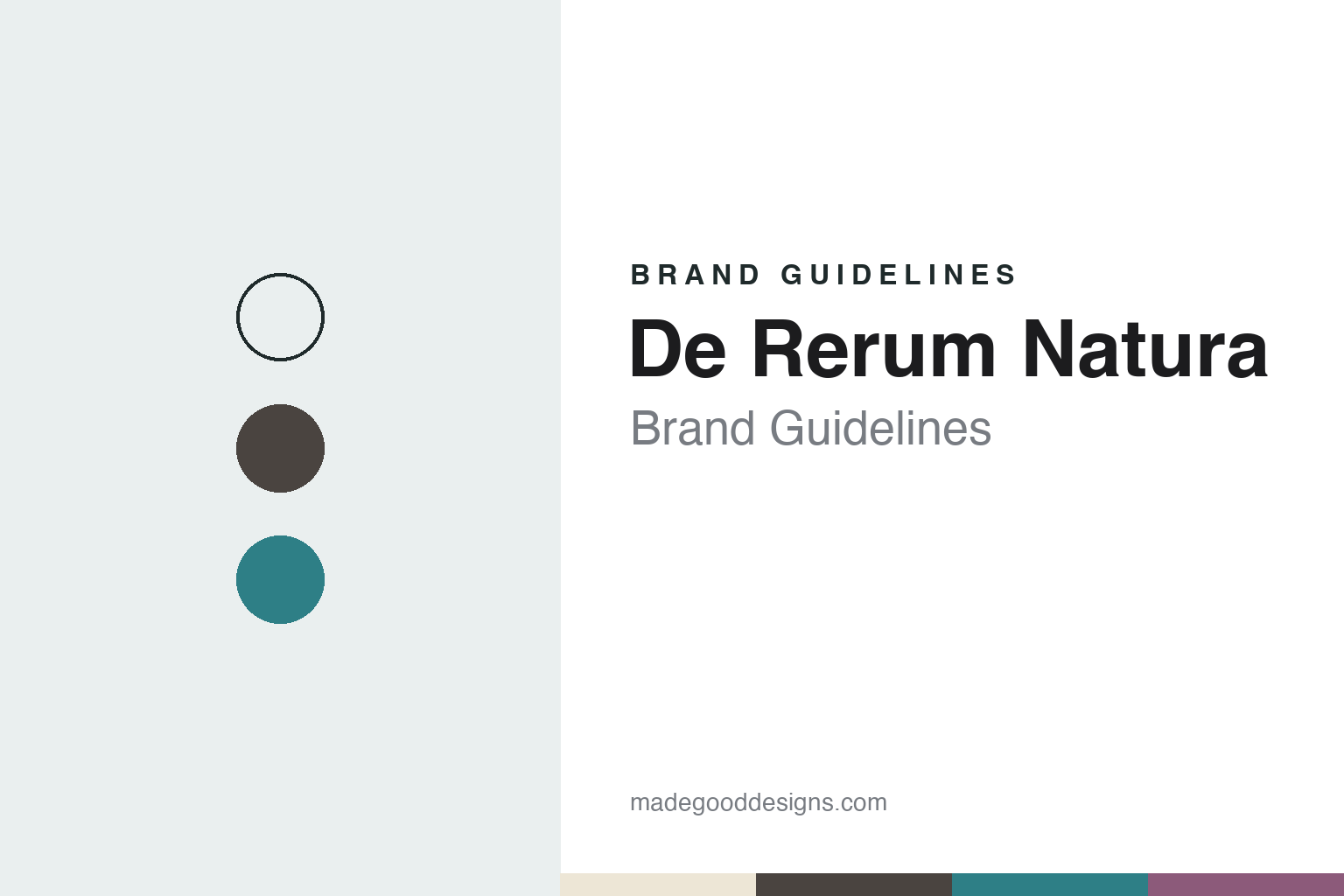
Two constants: a De Rerum Natura fleece, pepper and lagoon palette and a literary serif register. Abstract homage — not a De Rerum Natura product or mark; no skein, label or logo is reproduced.
A corner of the living room
A knitter who wanted to know where her wool came from.
De Rerum Natura is a French knitting-yarn brand created by Solenn Couix-Loarer. In the company’s own account, written in the first person, she started it in 2012 after taking up knitting and realising she “knew next to nothing about the yarns that would spend hours in my hands and live on my children’s skin”: the word “wool” on a label did not say whether the sheep had been mulesed, where the fibre came from, or where and under what conditions it had been spun and dyed. Country wools, she writes, were authentic but too rough to wear next to the skin, and the colour ranges were basic.
Her answer was what she calls “a reinvented country wool.” The company says she discovered the wool of the Mérinos d’Arles — the merino breed of the Arles region in Provence — and the work of breeders trying to raise its value in 2009, and that the first two yarns, Gilliatt and Pénélope, launched in 2012, from “a corner of the living room,” helped by readers of her blog and by the designer Nadia Crétin-Léchenne, who shared the news.
The business became a company two years later. France’s national company register, which we consulted in October 2026, lists De Rerum Natura SAS as created on 2 April 2014, with its head office in Toulouse and Solenn Couix-Loarer as its president; the website’s legal notice names her as its publisher. The register classes it as a small business.
The name comes from De rerum natura, “On the Nature of Things,” the Latin poem by Lucretius. The company quotes it and says it wanted its yarns to be seen as “a thing of nature” rather than an anonymous product.
Colour
Arles merino, carded in the Creuse, combed near Biella.
The brand’s story rests on one fibre. The company says all the undyed wool in its yarns comes from Arles merino sheep, averaging 21.5 microns, which it calls “probably the finest that can be found in Europe at the moment,” and which it values for a pronounced crimp that makes yarns springy and lofty. It says the flocks graze mountain pastures in summer on transhumance, that most farms are in south-east France near Arles, and that it favours certified organic farms by committing to buy all they produce — enough, it says, for organic Arles merino in its combed yarns and 50% in its carded ones. Brown wool, used to make heathered shades, comes from merino sheep in Portugal’s Alentejo, it says.
It is specific about where the yarns are made, and about where they are not. Its carded, woollen-spun range, which includes Ulysse, Gilliatt and Cyrano, is “spun and dyed in France in the Creuse,” the company says. Its finer combed yarns, Albertine and Pénélope, which add a little silk, “are spun in Italy by a small spinning mill near Biella, as no spinning mill in France is currently equipped to produce such fine worsted yarns.” It does not name either mill on the pages we read, so neither do we. These are the company’s statements; we found no independent audit of them.
The company also describes its processing: wool cleaned by mechanical combing rather than carbonisation, so a few plant fibres may remain; no bleaching and no superwash treatment; carded yarns washed with a non-silicone biodegradable soap; and dyes that meet the European REACH regulation, applied at a dyehouse that it says treats its own water with a planted filtration system.
The range has grown beyond wool. The company lists Antigone, a yarn in organic linen, and its shop now offers Bérénice, Alice, Candide and Robinson alongside the original yarns, plus kits, patterns and books.
Typography
Design and documentation.
The seven brands in this group all sell yarn for hand knitting and crochet, and they are linked to six countries: Paintbox Yarns and Erika Knight from the United Kingdom, Juniper Moon Farm from the United States, Lamana from Germany, Laines du Nord from Italy, De Rerum Natura from France, and ITO, a label run from Germany whose yarns, it says, come from Japan. What they share is less a place than a question: who actually makes the yarn that carries the name on the label?
Some yarn brands are, in effect, designer or retailer labels. The company chooses the fibres, sets the colour card, writes the patterns and builds the brand, but the spinning and dyeing are done by mills elsewhere, sometimes in another country, and the name on the ball tells you who designed it rather than who made it. Others are fibre-led, built around a particular wool, a flock or a mill, where the story of the yarn starts with the raw material and the place it was grown or spun.
Many brands sit somewhere between the two, and their own descriptions do not always make the line clear. Each guide therefore separates what independent sources record from what the company says about itself — who founded it, who owns it now and where its yarn is made — and marks plainly what rests only on the company’s own word.
Aa
A literary serif for a brand named after a Latin poem. (Specimen set in DM Serif Display, a serif STAND-IN; NOT the De Rerum Natura logo.)
De Rerum Natura
Colour from a salt-and-pepper base.
Colour is the other half of the brand. The company says its first three shades were undyed blends of white and brown wool, called “sel,” “poivre et sel” and “poivre” — salt, salt-and-pepper and pepper. To show them off, Solenn Couix-Loarer writes, she designed a cardigan with a few bright stripes, dyeing the colours over the heathered salt-and-pepper base “between my kitchen and my bathroom”; the resulting “rainbow” cardigan “became a bit of a mascot for the brand,” and the mill was asked to reproduce the shades at scale. Dyeing over a heathered base muted the colours, which she says was the point.
Newer shades in the carded range are made by blending fleece dyed before spinning, the company says. Its example is “ébène,” an off-black of 80% black-dyed wool and 20% natural brown, which it says avoids a fifth of the dyeing a conventional black would need. It describes building colour families that share a hue — the same turquoise runs through “ciel,” “lagon,” “plume” and “nuit” — and matching ideas against Pantone binders before briefing the dyer.
The brand reaches knitters largely through designers and the independent knitting press. Its blog in 2026 announced patterns by international designers in its yarns and noted features in Laine, the knitting magazine, which marked its tenth anniversary that year. The company ships worldwide from France.
For a design guide, De Rerum Natura shows how a small brand can make traceability its identity, naming the breed, the region and the country of each step. Compare Bergère de France, a French spinning mill on a much larger scale, and Plassard, another French yarn house. For this guide we use fleece, pepper and lagoon tones with a serif, an unofficial interpretation; no product or logo is reproduced.
Explore & save
Keep De Rerum Natura’s identity on hand — save it to a board in the Made Good inspiration library.
De Rerum Natura identity set
Pin the De Rerum Natura fleece, pepper and lagoon palette and the literary serif register to your own board.