Purl Soho Brand Guidelines
The Soho yarn shop that became an online yarn brand.
Aa
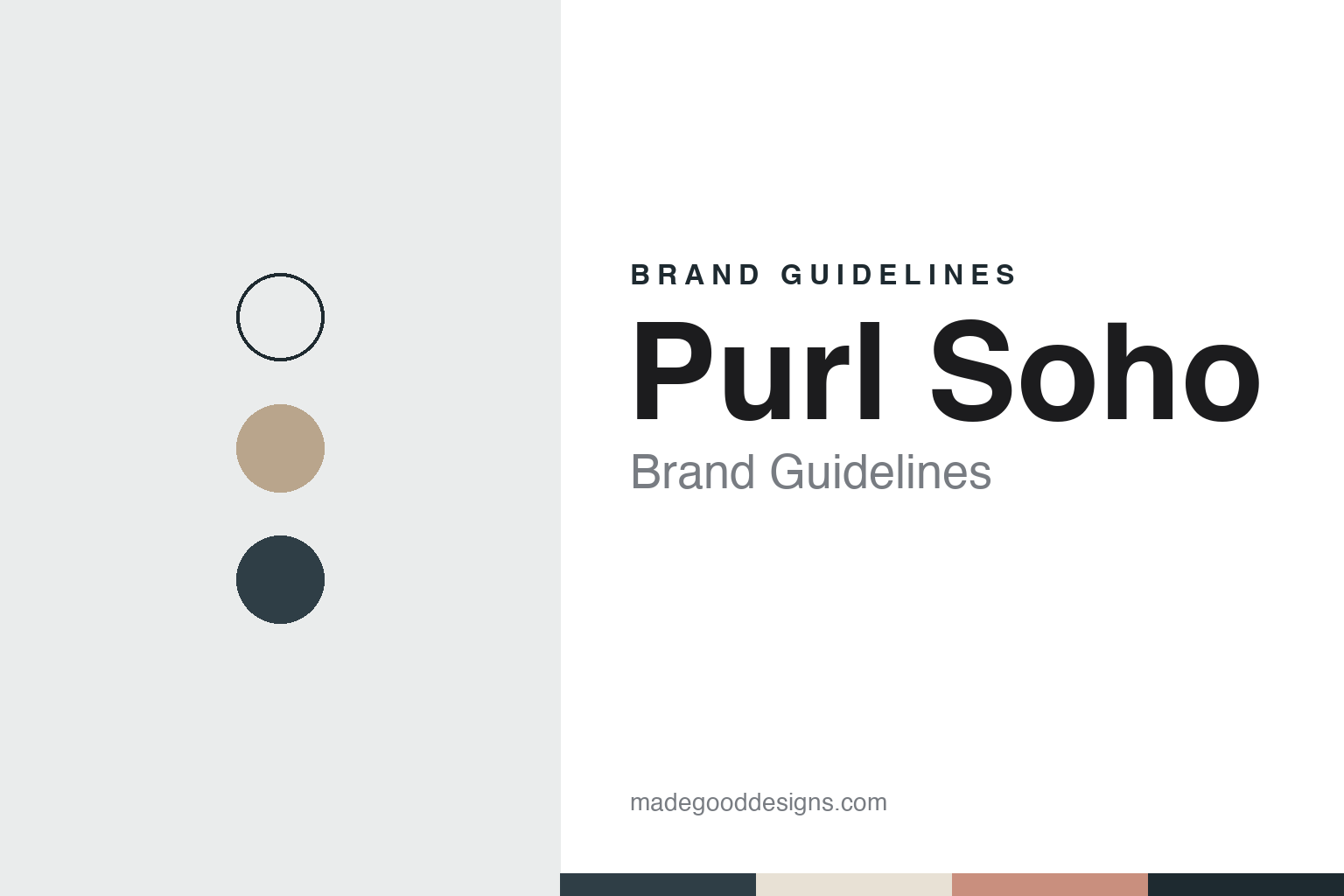
Two constants: a Purl Soho slate, undyed wool and faded rose palette and a quiet bookish serif register. Abstract homage — not a Purl Soho product or mark; no skein, logo or label is reproduced.
A tiny shop in Soho
Joelle Hoverson’s knitting shop, opened in 2002.
Purl Soho began in New York City in 2002. The company’s own “About Us” page, as archived in 2017, opens with “Since 2002,” and a later version describes its “very beginning as a tiny shop in New York City’s Soho neighborhood,” set up by its founder, Joelle Hoverson. Craft Industry Alliance, the trade organisation for the craft business, gives the same founder and the same year in a 2018 profile and a 2019 podcast interview.
According to that 2019 interview, the first shop was a small knitting store on Sullivan Street. A second storefront for fabric and quilting followed, called Purl Patchwork, and the two later came together in a single shop at 459 Broome Street, still in Soho. The interview describes the founder’s aim as a shop that “had a vision”.
The business soon had more than one owner. In 2017 the website’s “About Us” page was signed by three “co-owners”: Joelle Hoverson, her sister Jennifer Hoverson and Page Marchese Norman. The 2024 version says “two more owners have joined Joelle since then,” naming Jennifer Hoverson Jahnke and Page Marchese Norman; the 2019 podcast page gives 2008 as the year Page Marchese Norman became a co-owner, and credits Jennifer with building the online side of the business.
We found no report of a sale or outside investor in the sources we checked, and the company’s pages still name the same three owners.
Colour
Own-label yarns, made in Peru.
What began as a shop selling other makers’ yarns now puts its own first. The company says it sells “only the things we love, most especially our own brand of hand-knitting yarns, available only at Purl Soho,” and that it works “with partners around the world” to make them.
Its product pages say where those yarns come from. Good Wool is described as “Made in Peru,” spun from the wool of highland sheep on the Peruvian Altiplano, and Oeko-Tex certified; Linen Quill, a blend of highland wool, alpaca and linen and one of its best sellers, is “Made in Peru and inspired by the traditional yarns of the Andean highlands,” from a Fair Trade certified mill; and Line Weight, a fingering-weight yarn, is listed as “Made in Peru” with Peru Fair Trade, REACH and Oeko-Tex certification. These are the company’s own statements, as shown on its pages in late 2024 and early 2025; we did not find independent reports naming the mills.
The “About Us” page widens the picture, describing “fine highland wool from the Andes mountains,” “linen grown in France” and “100% Mongolian cashmere” among the fibres it buys. Purl Soho also sells fabric under its own name, such as the Mineral Linen bundles mentioned in the 2019 interview, alongside needles and tools from other makers.
The other half of the brand is its writing. The Purl Bee, the company’s pattern blog, was described in 2017 as updated “two or three times a week with (mostly) free patterns developed by our own team of talented designers.” The patterns are written for the house yarns, and the 2024 page says they come from in-house designers and from designers in “the worldwide knitting community.” Its tutorials and free patterns are cited by knitting references, including several Wikipedia articles on stitches and bind-offs. The interview credits those tutorials with driving the growth of the online shop.
Typography
Yarn makers and their mills.
The seven brands in this group all sell yarn for hand knitting and crochet, and they come from seven countries: Purl Soho from the United States, Dale Garn from Norway, Schoppel from Germany, Puppy from Japan, King Cole from the United Kingdom, Mirasol from Peru and Fonty from France. What links them is less a fibre or a price point than the question of who actually stands behind the label on the ball.
Some yarn brands begin as shops, where a retailer’s taste in colour and pattern becomes a house range that others then spin to order. Some are spinners first, mills whose brand name is simply the name over the factory door, and whose shade cards grew out of what their machines and dye houses could make. Others are built around a social purpose, using the sale of yarn to fund work, training or schooling in the places where the fibre is grown and the yarn is made. Many sit somewhere between these models, and some have moved from one to another as owners changed.
Each guide separates what independent sources record from what the company says about itself — who founded it, who owns it now and where its yarn is made — and marks plainly what rests only on the company’s own word.
Aa
A quiet, bookish serif in keeping with a shop known for its patterns and photographs. (Specimen set in Libre Caslon Text, a serif STAND-IN; NOT the Purl Soho logo.)
Purl Soho
From Broome Street to a warehouse in California.
The shop’s address has changed in meaning more than its name. In 2019 the company told Craft Industry Alliance that a warehouse in Tustin, California, handled all of its online orders, while the Broome Street shop served customers in New York. In July 2021 its contact page said “Our New York City Shop: Closed For Now!”, citing the pandemic, and gave a warehouse in Irvine, California. By May 2023, and again in May 2025, the archived contact page listed only a warehouse in Santa Ana, California, “not open to customers,” and no New York shop; the 2024 “About Us” page says Purl Soho “has evolved into an online shop.”
Help for customers has moved online with it. The company offers free one-to-one project help over Zoom, according to its contact page, and runs knit-alongs built around its own patterns. The website notes that its patterns are for home use and may not be made for sale.
The look is consistent across those pages: soft natural light, undyed and muted colours, and yarn photographed in neat ranks of skeins — the same orderly abundance of cubbyhole shelves that Craft Industry Alliance described in the Broome Street shop. The company publishes no brand colours or typefaces, so what we show is an interpretation.
For a design guide, Purl Soho shows how a shop can turn its taste into a brand: own-label yarns, free patterns and a steady photographic style. Compare Brooklyn Tweed, another American yarn brand built on patterns and photography, and Knit Picks, which sells its own yarns directly online. For this guide we use slate, undyed wool and a faded rose with a serif, an unofficial interpretation; no product or logo is reproduced.
Explore & save
Keep Purl Soho’s identity on hand — save it to a board in the Made Good inspiration library.
Purl Soho identity set
Pin the Purl Soho slate, undyed wool and faded rose palette and the quiet bookish serif register to your own board.