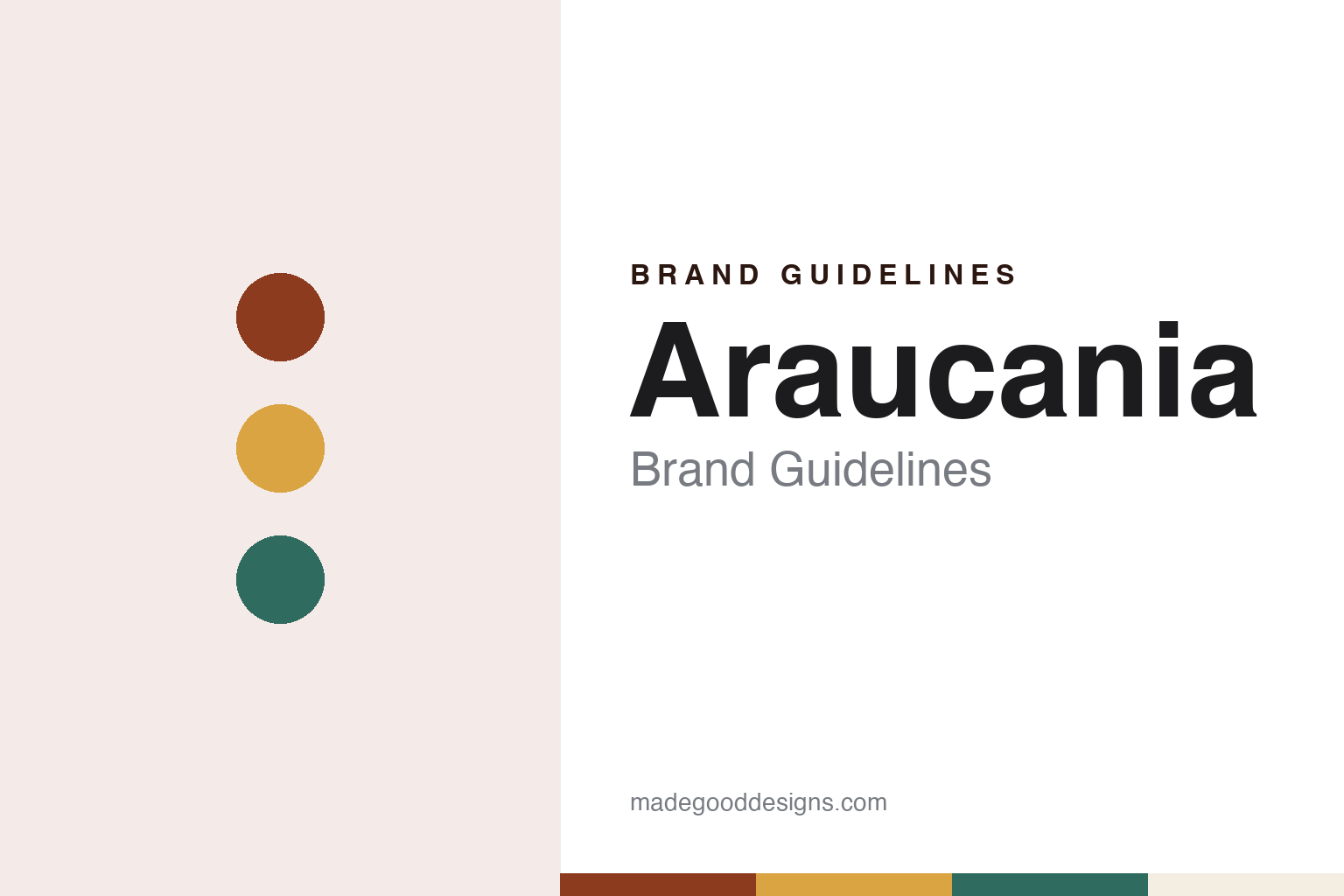
Araucania Brand Guidelines
The hand-painted yarn named for southern Chile.
Aa
Two constants: a rust, gold and green kettle-dye palette and a soft old-style serif register. Abstract homage — not an Araucania product or mark; no label, logo or skein tag is reproduced.
A Chilean name
A region, a river and a hand-painting technique.
Araucania is a hand-painted yarn brand whose name and yarn names point to Chile. Araucanía is a region of southern Chile, historically the heartland of the Mapuche people, and the name is also linked to the araucaria, the monkey-puzzle tree native to the area. The brand’s best-known yarn family is called Huasco, the name of a river and a province in northern Chile; the brand’s website says the name is inspired by “the Mapuche word for ‘river of gold.’”
The brand presents itself through craft rather than company history. Its distributor, Knitting Fever Inc. (KFI), describes it this way: “Ancient South American crafts inspire Araucania Yarns, a trailblazer as one of the first brands in America to use the hand painted techniques in the early 2000s. Each hank is different!” The brand’s Facebook page uses similar words, saying the yarns “take inspiration from ancient South American crafts created with hand-painted natural yarns.” Neither page gives a founding date or names the people who started the brand, and its earlier website, araucaniayarns.com, no longer loads; we have not been able to document its founders or founding year, so we leave both out.
What is clear is the technique the brand is known for. Hand-painted yarn is dyed by applying colour to sections of a skein by hand, and kettle-dyed yarn is coloured in a pot, so that the shade varies from one part of the hank to the next. That is why the brand stresses that “each hank is different” — and why knitters are usually told to alternate skeins of a hand-dyed yarn in a large project.
Colour
Huasco, Casita and the range today.
The current range, as listed on the brand’s website and on Knitting Fever’s, is broad. The Huasco Sock family, in 75% superwash merino wool and 25% polyamide, comes in several dye styles — hand painted, kettle dyed and colour-shifting “paints” — in 100-gram skeins of about 430 to 440 yards. Huasco Cotón is a fine 100% cotton, with a version that adds a little Lurex. Casita, a blend of alpaca, wool and nylon, is described as “a harmonious marriage of South American fibers & Italian luxury.”
Newer lines range further. Alga blends organic cotton, bamboo viscose and SeaCell, a fibre made with seaweed; Aquarella is a silk print yarn that the website says is made from 100% recycled silk taken from production waste; Espiral and El Gigante are bulky and super-bulky merino yarns. Other lines include Carnival, a hemp, cotton and linen blend, and Jaspeada, a bulky blend of superfine alpaca, wool and recycled polyamide, and Suave, a superwash merino.
The range is backed by patterns. Knitting Fever publishes Araucania designs as numbered leaflets, and its most recent leaflets, numbered for 2026, include designs in El Gigante and Espiral; the brand’s website links each yarn to its colourways and to the designs made in it, so a knitter can move from a skein to a finished garment in one step.
On where the yarn is made, the website is specific only for some lines. It says Huasco Sock Hand Painted is “spun and hand-painted in Peru,” and that the Kettle Dyes version is “skillfully crafted by Peruvian artisans.” For the other yarns we checked, it does not name a country of manufacture. Those statements are the company’s own; we could not check them independently.
Typography
Yarn brands and where they are made.
The seven brands in this group all sell yarn for hand knitting and crochet, and they come from seven countries: Stylecraft from the United Kingdom, Araucania from Chile, Tukuwool from Finland, Cardiff Cashmere from Italy, Wollmeise from Germany, Blue Sky Fibers from the United States and Biggan Design from Australia. What separates them most is not the shape of a ball or the length of a colour card but the question every knitter eventually asks: where does the fibre come from?
Yarn brands answer that question in very different ways. Some tie their identity to the sheep of one country or even one local breed, and put the farm and the flock at the centre of the story. Some build a name on a single luxury fibre such as cashmere, where sourcing and finishing matter as much as colour. Some are defined by the dye pot, turning bought-in yarn into one-of-a-kind hand-dyed skeins, while others make affordable acrylic in large volumes, for knitters who want bright colour, easy washing and a low price.
Each guide separates what independent sources record from what the company says about itself — who founded it, who owns it now, where its fibre is grown and where its yarn is spun — and marks plainly what rests only on the company’s own word.
Aa
A soft old-style serif for a hand-painted yarn. (Specimen set in Fraunces, a serif STAND-IN; NOT the Araucania logo.)
Araucania
A brand presented through its distributor.
Today Araucania reaches knitters mainly through Knitting Fever. KFI lists the brand alongside others it distributes, including Noro, Katia and Lana Gatto, and the Araucania website uses Knitting Fever’s newsletter sign-up and lists stockists in North America, Europe, Australia and Japan. Knitting Fever’s own history says it began in 1974, when Sion Elalouf opened a needlepoint and knitting shop in Great Neck, New York, and that in the early 1980s it gave up retail to supply specialty yarns to shops across the United States, later expanding into Canada and other countries.
We could not confirm who owns the Araucania name, or whether the brand is still run by a company in Chile, from the sources we checked. The record therefore stands as this: a yarn brand with a Chilean name and Chilean-named yarns, credited by its distributor with an early role in hand-painted yarn in the American market, whose current sock yarns are described by its own website as made in Peru. That gap between a brand’s place-name and its documented supply chain is common in the yarn trade, where names often outlast the mills and dye-houses behind them.
Its visual language is that of the skein itself. Product photographs show hanks twisted to display the run of colour, and colourway names lean on landscape and light — dawn, twilight, prism — rather than on a logo or mascot.
For a design guide, Araucania shows how a yarn brand can build its identity around a dyeing technique and a sense of place. Compare Manos del Uruguay, another South American hand-dyed yarn, and Noro, also sold in the US through Knitting Fever. For this guide we use rust, gold and green with a serif, an unofficial interpretation; no product or logo is reproduced.
Explore & save
Keep Araucania’s identity on hand — save it to a board in the Made Good inspiration library.
Araucania identity set
Pin the Araucania rust, gold and green palette and the soft old-style serif register to your own board.