Manos del Uruguay Brand Guidelines
The rural women’s cooperatives behind a hand-dyed yarn.
Aa
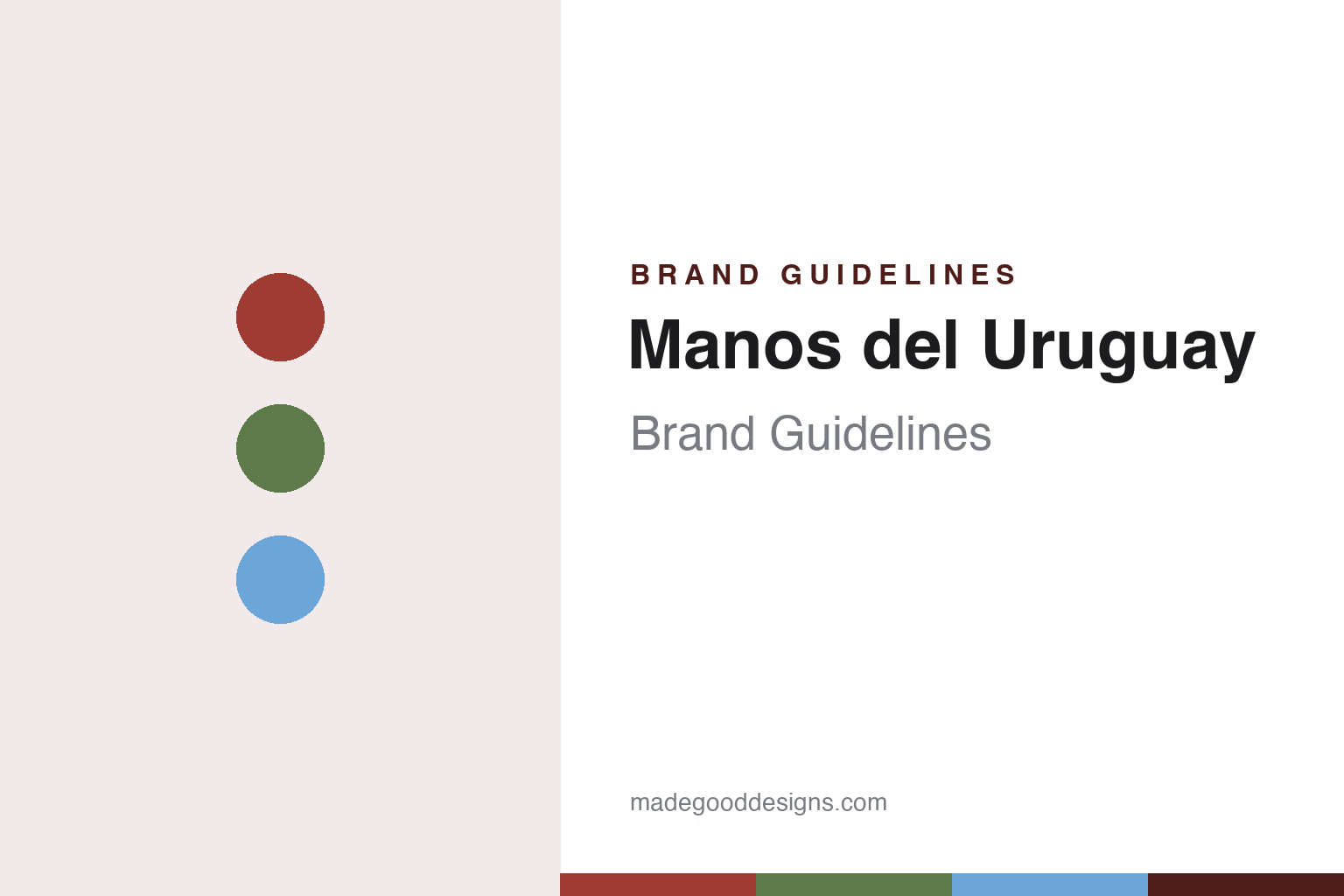
Two constants: a Manos del Uruguay madder, green and sky-blue palette and a Warm serif register. Abstract homage — not a Manos del Uruguay product or mark; no skein, tag or logo is reproduced.
Five founders
Blankets, saddle pads and a question about rural women.
Manos del Uruguay began in 1968 with a question the organisation still repeats: how could the lives of women in rural Uruguay be improved? Its own history names five founders — Olga Pardo Santayana de Artagaveytia, Sara Beisso de Souza, Dora Muñoz de Cibils, María del Carmen Bocking and Manila Chaneton de Vivo — whom it describes as friends who shared a concern for “the hard life and lack of opportunities” of country women at the time. Spanish Wikipedia lists Manos among organisations founded in 1968, although its text gives 1989 as the year the organisation was constituted, without explaining the difference; the organisation itself, and its profile with the World Fair Trade Organization, date it to 1968.
The idea, as Manos tells it, was practical. The founders planned to sell things rural women were already making — wool blankets and saddle pads for horses — and when those sold well, they began organising workshops around the country. With the help of social workers, the women were taught to organise production, run cooperatives and deal with suppliers and customers, while balancing that work with family life. The founders’ vision, the organisation says, was that Manos should be “not only a work source, but a means of women’s empowerment and development,” and training leaders who could carry it forward was a priority.
The raw material was the one Uruguay had in abundance. Manos says the answer to its founding question lay in handcrafts, “using skills inherited from our mothers and grandmothers and the raw material that we had at hand: wool.” Spanish Wikipedia’s article on the hand-knitter’s trade describes knitting in Uruguay as a skill passed from generation to generation among women at home since the nineteenth century, often turned into a source of income, and mentions Manos in the same section.
Colour
Twelve cooperatives and a signed tag.
Manos is a non-profit organisation built from cooperatives. It says it is organised in 12 cooperatives, each a workshop in a small village in Uruguay’s countryside, and that the artisans are the owners: profits are shared among the cooperatives or reinvested in the organisation. Spanish Wikipedia, citing the Montevideo newspaper El País, puts the number of artisans at about 250 across the interior of the country, and its article on Fray Marcos, a small town in Florida department, lists a Manos del Uruguay knitwear workshop among the town’s businesses.
The cooperatives also govern. Each one is a small enterprise in which the women are both makers and administrators, Manos says; they elect representatives to a board of directors every two years, and representatives of every cooperative meet once a year to decide matters for the whole organisation. Its website names Gabriela Cabrera, a member of a cooperative at Egaña in Soriano department, as president since 2014, with fellow officers from cooperatives in Sarandí Grande, in Florida, and Carlos Reyles, in Durazno, alongside a management team led by a chief executive.
The yarn is where the brand meets knitters abroad. Manos says all of its yarns are hand-dyed, in small batches in large pots heated with wood, so that “no two skeins are the same,” and that two of them, Serpentina and Clasica wool, are also hand-spun by its artisans. Its current list includes Alegria, Fino and Maxima. Every garment and skein, it says, carries a tag with the artisan’s signature and the name of the village where her cooperative works — the organisation’s most direct piece of branding, and a reminder, in its words, that “behind each poncho, throw or scarf, there is a woman, a story.”
Typography
Design and documentation.
The seven brands in this group all sell yarn for hand knitting and crochet, and they come from seven countries: Sirdar from the United Kingdom, Lana Grossa from Germany, Ístex from Iceland, Manos del Uruguay from Uruguay, Brooklyn Tweed from the United States, Filatura di Crosa from Italy and Hjertegarn from Denmark. What sets them apart is less the colour card than the question behind every ball: where the wool comes from, and who spins it.
The answers differ widely. Some yarn is washed and spun by a national wool processor that takes in a country’s own fleece; some is made by artisan cooperatives, where the people who dye and twist the fibre share in the business; some comes out of an old spinning district, where generations of mills grew up beside the same rivers; and some is sold by brands that design the yarn and its colours but commission mills to make it. Each route leaves its mark on a brand’s name, its labels and the way it talks about wool.
Each guide also separates what independent sources record from what the company says about itself — who founded it, who owns it now and where its yarn is made — and marks plainly what rests only on the company’s own word.
Aa
A warm serif — a tag signed by its maker. (Specimen set in Lora, a serif STAND-IN; NOT the Manos del Uruguay logo.)
Manos del Uruguay
Made in the villages, sold by partners.
Manos sells in two directions. At home it runs its own shops — Spanish Wikipedia lists branches in two Montevideo shopping centres, in the city centre and Carrasco, and in Punta del Este and La Barra on the coast — selling ponchos, sweaters, throws, leather goods and mate gourds as well as yarn. Abroad, its yarn reaches knitters through distributors: its website lists Universal Yarn as exclusive distributor in the United States, Estelle Designs in Canada, Rooster Yarns in Britain and Ireland, Selected Yarns for much of continental Europe and Morris & Sons in Australia, with partners in Portugal, Japan and Korea. The making stays in Uruguay’s cooperatives; the selling abroad is done by others.
Its fair-trade status can be checked. Manos says it has been a member of the World Fair Trade Organization since 2009, and the WFTO’s own member directory lists it as a “Guaranteed Member.” It also makes knitwear for fashion labels, and names Polo Ralph Lauren, Marc Jacobs, Gabriela Hearst and Stella McCartney among its customers, which we give as its claim. The Hearst link is documented: Spanish Wikipedia, citing Wallpaper* and Vogue, says the Uruguayan-born designer worked with Manos from her autumn 2016 collection, had it make cashmere cushions from leftover materials for the audience at her February 2017 New York show, and used recycled cashmere hand-knitted by Manos for 30 per cent of her autumn 2020 collection. Its online shop is set in Open Sans; we found no published brand guidelines.
For a design guide, Manos del Uruguay shows how a label can carry a social structure: the tag signed by its maker and naming her village does the work a logo usually does. Compare malabrigo, the hand-dyed yarn company founded in Montevideo in 2005, and madelinetosh, the Texas hand-dyer. For this guide we use a madder red, a pampa green and a sky blue with a serif, an unofficial interpretation; no product or logo is reproduced.
Explore & save
Keep Manos del Uruguay’s identity on hand — save it to a board in the Made Good inspiration library.
Manos del Uruguay identity set
Pin the Manos del Uruguay madder, green and sky-blue palette and the Warm serif register to your own board.