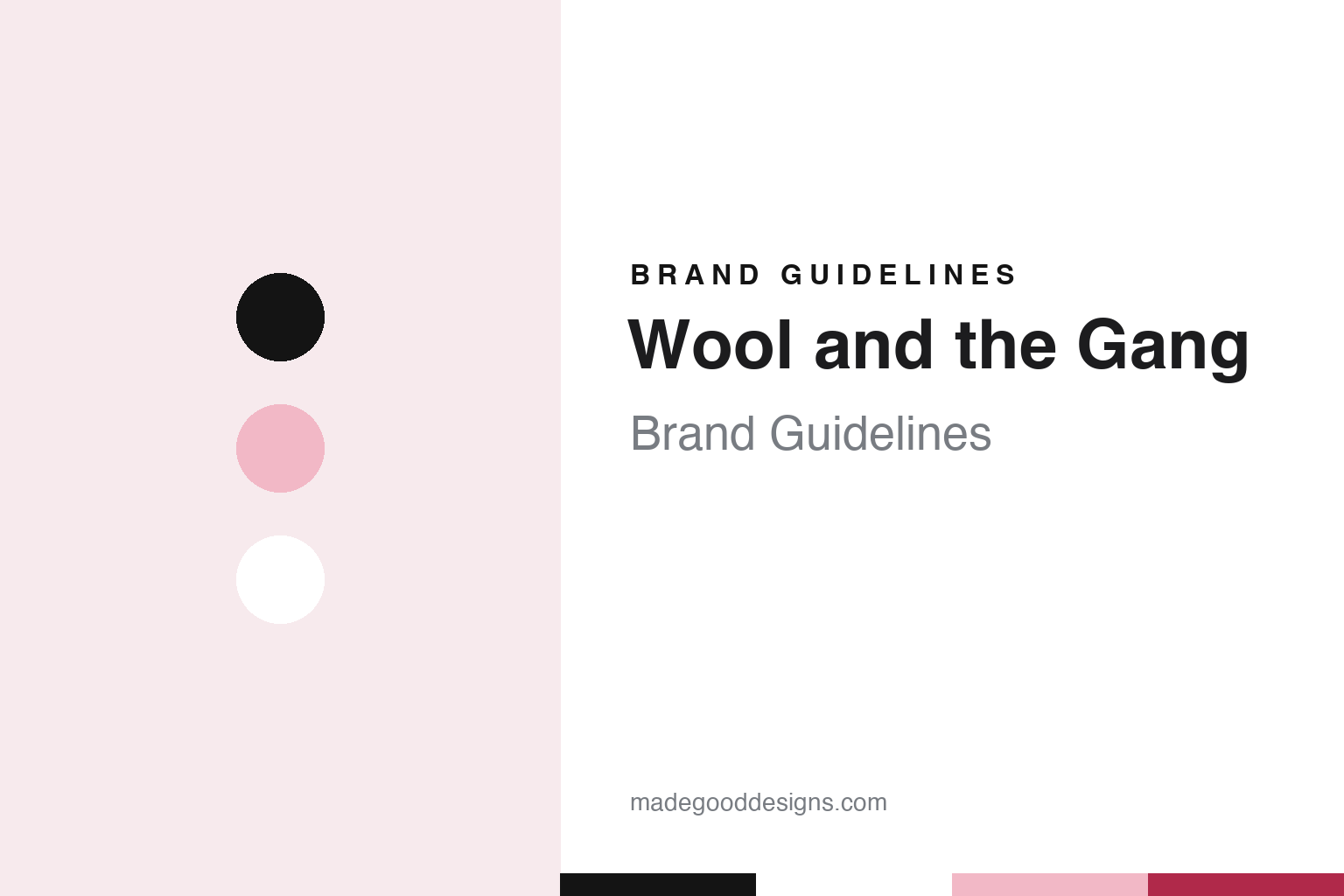
Wool and the Gang Brand Guidelines
The London knitting-kit brand that sold yarn as fashion.
Aa
Two constants: a black, raspberry and pink palette and a heavy grotesque register. Abstract homage — not a Wool and the Gang product or mark; no kit, label or logo is reproduced.
Fashion made by you
A London brand that sold knitting as fashion.
Wool and the Gang — often shortened to WATG — is a London brand that sells knitting and crochet as fashion. Its idea is simple: rather than buying a finished jumper, the customer buys a kit containing the yarn, the needles or hook and the pattern for a garment designed by the brand, and makes it themselves. The brand’s own tagline puts it in three words: “Fashion made by you.”
The brand began in London in the late 2000s. Its present trading company, Wool and the Gang Ltd, was incorporated at Companies House in December 2012, and the public register lists Jade Harwood, Aurelie Popper and Elisabeth Sabrier among the company’s past directors. The register shows who held office and when; it does not tell the brand’s founding story, and we have not relied on other accounts of it here.
From the start the pitch was about fashion rather than craft tradition. Its kits are presented like a clothing range — sweaters and jumpers, cardigans, hats and beanies, scarves and snoods, bags, tops and vests, shawls and wraps — with homeware, babywear, menswear and even clothing for pets alongside. Each design is graded by difficulty, from beginner and easy to intermediate and advanced, and the website offers size, yarn, level and needle guides, plus a guide to the differences between US and UK crochet terms, so that someone who has never knitted can choose a first project.
The kits have widened beyond knitting. The shop now also sells crochet, needlepoint, embroidery, cross-stitch and macramé kits, and its patterns can be bought alone, without the yarn, or downloaded free. Its website is offered in English, German and French and ships internationally, and the company says it has “1 million makers worldwide,” a figure we give as its own.
Colour
Crazy Sexy Wool and the language of the range.
Wool and the Gang’s yarns carry names that sound more like a fashion label than a spinning mill. Its best-known is Crazy Sexy Wool, a super-chunky yarn that suits the brand’s big, quick-to-knit garments, sold alongside a lighter version, Lil’ Crazy Sexy Wool. Other best sellers listed on its site in October 2026 include Shiny Happy Cotton, Ra-Ra Raffia and Alpachino Merino. The playful naming is one of the clearest parts of the brand’s identity: it treats yarn as a product with a personality rather than as a commodity sold by weight and fibre.
The range covers the main fibres — wool, merino, alpaca, mohair, cashmere, cotton, Tencel, jersey and raffia — and the main weights, from super chunky through aran and double knit to 4-ply. The company describes them as “premium, sustainably sourced yarns that don’t cost the earth”; that is its own description, and its website groups its environmental claims under a section it calls “Crafting a Better Future.” We have not checked where each yarn is spun or dyed, and the company’s website does not set that out in the pages we could read, so we make no claim about it.
Collaborations are a regular part of the calendar. In October 2026 the website featured a Hope x WATG collection and one with the fashion label Damson Madder, alongside its own themed collections — bridal, sailor, stripes, tennis, rugby, ballet, patchwork and Christmas — and a “Makers Market” for its community. That mix of seasonal edits, named collections and partner labels is how a clothing brand plans a year, and it is a large part of what separates Wool and the Gang from older yarn houses.
The brand also teaches. Its “Wool School” offers knitting and crochet video tutorials, beginner lessons and technique guides, and its pages encourage makers to share finished projects under the brand’s hashtag — a community model that turns customers into the brand’s most visible advertising.
Typography
Design and documentation.
The seven brands in this group all sell yarn for hand knitting and crochet, and they come from seven countries: Novita from Finland, Järbo from Sweden, Alize from Turkey, Hamanaka from Japan, Adriafil from Italy, Wool and the Gang from the United Kingdom and Knit Picks from the United States. Set side by side, they show two quite different ways of putting a ball of yarn in front of a knitter.
One is the national yarn maker: a name that grew up in a single country, sold through that country’s department stores, craft shops and yarn shops, and often found in homes for generations. The other is the brand built around the buyer rather than the shop — one that sells online or by catalogue, or packs yarn, needles and a pattern together as a kit, and talks to knitters directly. The first kind tends to lean on heritage and place; the second on convenience, price or a sense of belonging to a community. Each route shapes a brand’s name, its labels and the voice it uses.
Each guide also separates what independent sources record from what the company says about itself — who founded it, who owns it now and where its yarn is made — and marks plainly what rests only on the company’s own word.
Aa
A heavy grotesque — loud enough for a brand that names its yarn Crazy Sexy Wool. (Specimen set in Archivo Black, a sans STAND-IN; NOT the Wool and the Gang logo.)
Wool and the Gang
Part of the DMC Group.
Wool and the Gang is not independent. The footer of its website says plainly that it is “Part of the DMC Group,” and the public register at Companies House sets out when that began. Its record of people with significant control shows a company called The DMC Group Holding Limited holding more than 75 per cent of the shares and voting rights, with the right to appoint and remove directors, from 5 August 2016; on 16 September 2020 that entry passed to The DMC Group Holdings Limited, a London-registered company that remains the controlling owner. Several directors were appointed on 5 August 2016, the same day, and some of the earlier directors left the board then or over the following years.
The register shows control, not price or terms, and we have not found a published announcement of the deal, so we say only what the record shows: since August 2016 Wool and the Gang has been owned and controlled within the DMC Group. Its website also links to a modern slavery statement, the disclosure that UK businesses above a turnover threshold must publish about their supply chains.
Ownership has not changed the voice. The website still talks to makers as customers of a fashion brand: bold colour, cheerful product names, partner collaborations and constant newness, sold online in pounds, dollars and euros. The kit format is the brand’s real invention — a complete garment in a box, with the pattern written for beginners — and it has since become common across the hand-knitting market, from We Are Knitters in Madrid to the kit ranges now sold by many traditional yarn brands.
That shift matters for the wider yarn trade. Older yarn houses grew by selling balls of yarn through local shops, with patterns as a support for the yarn. Wool and the Gang reversed the order: the design comes first, the yarn is sold as part of it, and the shop is online. Its range of fibres and finishes is broad, but its brand rests on a few constants — the kit, the playful names and the language of fashion.
For a design guide, Wool and the Gang shows how a yarn brand can borrow the tools of a fashion label — seasons, edits, collaborations and loud product names — and keep them after a change of owner. Compare We Are Knitters, the Madrid kit brand built on the same idea, and Rowan, a British yarn brand built around designer knits. For this guide we use black, raspberry and pink with a heavy sans, an unofficial interpretation; no product or logo is reproduced.
Explore & save
Keep Wool and the Gang’s identity on hand — save it to a board in the Made Good inspiration library.
Wool and the Gang identity set
Pin the Wool and the Gang black, raspberry and pink palette and the heavy grotesque register to your own board.