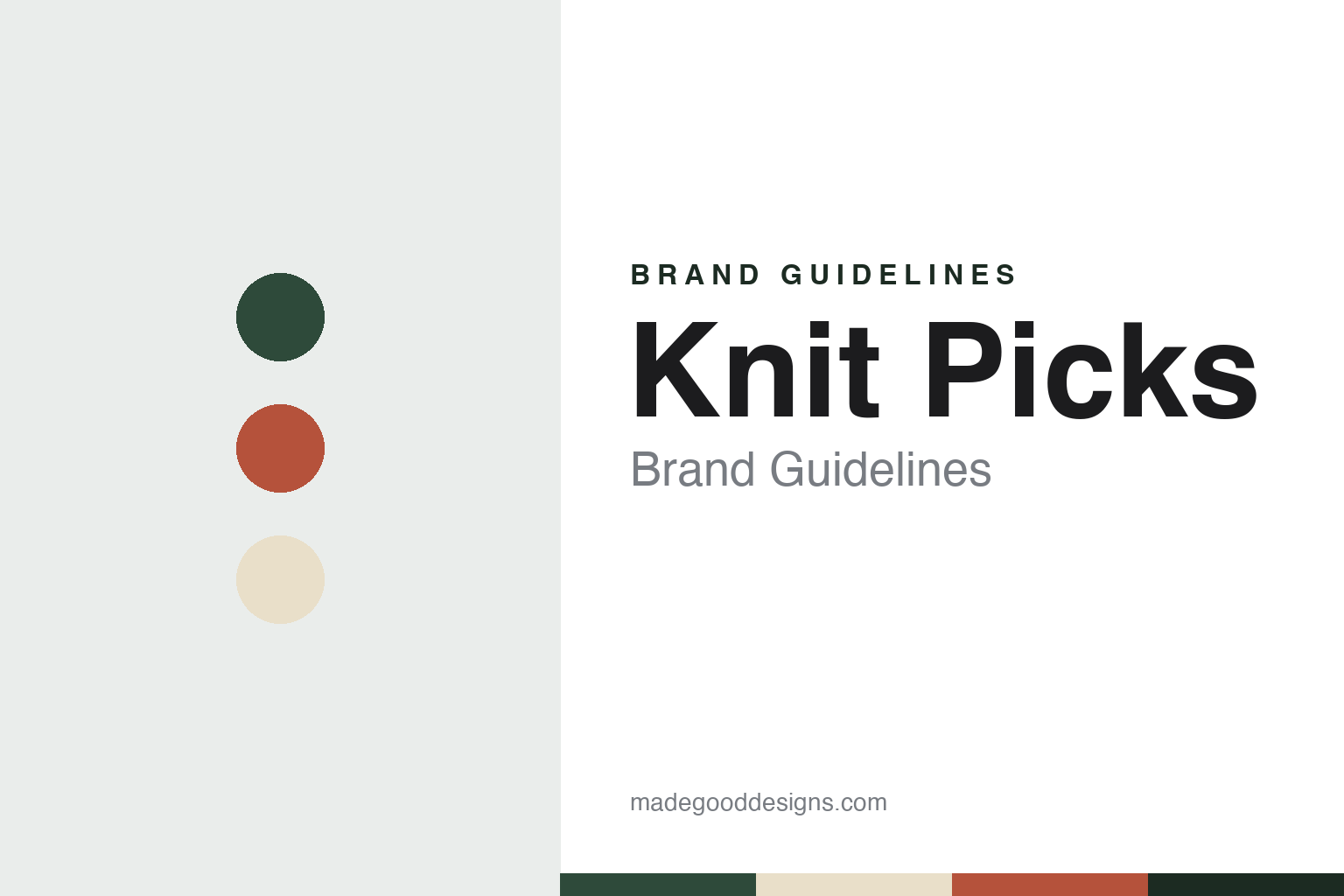
Knit Picks Brand Guidelines
The Vancouver, Washington catalogue brand that cut out the middleman.
Aa
Two constants: a Knit Picks green, cream and clay palette and a catalogue serif register. Abstract homage — not a Knit Picks product or mark; no ball band, logo or label is reproduced.
Our Start
A knitter, an engineer and a mail-order catalogue.
Knit Picks began in 2002 in Vancouver, Washington, across the Columbia River from Portland, Oregon. The Craft Industry Alliance gave the same founding year in 2019, describing Knit Picks as “both yarn manufacturer and retailer, selling online and through print catalogs.” The company’s own history, archived from its website in 2009 and 2012, names the founders as Bob and Kelley Petkun. It describes Kelley Petkun as an accomplished knitter and spinner and Bob Petkun as an engineer, and says the idea was to sell yarn, books and needles to knitters at lower prices than they paid in shops.
From the start Knit Picks was a division of a larger mail-order business. The 2009 version of the company’s “About Us” page says Knit Picks and KnitPicks.com were a division of Crafts Americana Group, a privately owned company with three divisions — Knit Picks, the quilting-fabric brand Connecting Threads and The Artist’s Club — and about 80 employees in two locations. At that time, the page says, Bob Petkun was president, in charge of marketing and finance, and Kelley Petkun was creative director, in charge of product development. The site’s footer in 2010 described Knit Picks and KnitPicks.com as registered trademarks of Crafts Americana Group.
The business model shaped the brand. Knit Picks did not sell through yarn shops; it sold by catalogue and online, and the company told its customers that this was how it kept prices down. Catalogues remained central for years. In 2020 Matt Petkun, then president and chief executive of Crafts Group, the renamed Crafts Americana, told the Craft Industry Alliance that the company’s catalogues reached customers’ homes about eight times a year and that many readers used them to choose what to buy online. “A lot of our customers refer to our catalogs as a magazine,” he said.
Colour
Mills in Peru and Italy, needles from India.
Knit Picks’s central claim is that it buys straight from the mills. Its 2009 history says that in 2004 the owners began to explore working directly with yarn mills “to bring high quality, natural fiber yarns to knitters without all the extra levels of distribution that increase costs.” The fuller 2012 version tells it as a story: in 2003, it says, Kelley Petkun sent Bob Petkun to Peru to find a source of yarn, and he met mill owners there; the two versions differ by a year, so we give both. The 2012 text says the couple later visited mills in Peru and Italy, “where our yarns are produced.” That is the company’s own account of where its yarn was made in 2012. We could not confirm the current origin of each line from the company’s present website, so we treat it as a company claim with a date.
Needles came next. The 2009 page says the company turned to knitting needles in 2006, asked a large group of knitters what the ideal needle would have and then found a manufacturer willing to make it; the 2012 page says that manufacturer was in India.
In 2021 the company moved part of its range closer to home. On the Craft Industry Alliance podcast that August, Ursula Morgan, chief marketing officer of Crafts Group, discussed High Desert, which the podcast notes describe as Knit Picks’s new “100% American-made” yarn. That claim came from the company, and we have not seen an independent account of which mills make it.
A low-price, direct model also brought conflict with other yarn firms. Federal court records for the Western District of Washington show that Cascade Yarns, of nearby Seattle, sued Crafts Americana Group over trademarks in December 2006 and again in December 2009; the Craft Industry Alliance later described the second case as a dispute over keyword advertising. The docket for the 2009 case closed in November 2010; the records we checked do not say how it ended.
Typography
Seven yarn makers, seven countries.
The seven brands in this group all sell yarn for hand knitting and crochet, and they come from seven countries: Novita from Finland, Järbo from Sweden, Alize from Turkey, Hamanaka from Japan, Adriafil from Italy, Wool and the Gang from the United Kingdom and Knit Picks from the United States. Set side by side, they show two quite different ways of putting a ball of yarn in front of a knitter.
One is the national yarn maker: a name that grew up in a single country, sold through that country’s department stores, craft shops and yarn shops, and often found in homes for generations. The other is the brand built around the buyer rather than the shop — one that sells online or by catalogue, or packs yarn, needles and a pattern together as a kit, and talks to knitters directly. The first kind tends to lean on heritage and place; the second on convenience, price or a sense of belonging to a community. Each route shapes a brand’s name, its labels and the voice it uses.
Each guide also separates what independent sources record from what the company says about itself — who founded it, who owns it now and where its yarn is made — and marks plainly what rests only on the company’s own word.
Aa
A warm catalogue serif for a mail-order yarn brand. (Specimen set in Fraunces, a serif STAND-IN; NOT the Knit Picks logo.)
Knit Picks and WeCrochet
From family firm to private-equity crafts group.
Knit Picks did not stay with its founders. In February 2017, according to a press release dated 27 February 2017 and the website of the investor Blue Point Capital Partners of Cleveland, Blue Point and its portfolio company Premier Needle Arts bought Crafts Americana Group, which the release called “a leading supplier of knitting, crochet, quilting, sewing, and other hobbyist products.” Blue Point had invested in Premier Needle Arts in 2014. Premier Needle Arts, based in North Salt Lake, Utah, was organised in two divisions, the Craft Industry Alliance reported in 2021: the quilting-machine maker Handi Quilter in Utah, and Crafts Group in Vancouver, Washington, which held Knit Picks.
In October 2019 Knit Picks soft-launched a sister brand, WeCrochet, on the crochet.com domain, the Craft Industry Alliance reported; the company said it bought the address from a domain broker, and that it had once belonged to the Crochet Guild of America. WeCrochet carried the Knit Picks yarn range with patterns, a magazine-style catalogue and a podcast aimed only at crocheters, while Knit Picks kept its own crochet section.
The group then grew. Premier Needle Arts bought the yarn wholesaler Berroco in October 2021, and in April 2025, now trading as Local Crafts, it bought the Reno yarn retailer Jimmy Beans Wool, which had acquired the hand-dyed yarn brand madelinetosh in 2019; the sources we checked do not say whether madelinetosh moved with it. Blue Point’s website lists Local Crafts as headquartered in Vancouver, Washington, with Knit Picks, WeCrochet, Berroco and Jimmy Beans Wool on the yarn side and Superior Threads and Connecting Threads on the quilting side. The localcrafts.com site describes itself as “formerly” Premier Needle Arts.
For a design guide, Knit Picks shows how a direct-selling yarn brand builds an identity in catalogues and on a website rather than on a shop shelf, and how that identity survives a change of owner. Compare it with Cascade Yarns, the Seattle wholesaler that sells through shops, and with madelinetosh, the hand-dyed brand Jimmy Beans Wool bought in 2019. For this guide we use fir green, undyed cream and clay with a serif, an unofficial interpretation; no product or logo is reproduced.
Explore & save
Keep Knit Picks’s identity on hand — save it to a board in the Made Good inspiration library.
Knit Picks identity set
Pin the Knit Picks green, cream and clay palette and the catalogue serif register to your own board.