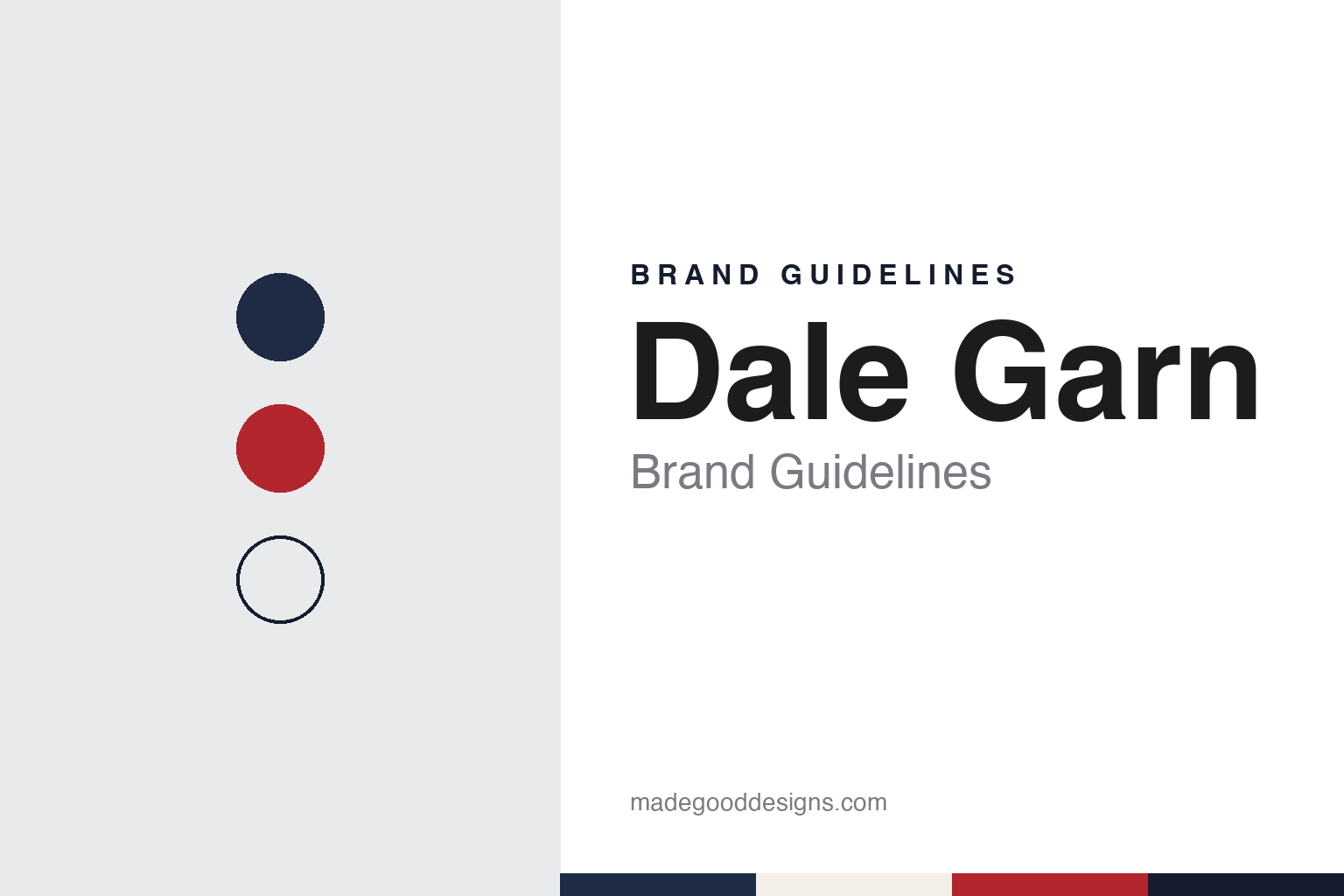
Dale Garn Brand Guidelines
The Norwegian mill yarn that outlived its spinning mill.
Aa
Two constants: a Dale Garn navy, white and red palette and a sturdy grotesque register. Abstract homage — not a Dale Garn product or mark; no pattern, logo or label is reproduced.
Dale Fabrikker
A water-powered mill between Bergen and Voss.
Dale Garn grew out of one of Norway’s largest textile mills. Norwegian Wikipedia says the industrialist Peter Jebsen founded Dale Fabrikker in 1879 at Dale, in Vaksdal municipality between Bergen and Voss, after buying the water rights on the Bergsdalselva river from local farmers. The machinery — carding machines, spinning frames and 200 looms — came from England by boat and was carried up from the fjord by horse and cart. English Wikipedia dates the start of the business to 1872, when Jebsen first set up a textile factory at Dale, completed in 1879; the company itself counts from 1879.
The mill shaped the village. Norwegian Wikipedia says that when it was built there was little more than a smallholding at Dalekvam; by the end of the nineteenth century the mill employed about 500 people, and the railway between Bergen and Voss reached the village in 1883. After the Second World War, it says, Dale Fabrikker was Norway’s largest textile company, and in the 1950s and 1960s around 1,200 people worked there.
Cotton came first. A cotton mill opened in 1879, a wool mill followed in 1890 and a worsted spinning mill in 1912, and English Wikipedia says hand-knitting yarn was made from 1912. Over the century the company made everything from bed linen and sweaters to knitting yarn and technical textiles, with its head office in Bergen.
Colour
Yarn and knitwear, split in two.
Dale Garn’s name comes from a series of break-ups. Norwegian Wikipedia says the yarn and finished knitwear were spun off in 1991 as a separate company, Dale Garn og Trikotasje — later Dale of Norway — while flame-retardant fabrics went into a company called DaleTec. In 2009 the yarn and the knitwear were divided again, into Dale of Norway for knitted garments and Dale Garn for hand-knitting yarn, still in the same buildings at Dale.
The two names are easy to confuse, and they now belong to different owners. Dale of Norway, known for the patterned wool sweaters it has made for Norwegian teams at the Olympic Games and world championships since 1956, was acquired by the French ski group Rossignol in 2018, English Wikipedia says. Norwegian Wikipedia says its knitwear production at Dale has ended, though a factory museum and outlet remain open in the village.
Dale Garn went another way. Norwegian Wikipedia says yarn production at Dale ended in 2014, while the brands lived on. The same year, according to its current owner, Dale Garn was taken over by House of Yarn, a Norwegian company that describes itself as the leading supplier of hand-knitting yarn in the Nordic countries. Its customer service is based at Oltedal in Rogaland, south of Stavanger.
House of Yarn tells its own story of the change. It says that wool yarn from Norwegian sheep was originally made at Dale, but that new trends led to importing fibres “from many parts of the world,” giving softer qualities such as merino, alpaca, mohair, silk and cotton. It does not say where the yarns are now spun, and we did not find that documented.
Typography
Yarn makers and their mills.
The seven brands in this group all sell yarn for hand knitting and crochet, and they come from seven countries: Purl Soho from the United States, Dale Garn from Norway, Schoppel from Germany, Puppy from Japan, King Cole from the United Kingdom, Mirasol from Peru and Fonty from France. What links them is less a fibre or a price point than the question of who actually stands behind the label on the ball.
Some yarn brands begin as shops, where a retailer’s taste in colour and pattern becomes a house range that others then spin to order. Some are spinners first, mills whose brand name is simply the name over the factory door, and whose shade cards grew out of what their machines and dye houses could make. Others are built around a social purpose, using the sale of yarn to fund work, training or schooling in the places where the fibre is grown and the yarn is made. Many sit somewhere between these models, and some have moved from one to another as owners changed.
Each guide separates what independent sources record from what the company says about itself — who founded it, who owns it now and where its yarn is made — and marks plainly what rests only on the company’s own word.
Aa
A sturdy grotesque with the plainness of a pattern leaflet. (Specimen set in Archivo, a sans STAND-IN; NOT the Dale Garn logo.)
Dale Garn
One of four sisters at House of Yarn.
Today Dale Garn is one of four yarn brands at House of Yarn, alongside Gjestal Garn, Du Store Alpakka and Bæstmor; the company says it bought Du Store Alpakka from its founders in 2012. The old dalegarn.no address now leads to House of Yarn’s shop. House of Yarn sells through yarn shops, online and through chains, and says it is the sole yarn supplier to the Coop, Sparkjøp and Europris chains in Norway, as well as making private-label yarns for partners.
On its brand site, House of Yarn calls Dale Garn “the proud tradition-bearer,” with “iconic patterns” rooted in Norwegian heritage, and the brand still trades on its date, under the line “a proud history since 1879.” Its range includes Dale Baby Ull, a superwash merino; Lerke, a merino and cotton blend; Fjellrype, which mixes Norwegian wool with mohair; and Merino 22, which it describes as RWS-certified merino. The range also takes in a pure cotton for baby clothes and glitter effect threads for trimming, and each quality is sold under a three-digit number in House of Yarn’s shop. Its pattern library still has a section for Olympic and World Championship sweaters, next to baby clothes and fashion knits.
That is the brand’s particular position: a yarn name whose identity rests on the sweaters of a sister company it no longer shares an owner with, and on a mill where it is no longer spun. The company publishes no brand colours or typefaces, so the palette here is ours, drawn from the navy, white and red of Norwegian patterned knitwear.
For a design guide, Dale Garn shows how a heritage name can carry a brand after its factory has gone. Compare Sandnes Garn, a Norwegian yarn maker of similar age, and Rauma, a Norwegian wool mill. For this guide we use navy, undyed white and a sweater red with a sans, an unofficial interpretation; no product or logo is reproduced.
Explore & save
Keep Dale Garn’s identity on hand — save it to a board in the Made Good inspiration library.
Dale Garn identity set
Pin the Dale Garn navy, white and red palette and the sturdy grotesque register to your own board.