Puppy Brand Guidelines
The Tokyo hand-knitting yarn brand of a wool-weaving group founded in 1879.
Aa
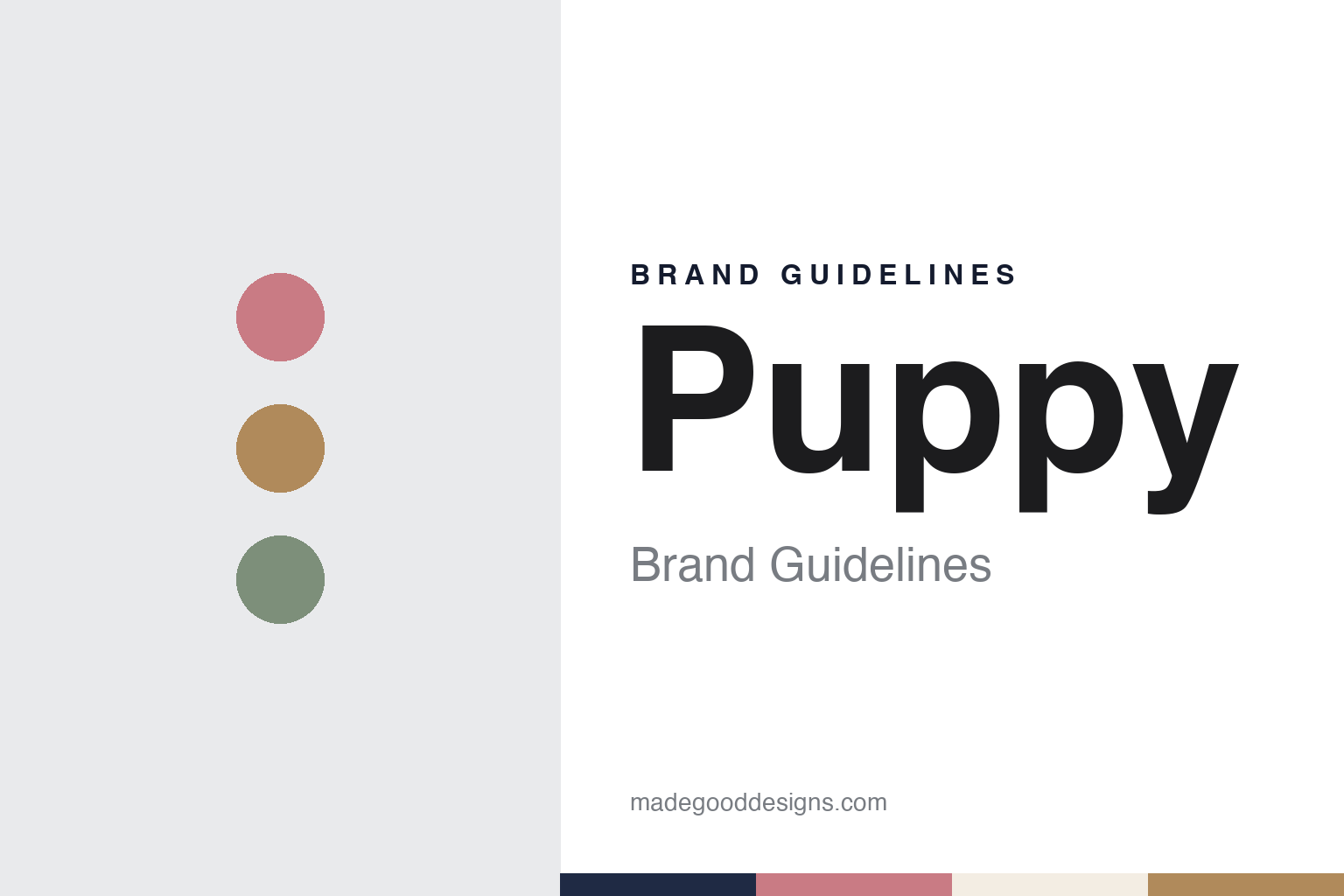
Two constants: a Puppy navy, mohair rose and camel palette and a Rounded gothic sans register. Abstract homage — not a Puppy product or mark; no yarn, ball band or logo is reproduced.
Puppy Wool, 1960
A yarn company born inside a woollen mill group.
Puppy — パピー in Japanese — is a hand-knitting yarn brand from Tokyo, and its history belongs to a much older textile company. Its owner, Daidoh Limited, says on its own history page that it was founded in 1879 by Ine Kurihara, when a weaving business began; that in 1918 it set up English-style wool-top equipment; and that in 1923 its new integrated mill was destroyed by the Great Kanto Earthquake on the very day of its completion.
The company rebuilt. In 1936 Kurihara Keori opened a woollen mill in what is now Inazawa, in Aichi prefecture; a 1941 merger created Daidō Keori, a woollen-textile maker that, by its own account, ran every stage from spinning to cloth finishing. Its shares were listed in Tokyo and Nagoya in 1950, the year it launched the Milliontex men’s suiting cloth, and in 1953 it built a spinning mill at Odawara, in Kanagawa.
Puppy came next. The group’s history records that in 1960 “Puppy Wool Co. Ltd.” was established — パピー毛糸株式会社 in the Japanese version — and that it was renamed Puppy Co. Ltd. in 1962. The history does not name the people who started it, and we do not. It was a hand-knitting yarn company set up by a maker of woollen cloth.
Colour
Mergers, from Daidō Keori to Daidoh Forward.
The parent changed its name in 1989, from Daidō Keori to Daidoh Limited, and over the following years turned from making cloth to selling clothes and running property. Its history records the closure of the Odawara mill in 1996, the opening of the Dynacity shopping centre on the site in 2000, and the closure of the Inazawa mill in 2002. In 1999, it says, the group ended its business selling yarn to the knitwear trade; the hand-knitting brand carried on.
Puppy itself passed through several companies. In 2002 Daidoh acquired all the shares of Jardin Co., and in 2006 Puppy Co. was absorbed into Jardin, which was renamed Puppy Jardin, according to the Japanese history. In 2004 the group set up a company in Shanghai to sell hand-knitting yarn in China, renamed in 2011. In 2007 it formed Daidoh International; on 1 January 2018 Daidoh International, the clothing company NewYorker and the Dynacity mall operator merged as Daidoh Forward, a notice repeated on the Puppy website. We did not find exactly when the Puppy business moved from Puppy Jardin into Daidoh International.
Today the Puppy online store names its seller as Daidoh Forward’s sales and product division, Puppy, based in the Daidoh Limited Building in Sotokanda, Tokyo, near Akihabara. Daidoh Forward says it is wholly owned by Daidoh Limited, the holding company, whose group also includes Brooks Brothers Japan — set up in 1979 as a joint venture with the American clothier and consolidated in 2021 — and the Italian cloth mill Pontetorto, acquired in 2016. From 2007 to 2019, the history adds, Daidoh was an equity-method affiliate of the clothing company Onward Kashiyama, now Onward Holdings. Its own clothing business began with NewYorker, a ready-to-wear company it founded in 1964, four years after Puppy.
Typography
Yarn and documentation.
The seven brands in this group all sell yarn for hand knitting and crochet, and they come from seven countries: Purl Soho from the United States, Dale Garn from Norway, Schoppel from Germany, Puppy from Japan, King Cole from the United Kingdom, Mirasol from Peru and Fonty from France. What links them is less a fibre or a price point than the question of who actually stands behind the label on the ball.
Some yarn brands begin as shops, where a retailer’s taste in colour and pattern becomes a house range that others then spin to order. Some are spinners first, mills whose brand name is simply the name over the factory door, and whose shade cards grew out of what their machines and dye houses could make. Others are built around a social purpose, using the sale of yarn to fund work, training or schooling in the places where the fibre is grown and the yarn is made. Many sit somewhere between these models, and some have moved from one to another as owners changed.
Each guide separates what independent sources record from what the company says about itself — who founded it, who owns it now and where its yarn is made — and marks plainly what rests only on the company’s own word.
Aa
A rounded gothic sans — パピー in katakana. (Specimen set in Zen Maru Gothic, a sans STAND-IN; NOT the Puppy logo.)
Puppy
“Look at the genuine article.”
Puppy describes itself with a motto: 「本物を見つめ良いものを大切に売っていく」 — roughly, “look at the genuine article, and sell good things with care.” It says it offers yarns of every fibre and type, its own and others “from around the world,” and lists its business as two activities: the manufacture and sale of original high-grade hand-knitting yarn, and the import and sale of hand-knitting yarns from European countries. It names its main overseas trading countries as Italy, Spain, Germany and Switzerland. In 2026, for example, it sold an imported raffia yarn from Katia, the Barcelona brand.
Daidoh Forward describes the work as the manufacture, wholesale and sale of high-grade hand-knitting yarn and craft supplies under the Puppy brand. Neither company says where all its own yarns are spun, and the group no longer lists a spinning mill of its own; the one product page we checked, for a gradient mohair launched for autumn and winter 2026, is marked “made in Japan.” We do not generalise from one page.
The brand sells through yarn and craft shops across Japan, major department stores and its own shops — the website links to stores in Shimokitazawa in Tokyo and in Hiroshima — as well as online. It publishes yarn sample books each season, free and paid patterns, and kits for designs in annual Japanese knitting books such as Yōroppa no Teami, “European Hand Knits.” Its name is written in the Latin alphabet as Puppy and in katakana as パピー.
For a design guide, Puppy shows how a yarn brand can outlive the mills that made its parent. Compare Hamanaka, the Kyoto craft-yarn maker, and DARUMA, the Osaka thread house. For this guide we use navy, mohair rose, camel and cream with a rounded sans, an unofficial interpretation; no product or logo is reproduced.
Explore & save
Keep Puppy’s identity on hand — save it to a board in the Made Good inspiration library.
Puppy identity set
Pin the Puppy navy, mohair rose and camel palette and the Rounded gothic sans register to your own board.