DARUMA Brand Guidelines
The Osaka thread house that sold a cotton thread with the lustre of silk.
Aa
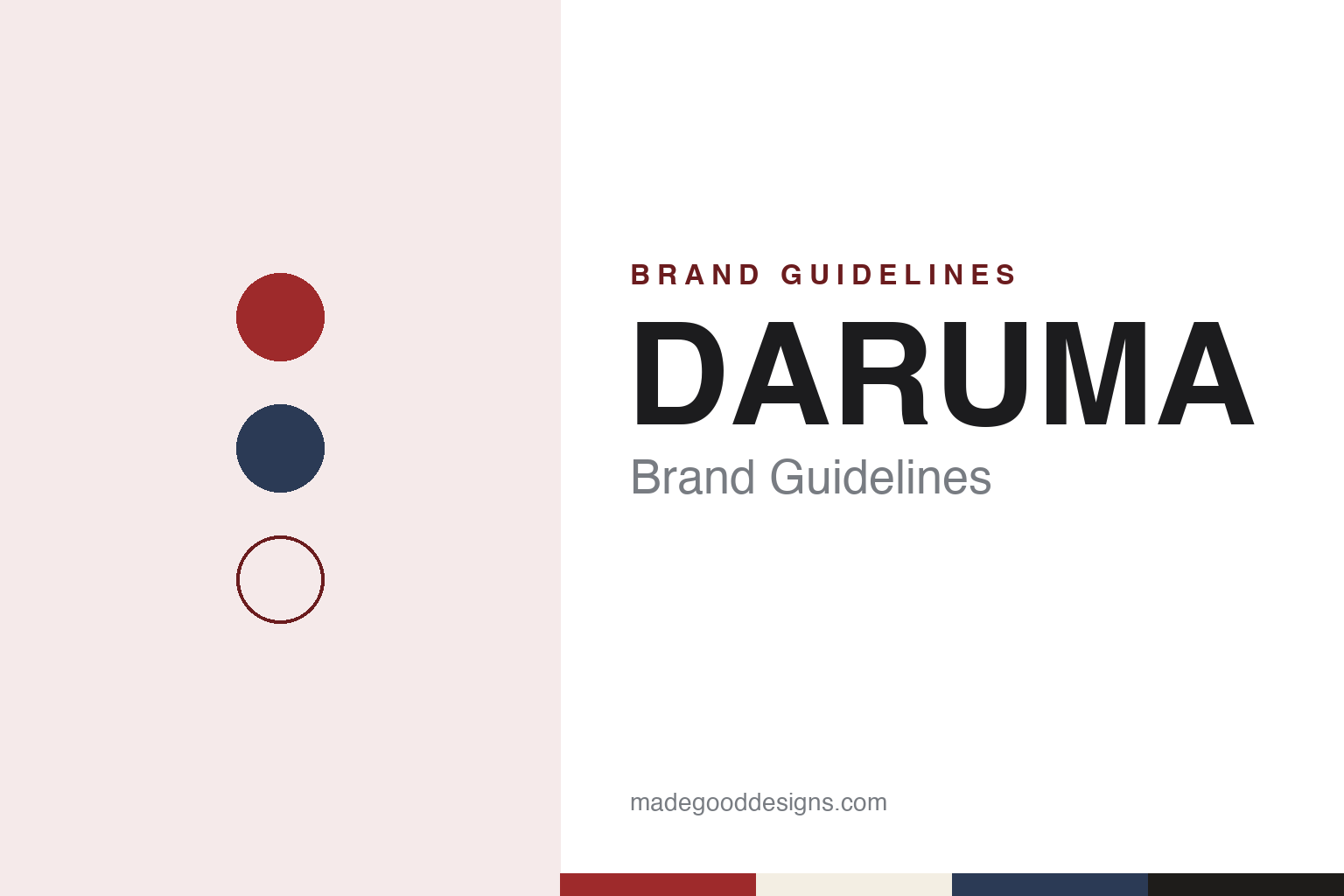
Two constants: a Daruma red, raw cotton and indigo palette and a Mincho serif register. Abstract homage — not a DARUMA product or mark; no spool label, logo or pattern is reproduced.
Yokota Co., Ltd.
A thread maker from the Meiji era.
DARUMA is the thread and yarn brand of Yokota Co., Ltd. (横田株式会社), a company based in Chūō-ku, Osaka. The company says it was founded in 1901, the 34th year of Meiji, and incorporated in 1934. It writes the brand name in capitals, DARUMA, across its website, its packaging and its online store, and we follow that styling here.
The company’s own history credits the start to Chozaemon Yokota. It says he trained with a Kyoto merchant dealing in kanoko shibori, the finely dotted tie-dyed fabric, and in 1901 began making thread and selling it himself. According to the company, he noticed that women’s kimono were moving from cotton to silk and set out to make a cotton thread that had the lustre of silk while staying strong and smooth. The result, the company says, was sold as kinu katan-ito — “silk katan thread” — a cotton sewing thread offered in place of silk. The company also attributes a motto to him, which it translates as “the price is temporary, quality is eternal,” and says he put the DARUMA mark only on his top-grade products.
We found no Wikipedia article on the company in English or Japanese, and no independent press history in the sources we checked, so the account in this guide is the company’s own and is attributed to it throughout.
The name needs care. A daruma is the round, red Japanese votive doll modelled on Bodhidharma, the founder of Zen, and the word is used by many unrelated restaurants, shops and products. The thread and yarn brand has no connection with them beyond the name. Nor is it connected with an unrelated Japanese food-container maker that also has Yokota in its company name.
Colour
From thread wholesaler to maker.
The company describes a slow move from trading to making. It says it took dyeing and bleaching in-house early on and mechanised its work step by step, so that Yokota Shoten, as the business was then called, turned from a thread wholesaler into a manufacturer. It says it opened branch offices in Japan’s major cities and organised its retailers into dealer associations, the Daruma-kai, which it says numbered 152 member companies by 1951. When lace crochet became popular in Japan in the late 1950s, the company says it held the first hand-knitting lace-crochet classes in the country — a claim we give as its own.
Today the company lists its business as the manufacture and sale of sewing thread and hand-knitting yarn, the sale of industrial sewing thread, and the development and sale of handcraft goods. It says it employs 81 people across the parent company and its affiliates, counting part-time staff.
Two affiliated works handle the thread. The company says its Daruman factory in Nagahama, Shiga, at the foot of Mount Ibuki, receives single cotton yarn from a spinning mill and then twists it and singes it with gas to give a smooth finish; DARUMA does not spin the cotton itself. Its Murasakino factory in Kyoto, near the temple of Daitoku-ji, mercerises, bleaches and dyes the thread, and the company says it has been dyeing DARUMA thread there for more than 70 years. Mercerising, a treatment of cotton with caustic soda, is the standard way of giving cotton thread a silk-like sheen — the quality the company says its founder was after in 1901. Another affiliate, Kyushu Katan-ito, is based in Kurume, Fukuoka, and the company runs a logistics centre in Nagahama and a shop, DARUMA STORE, in Ebisu, Tokyo.
Those factory pages describe sewing thread. The company does not say where each of its knitting yarns is spun or finished, so we make no claim about where they are made.
Typography
Mills, spinners and yarn houses.
The seven brands in this group all sell yarn for hand knitting and crochet, and they come from seven countries: Plassard from France, Opal from Germany, Holst Garn from Denmark, Rauma from Norway, Daruma from Japan, Lana Gatto from Italy and Red Heart from the United States. They sit at very different points on the map of the yarn trade, from small regional names to brands sold by the million.
At one end are regional spinners and family firms, whose names are tied to a town, a valley or a national wool tradition, and whose colour cards often grew out of what local mills could make. At the other end are mass-market brands, built for craft chains and online shops, where a yarn name can pass from one corporate owner to another while the label on the ball stays the same. Between them sit companies that design yarn and its colours but rely on others to spin it.
Each guide separates what independent sources record from what the company says about itself — who founded it, who owns it now and where its yarn is made — and marks plainly what rests only on the company’s own word.
Aa
A Mincho serif — the plain, upright register of Japanese print, for a Meiji-era thread house. (Specimen set in Shippori Mincho, a serif STAND-IN; NOT the DARUMA logo.)
DARUMA yarn
From sewing thread to the knitting basket.
Thread remains the base of the business. The company’s product pages list hand-sewing threads, basting threads, silk threads and machine threads. Alongside them it now sells a wide range of knitting yarns: its online store lists more than thirty, most of them named plainly after their fibre or breed, among them Shetland Wool, Airy Wool Alpaca and GENMOU, as well as SASAWASHI, a paper-based yarn the company describes as made from washi and kumazasa bamboo grass.
The store also carries kits, fabrics, supplies for sashiko and kogin embroidery, dyeing goods and the company’s own DARUMA PATTERN BOOK series, whose eleventh volume it announced in August 2026. It runs workshops too, including hand-dyeing sessions at the Murasakino factory in Kyoto. Separate company websites cover its sewing threads and its fabrics, so the yarn shop is one part of a larger catalogue rather than the whole of the brand.
We could find no published record of who designed the DARUMA logo, of an official typeface or colour code, or of design awards.
For a design guide, DARUMA shows how a thread house can carry a single quality mark for well over a century, letting a capitalised name and a founder’s motto stand for the product. Compare Noro, the Japanese yarn maker from Ichinomiya, and Isager, the Danish yarn house built on natural fibres. For this guide we use a Daruma red, raw-cotton white and indigo with a serif, an unofficial interpretation; no product or logo is reproduced.
Explore & save
Keep DARUMA’s identity on hand — save it to a board in the Made Good inspiration library.
DARUMA identity set
Pin the Daruma red, raw cotton and indigo palette and the Mincho serif register to your own board.